Showing posts with label glyphosate. Show all posts

Monday, August 29, 2016

I Expose My Family to Carcinogens Everyday And So Do You

Last year, the International Agency for Research on Cancer (IARC) classified glyphosate, a common herbicide, as a probable carcinogen. I've been asked how it is that I can ingest "a known carcinogen",
"The Globally Harmonized System sign for carcinogens,
 mutagens, teratogens, respiratory sensitizers
and substances which have target organ toxicity." Wikipedia
so I'm going to take the time to outline what the IARC does, the difference between the IARC's ranking and risk, and why I expose myself and my child to known carcinogens everyday (a shout out to @mommyphd for editing this post).


First, it's important to note that the IARC's categorization of glyphosate contradicts statements from many other organizations including the European Food and Safety Authority. Second, the IARC's ranking has been controversial due to potential conflicts of interest. Third, to explore the data behind the IARC’s categorization, I highly recommend this blog post by Dr. Andrew Kniss. For the sake of simplicity, I'm writing this piece assuming that the IARC's ranking is correct and ethical.

What is the IARC?

The IARC is an agency of the World Health Organization and it reviews data regarding a substance's carcinogenicity to identify hazards. Their job is to answer these questions: Is there any evidence that substance X causes cancer? How much evidence is there? Based on the strength of data, not the likelihood of harm (the actual risk), it categorizes substances as "probably not a carcinogen", "not classifiable", "possibly a carcinogen", "probably a carcinogen", and "a known carcinogen". The IARC has only ever classified one substance as "probably not a carcinogen". If you’re not sure about the difference between hazard and risk, here’s an extreme example: is a meteor striking me a hazard? Yes… It is. I’d probably die or get injured if it struck me. Is it a risk? No. Apparently, there’s only a 1 in 1,600,000 chance that I’d get hit by a meteor in my lifetime and die.


That is the extent of the IARC's role: to determine the level of evidence for whether a substance has the potential to cause cancer. It doesn't tell you the level of risk or what you can do about it. That's why the IARC's classification is so confusing: it lumps processed meat in the same category as smoking. But does that mean that your risk of getting cancer from smoking two packs a day is the same as your risk of getting cancer by eating a pastrami sandwich? No, it doesn't. Does it tell you if your risk is the same if you smoke a cigarette once in your lifetime or if you eat 3 pastrami sandwiches a day? No, it doesn't. For that, we need to assess the risk of the substance and that is often done by public health organizations.

The Carcinogens We Encounter Every Day
Whether you're aware of it or not, every day you're choosing to expose yourself to at least one known carcinogen. That's because UV rays from sunlight are carcinogens. One of my son's favorite lunches is a sliced ham sandwich. And that's a carcinogen. There are many other possible and probable carcinogens that we knowingly expose ourselves to: my husband and I have cell phones, we eat red meat and french fries (the latter have acrylamide), and some of our lotions have aloe vera extract. Even hot beverages that we drink were recently classified as “probably a carcinogen”.


But thanks to public health officials that have assessed the risk and provided guidelines on mitigating risks in my life, my kid uses sunscreen when he's out in the sun and we try to stay in the shade. We don't eat red meat every day, and there are no public health guidelines on avoiding aloe vera extract because the evidence for actual risk of carcinogenicity is weak.

What About Glyphosate? What Should I do?

In the case of glyphosate, the World Health Organization has stated that the amount of glyphosate residues found in our food is unlikely to be carcinogenic. In other words, the risk to my family is negligible. The risk to pesticide appliers may be higher and worker safety organizations may provide recommendations specific to pesticide application for such individuals to mitigate their risks.

So many things around us are potential hazards and could possibly kill us some way or another. However, it’s more important to understand the level of risk that something poses in making decisions about how to keep ourselves and our families safe. It’s also important to note that we cannot avoid hazards: even something as simple as eating a salad, be it organic or conventional, has the risk of a foodborne illness. What’s important is that we make informed decisions based on genuine risk, otherwise we live our lives unnecessarily fearing our environment and our food. We could live cooped up inside our houses, in a "chemical-free" bubble with UV-reducing windows or shut-out curtains, but that's not what our public health officials recommend. Following their recommendations ensures that we reduce the risk for the things that can harm us by using sunscreen, eating plenty of properly washed fruits and veggies, getting our vaccinations on schedule, using seat belts and having car seats installed properly, etc. We should focus our efforts on following guidelines put forth by our public health officials and medical institutions, rather than creating boogie-men out of low-risk items in our environment.

Saturday, May 28, 2016

Review of "GMO Dangers: The Facts You Need to Know"

Hi everyone!!! I was on vacation for the past month, which is why you haven't heard from me here. We went to Prague and to Haifa in Israel, both of which were awesome. I was able to keep up with my Facebook page and share lots of GMO news from the past month, which included a report from the National Academy of Sciences declaring GMOs to be as safe as conventionally bred crops and a statement from the Royal Academy calling for a review of the cultivation ban in Europe. It's been a busy month!!

I also got an email asking me to review this article entitled "GMO Dangers: The Facts You Need to Know", which is the topic of today's blog.

Why is there a person in a hazmat suit holding up an ear of corn
as if it were a stick of dynamite? Is the corn radioactive?
Is hazmat dude allergic to corn and has to wear a filter?
I know!!! The kernels are somehow in a Fibonacci Sequence,
and the hazmat dude knows it's worth a fortune and doesn't want to
damage it.
The article, written by Dr Jonathan Latham, starts by outlining his credentials and how his concerns about GMOs grew over the course of his career as he realized the complexity of biological systems. I think that a scientist would have to be very arrogant not to share this perspective. Nature is beautiful in its diversity and, as a scientist, I'm awed daily at the complexity and elegance of the smallest of proteins. The fact that a bunch of different molecules make something as amazing as my kid is astounding. But that doesn't mean that we should halt progress merely because nature is complex.

Dr Latham goes on to highlight that the risk assessment process in the regulatory process is flawed and that the data is often messy. I happen to agree with this, as do many others, as evidenced by the fact that US Biotech regulations and agencies are being restructured. I hope that Dr Latham provided his input on how these should be improved during the open comments period. But the fact that the risk assessment process is flawed doesn't mean that GMOs are dangerous, particularly when compared to other crop breeding processes.

Dr Latham then starts outlining the science-based "Dangers of GMOs". I've categorized each "danger" according to the trait. Italicized phrases are from the article.
  1. Regarding the Bt trait, which is an insecticidal protein produced by some GMOs. The gene is from the Bacillus thuringiensis bacterium. It's very important for the next few bullet points to keep in mind that the insecticidal protein that is produced by the Bacillus thuringiensis bacterium is a common pesticide used in organic farming. So any concerns about the safety of the protein should also be a concern for produce grown using organic standards. 
    1. "Bacillus thuringiensis is all but indistinguishable from the well known anthrax bacterium". The only possible reason this sentence could have been written is to create fear. A protein that is encoded for in a GM crop is not equivalent to the organism it came from. It's like saying that a wire is the same thing as a car, and then trying to scare you into not using wires by telling you numbers for car accidents.
    2. "Another reason is that Bt insecticides share structural similarities with ricin." This is altogether a stupid argument. It's like saying that eating mushrooms from the grocery store are dangerous because there are poisonous mushrooms out there.
    3. "A third reason for concern is that the mode of action of Bt proteins is not understood." In such a case, why is it used in organic farming? Much is understood about the proteins. Of course, we could always learn more, but that doesn't mean that it's dangerous.
  2. Regarding herbicide tolerance traits
    1. "This resistance is an invitation to farmers to spray large quantities of herbicides, and many do." Why on earth would a farmer spray any more than is needed and decrease their profit margin? But I can imagine that some farmers may not follow proper guidelines, but then how is this an issue unique to GMOs when there are non-GMO herbicide tolerant crops?
    2. "Glyphosate has been in the news recently because the World Health Organisation no longer considers it a relatively harmless chemical." Actually, the most recent statement from the World Health Organization says that: " ... glyphosate is unlikely to pose a carcinogenic risk to humans from exposure through the diet."
    3. A lot about the dangers of glufosinate. I haven't written about glufosinate crops because there doesn't seem to be much hoopla over them. My guess is that it's because a) it's not made by Monsanto (it's made by Bayer) and b) they aren't used as much. Looking at the EPA's data, only ~3 million pounds of glufosinate were used in 2013, whereas over 250 million pounds of glyphosate were used the same year. The section about the dangers of glufosinate resistant crops sound eerily similar to criticisms of Round-Up Ready crops: that we're eating small amounts of these pesticides that are absorbed by these plants over time and that these trace amounts will negatively impact our health. There's no evidence to this. The World Health Organization has also examined evidence to determine the likelihood of a health impact from long-term exposure to trace amounts of glufosinate, and has stated that it is "unlikely to present a public health concern".
  3. A terrifying paragraph about how a viral gene is possibly being made in GMOs.
    1. Except it's not. The paragraph is based on this paper. Basically, when a transgene is added to a crop's DNA, a segment of DNA known as the promoter region is also added. A promoter dictates when and where a gene should be turned on. Its DNA sequence isn't part of the protein that's made. If you think of the protein coding part as a factory, then the promoter would be the loading dock that dictates when things can go into the factory and is also the place where things that go into the factory get assembled.  The paper highlights that one of the promoters that are commonly used in transgenic crops could possibly encode for a small portion of a known viral gene, because the DNA sequence of the two have some similarities. The paper does computational analyses to determine how similar the promoter is to the viral gene, and what would happen if the viral gene actually got made. They computationally examine questions such as: is the protein structure similar to known allergens? Is the protein structure similar to known toxic proteins? Their conclusion is that, if the viral gene is ever made, it is unlikely to be an allergen and unlikely to be toxic. Most importantly, the paper states that the likelihood of the viral gene ever being made is low.
  4. The "real" reason for GMOs
    1. Folks... Farmers around the world have been fooled. GMOs pose no benefit to them!! Dr Latham highlights that the real reason that GMOs exist is because companies want intellectual property rights!! In fact, farmers must have been hypnotized into purchasing GM seeds season after season. Why else would they buy them, right?
Dr Latham ends with the following: "I left science in large part because it seemed impossible to do research while also providing the unvarnished public skepticism that I believed the public, as ultimate funder and risk-taker of that science, was entitled to." I find that hard to believe. If you genuinely believe that the public is being put at risk due to GMOs, why wouldn't you stay in science and demonstrate the risk/harm? It's like saying "As a water safety researcher, I left Flint because I was skeptical about the government's claims of water safety and I believed that the taxpaying citizens of Michigan deserved better."

Anyway, those are all my thoughts on this post. When reading posts such as "GMO Dangers", I think that it's really important to distinguish between the potential or possible dangers, and real evidence of harm. If you look through websites like the Institute for Responsible Technology, you'll note that every other sentence about GMOs is about how they "may" or "could" cause harm. Such articles/website use alarming language to instill fear. 

Feel free to comment below!

Sunday, April 3, 2016

Review of "Compositional differences in soybeans on the market: Glyphosate accumulates in Roundup Ready GM soybeans"

File:Soy Bean Field with Central Pivot Irrigation Sprinkler Summerfield Township Michigan.JPG
Soy bean field with irrigation system.
Wikimedia Commons. Image by Dwight Burdette.
A friend asked me to review the paper entitled "Compositional differences in soybeans on the market" (free available here), so I thought I'd make my comments publicly available. I'm going to read the paper first, provide comments as I go along, and then find reviews online (if any exist).

The paper starts by outlining the principle of substantial equivalence, meaning that GMOs have the same nutritional content than their unmodified counterparts. The authors outline that studies examining substantial equivalence for Round-Up Ready soybean were performed early on, but not when treated with Round-Up. A follow-up study found substantial equivalence when the soy was sprayed with Round-Up, but didn't examine how much glyphosate accumulated in the plant. It is the authors' hypothesis that this is a flaw and their study is designed to examine this question (i.e. is GMO Round-Up Ready soy substantially equivalent to its non-GMO counterpart when sprayed with Round-Up, and how much Round-Up accumulates). They hypothesize that high levels of glyphosate may affect plant metabolism. The authors point out that USDA data highlights that glyphosate use is increasing, so this question is all the more important.

I pause here to note that the authors do not clarify if this is glyphosate use per acre, or total glyphosate use. If I owned a house with 0.5 acre backyard ten years ago and now owned a house with 10 acre yard, and I used weed killers on both properties, then of course the total amount of weed killer I used would show an increase, simply because I have more land. But that may not mean that I've been using more weed killer per acre.

In their study, they examine 31 samples of soybeans grown in the state of Iowa to examine their two questions. They examined 3 different types of soy:
1) Round-Up Ready Soy
2) Conventional Soy possibly sprayed with other pesticides
3) Organic Soy bean which would have no glyphosate residues

The authors then list the variety of soy bean and how they were grown. They collected 3 kilos of soy from 31 different farmers, and it seems very odd to me that they'd select different varieties of soy and different methods of treatment for each category. Why wouldn't they try to find 31 farmers that used the same type of seed? The authors don't specify if the conventional soy is the isogenic variety to the Round-Up Ready soy. This is a key issue given the question they're trying to answer: for example, if I did a study on apples and collected apples from 31 different farmers, you'd want them all to be of the same variety rather then having some Red Delicious, some Fuji, etc.  Otherwise, it's not really an apples to apples comparison. Ha!! Get it???

So, they did a bunch of analyses on the soy beans. They found residues of glyphosate and one of the compounds it breaks down into in all the GM-soy, but not the conventional or organic (oddly enough, their graph doesn't have error bars...). Then, they did statistics on nutritional content and the authors highlight some of the differences (it's also worth nothing that they highlight measurements where the organic category had higher measurements, but not where GM/conventional had higher measurements). The authors then cluster the soy samples based on the results and find that the three different categories tend to group together.

Then the authors go on to reject the null-hypothesis of substantial equivalence. They highlight that their paper identified glyphosate residues in the crops at higher levels than had been hypothesized. They highlight the "toxicity" of Round-Up by citing Seralini (minus 200 points for citing Seralini).

My main comment, as I've mentioned in the past, is that substantial equivalence does not mean identical: "Substantial equivalence is often confused for identicality, however, the Food and Agricultural Organization of the United Nations states that substantial equivalence “is established by a demonstration that the characteristics assessed for the genetically modified organism, or the specific food product derived therefrom, are equivalent to the same characteristics of the conventional comparator. The levels and variation for characteristics in the genetically modified organism must be within the natural range of variation for those characteristics considered in the comparator and be based upon an appropriate analysis of data”" (emphasis has been added)

Also, the levels of glyphosate are provided and the authors point out that these are below the maximum permissible levels. So I'm not sure what their problemo is.

So, I searched for reviews of the paper and found one on GMOanswers, written by someone at Monsanto. They too, made the same criticism as me about the seeds: "When the authors collected the soybean varieties for this study, they separated them into the three groups — organic, conventional and GM. Unfortunately, each group contained different soybean varieties, with no overlap (with one exception) of varieties between the three groups, so each group was already inherently different from the others. Even the authors acknowledge that different varieties can have widely different seed composition. Therefore, concluding that any differences between the groups in this study were due to the way the soybeans were grown (organically or not), or the presence/absence of a glyphosate-tolerance gene in the GM varieties, is simply not possible. The three groups are expected to produce different results because they started out with different genetics."

GMOanswers also notes the fact that they were grown in different farms: "Since the plants in this study were not grown together but rather taken from separate fields across a region spanning a 200 km radius, any real differences between the three groups can’t be separated from the variation caused by location, and no reliable conclusion about their nutritional quality can be made. To put this in context, we are looking at satellite imagery to help farmers make more-informed decisions by increments of meters, not miles." I agree with this point, but having a bunch of crops that were grown in the same area could have provided some information if they were the same type of seed. But since they weren't, the different farms makes matters only worse.

GMOanswers puts the findings within the context of natural variation, which I appreciated: "Finally, when we take into account the effects of genetics and location, we see that the compositional differences the authors observed in this design are not unexpected. Protein levels in soybeans generally average ~40 percent dry weight (dwt) but have been shown to range naturally from 34.1 to 56.8 percent dwt (Wilson, 2004). This natural variability can be due to variety, location or environment, and it means that people are already consuming soybeans with larger variability than the differences in soybeans reported here."

The reviewer also notes that glyphosate residues were within permissible levels and then there's a blurb about the safety assessment of pesticides, yada, yada, yada... He also noted the slant that the authors have in not really discussing what pesticide residues in organic food means.

Amelia Jordan, whom I've interviewed in my series "Better Know a Scientist", did a review on Skepti-forum, and highlighted several other issues: the fact that there's no information on how the organic crops were treated, how the soil was treated in any of the farms, and very importantly, the
fact that 31 samples for a study with this much variability in a number of factors is very, very low.

All in all, I don't think the study is conducted well enough to draw any meaningful conclusion, especially not the one that they're trying to draw which is that organic food is "better" than GM. Their finding about glyphosate is interesting and I think that future studies that examine compositional differences between pesticide/herbicide tolerant crops and controls should do similar analyses, but the measurements in this study have been deemed to be safe.

Friday, November 20, 2015

Dear Christie Brinkley: We Aren’t Guinea Pigs

This letter is co-written by Mommy, PhD and BioChica (Dr Alison Bernstein and Dr Layla Katiraee. For more information about the authors, please see the end of the letter). Dear Christie,

We read this week about your new book and watched your interview on FOX Business. As scientists and science communicators, we are concerned that, while your motivations to help people eat healthy diets is honorable, your knowledge of genetic engineering, pesticide toxicity and the agricultural industry is not accurate. We are part of a group of moms (#Moms4GMOs) who also want to make healthy choices for ourselves and our families. We have previously reached out to other celebrities who are using their public platforms to spread misinformation and fear about the food supply in the US.

In our original letter, we addressed many of the concerns that you and others have raised about genetically engineered crops and pesticides. We hope that you will take the time to read the letter and the references we provided. There are a couple of points that were highlighted in your interview that we would like to discuss briefly here.

Colony Collapse Disorder is caused by many things, but GMOs are not one of them.

As you may know, much of our food relies on pollination by bees, so the health of these insects impacts all of us. Colony collapse disorder affecting honey bees is a topic of much controversy. This phenomenon is defined by the USDA as “a dead colony with no adult bees or dead bee bodies but with a live queen and usually honey and immature bees still present”. There are many theories on what may be causing CCD; the primary culprits seem to be parasites like the Varroa mite and flowerless landscapes, together with other factors, including exposure to pesticides and stress due to transportation. However, exposure to GMOs does not rank among the possible reasons underlying CCD.

Attempts to link GMOs to CCD have commonly focused on two factors: glyphosate and worm-resistant traits. Glyphosate, which is an herbicide used with some varieties of GMOs and is commonly used in gardens and parks around the country, has been examined to determine if it impacts honeybee health. A recent study examined the impact of the commercial formulations of 42 common pesticides on honeybees at concentrations actually used in the field. Due to the popularity of glyphosate, this herbicide was also included in the study. The study concluded that, while some pesticides are extremely toxic to bees, glyphosate was not harmful to their health.

Worm-resistant corn (commonly referred to as Bt-corn) is designed to kill the larval stage of many damaging insects, such as caterpillars, as they chew on the corn leaves. These crops have also been studied to determine if they impact honeybee health: a meta-analysis published several years ago concluded that their research “support[s] safety assessments that have not detected any direct negative effects” of the trait on the honeybee.

For more information on the science of CCD, we recommend these articles:

GMOs are the most tested and regulated food items: we are not guinea pigs.

The term “GMO” is commonly used to denote a crop or ingredient that is made using a laboratory technique known as “transgenesis”. But there are many different types of GMOs: non-browning apples, nutrient fortified rice, virus-resistant papayas, herbicide-tolerant soy, and pest-resistant corn. These cannot all be lumped into a single category. To underscore that the process is irrelevant and it is the trait that is important, herbicide-tolerant sunflowers have also been developed using traditional methods by the German chemical producer BASF and Dupont. By current rules, herbicide-resistant crops developed with targeted genetic engineering undergo extensive testing prior to being sold, while herbicide resistant crops developed by traditional breeding require no testing. In fact, genetically engineered food items are the most tested and regulated food in the market. No other foods undergo premarket approval by the EPA, FDA and USDA.

The sheer volume of data and number of studies on different traits used in biotech crops may surprise you. As a simple exercise, searching the NIH’s database of scientific studies for “MON810”, which is the trait that gives corn resistance to worms, identifies over 170 studies that have examined this trait. These range from multi-generational feeding studies to molecular analyses of the protein that makes the corn resist worms. Thousands of scientists around the world are dedicating their efforts to the development and testing of these crops, which defies notions implying that these crops are released into the market without being thoroughly tested.

For information about studies on GMOs and worldwide approvals of genetically engineered crops, check out these two databases.

The US food supply is safe, regardless of the breeding or farming method used.

We read about your adoption of an organic diet over concerns about possible links between GMOs and pesticides to sterility and breast cancer. Pesticides are important tools in agriculture, which farmers use judiciously depending on many factors including the type of pest and the type of crop, among many others. It is important to know that organic food production uses pesticides as well, and that pesticide residues in the US on non-organic produce are far below safety limits, but we have no data to compare it to for residues on organic produce. Furthermore, there’s no conclusive evidence suggesting that adopting an organic diet is significantly healthier (see meta-analyses here and here, and here and here for discussion of this research). Each pesticide has its pros and cons, and not using any pesticide at all can have significant consequences, including lower crop yields.

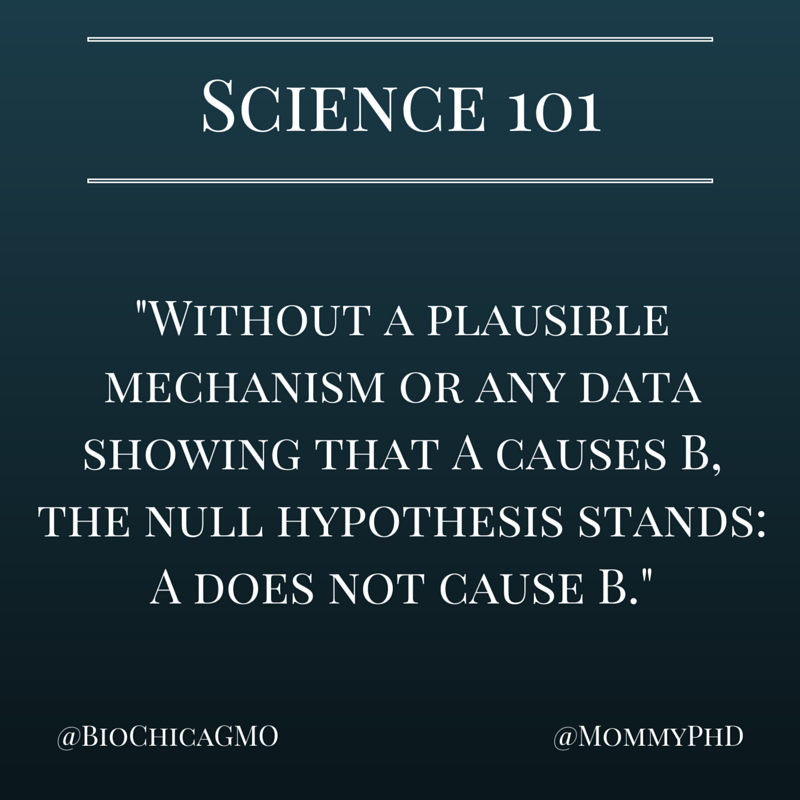
Despite searching for information, we found little to no credible evidence linking sterility or breast cancer to GMOs. It is a basic concept of scientific research that, when examining a cause-effect relationship between two items, the null hypothesis is what you start with - that there is no connection between the two items. This means that until someone comes up with a study showing that A causes B, then the null hypothesis stands: A does not cause B. Without this important principle, you could propose any hypothesis and people would have to “prove you wrong”. Instead, the burden of proof falls on those proposing a relationship between two items; they must provide evidence for that hypothesis.

Additionally, hypotheses are not invented out of whole cloth; they are based on previous knowledge. In considering how seriously to take a hypothesis, scientists consider plausibility, possible mechanisms, and what we already know about the subject. When a hypothesis has no plausible biological mechanism by which A can cause B, based on everything that we already know about biology, the burden of proof is even higher on those proposing the relationship between A and B and these hypotheses are often dismissed. This requirement for proof underlies the popular phrase “extraordinary claims require extraordinary evidence”. In the case of GMOs, breast cancer, and sterility: despite many studies of the health effects of GMOs, there is no evidence for a link to breast cancer or sterility and no plausible mechanism to explain such a link. At a minimum, scientists would need to have seen an increase in these things since the introduction of the first GMO in 1996. However, neither breast cancer rates nor infertility have increased since 1996. Thus, scientists have no evidence that GMOs are in any way associated with breast cancer or sterility and no plausible reason to hypothesize that they are. All the current evidence shows that GMO food is as safe as non-GMO food.

In North America, we have the luxury of having an abundant food supply with many options and choices. This includes the choice of being able to avoid GMOs entirely by adopting an organic diet, which excludes  genetically engineered crops and ingredients derived from them. However, in areas of the world where such abundance does not exist, GMOs can be extremely beneficial. GMOs may not solve world hunger, eliminate global warming, or ward off pests, but these crops will help us as we face these challenges. Disregarding an entire set of tools, based on the fears and privilege of those of us fortunate enough to have these choices, restricts the ability of farmers and scientists around the world to find solutions to real problems in agriculture.

Farmers have written about how they make their choices regarding pesticide use, and we encourage you to check out these resources:

To learn about the benefits of GMOs, see:

Talk to farmers and scientists about genetic engineering

From our original letter:

“Please, don’t co-opt motherhood and wield your fame to oppose beneficial technologies like genetic engineering. Certain celebrities have misled thousands of parents into thinking that vaccines are harmful, and we see the same pattern of misinformation repeating itself here. When GMOs are stigmatized, farmers and consumers aren’t able to benefit from much-needed advancements like plants with increased nutrients, or plants that can adapt to changing environmental stresses.

We, like millions of other Americans, line up to see your movies, and respect your occupation. Though our jobs differ, we share a common goal: to raise healthy, happy, successful kids. As moms we feel it is our responsibility to use the best available information to protect our children’s health, and to let the best science inform the choices we make for our families. We ask you to take the time to learn about how genetic engineering is being used by farmers, and the potential it has to help other moms raise healthy, happy, successful kids.

You have the opportunity to influence millions of people, so please use that influence responsibly, and ensure that your advocacy is supported by facts, not fear.”

We would like to extend the same invitation to you: talk to scientists, talk to farmers, talk to the experts in these fields. Arm yourself with knowledge, not fear, to help you make informed, healthy choices.

Sincerely,
Alison and Layla

About the letter writers:

meme2.png

Thursday, November 12, 2015

Better Know a Farmer: No-Till Guru Bill Crabtree

In this issue of “Better Know a Farmer”, I contacted Bill Crabtree to learn about “no-till farming”. If you’re saying to yourself, “No-till? What are you waiting for? Till when? It doesn’t make sense” then you’re not alone. Bill has an awesome website which highlights his expertise in this field (get it?? Field? Because he’s also a farmer? Amazing pun!!). He lives in Western Australia (WA), but he provides consulting services worldwide helping farmers adopt no-till farming. He’s actively engaged in social media using the very apt twitter handle @NoTillBill, so we “met” through Twitter. I learned a lot in this interview and the spouse added a few questions, too. I read it with Bill's Australian accent in my head :)


Q: What’s your background and training? What do you grow on your farm?


A: I grew up on the land, I was doing night shift ploughing our very sandy fragile soils to 3 AM with no cab, no lights, and a modest jacket at the age of 14 on the south coast of WA. I went to University of Western Australia twice - B.Ag.Sci and M.Sci and now enrolled in a PhD in No-Till at same university. Eight years ago after energising the no-till movement for most of my life and helping farmers make lots of money at 47 years old, I realised I needed a retirement plan as $200,000 in assets was not going to go far.  So, with the help of Rabobank, I borrowed very heavily, bought a farm in the driest region of the globe, and have been 100% cropping on the desert’s edge not far from Yalgoo - East of Geraldton in Western Australia.  It was risky but it has paid off. The only profitable crop in this heat and dry is just wheat.  So, in contrast to my agronomic training, I have been growing continuous wheat for 8 years and it has been a huge success with no-till and full stubble retention. I grow a little of canola, triticale and lupins, but 95% wheat [BioChica's Note: if you don't know what triticale and lupins are, you're not alone :) I had to look those up!]


Q: What’s no-till farming? Why is it important?


A: It is seeding with less than 20% topsoil disturbance with narrow metal openers (sharp 12 mm narrow points or discs) and with no soil cultivation after the last crop. [BioChica’s note: I wanted to add a picture of tilling equipment for farming but couldn’t find a freely available image, so you can see one here on the John Deere website]. Tillage, or cultivation, used to be needed to soften the soil enough to be able to evenly place seeds at the right depth in the soil and for mechanical weed control. Neither of these factors are now required due to better mechanical tools and herbicides. Within a few years of no-till the soil softens through organic residue retention that feeds the bugs in the soil which make the soil spongy and ready to rapidly soak up heavy downpours of rain.  This softer/spongy soil can then store more water at depth and mitigate against droughts. Symbiotic plant root relations also form that are otherwise destroyed by tillage, fungi are increased as the decomposition of the organic matter becomes more of a steady release of energy into the soil food web that is very complex and not well understood but well appreciated by farmers. [BioChica’s Note: Bill has a YouTube video on this topic which you can view here.]


No-till has many other immediate farm benefits also, including less fuel use, better timing, higher whole-farm yields and greater economic efficiencies.
Field of wildflowers on Bill's farm


Q: So basically, you harvest the crop from the previous season, you leave all the stems and roots behind, and the next season you plant right on top of that? Does no-till work with only some types of crops? I imagine that it wouldn’t work in regions of the world where they don’t have a winter/rainy season?


A: No-Till works for all crops really, but some horticultural crops, like potatoes, onions, carrots etc, need tillage to harvest these crops. But, perhaps greater than 99% of global cropland could be no-tilled.  Some soils and environments do not necessarily give yield increases to no-tillage, however, all soil in all environments are protected and conserved by no-tillage practices.  In some places it takes longer for no-tillage to give a yield benefit. In most places the whole farm yield benefit can be immediate and significant - like in my state!  One region where no-till struggles to reward farmers is the wet Red River Valley in Manitoba, Canada (and this likely extends into Minnesota as well). The heat units are limited, the season is short, the valley floods to some degree in April/May most years and the minute the snow melts the race is on to get a crop out of cold wet soil before the season is over again in cold September. The land is fertile and the residue that no-till helps to maintain can keep the soil cool and damp when the race is on to get the crop ‘making hay while the sun shines’.


No-till actually works best in regions globally where the rainy seasons are unreliable and spasmodic. The ability of the long-term no-till soil-biology complex to suck up rainfall quickly helps to drought-proof the crops. Additionally, arbuscular mycorrhizae and similar symbiotic bug activity in the rhizosphere (root zone), enable the crops to partner with soil-biology to extract more water than is normally available to crops from the soil. While not miraculous it is not what happens when farmers do tillage and it can result in some very nice and increased water use efficiency by crops over tillage based farming systems.


Q: What do GMOs have to do with no-till farming?


A: GMO’s can have nothing to do with no-till farming, as in South Australia where they are illegal and no-till adoption is about 90% adoption. However, these farmers would love to have GMO crops as they allow them to use less herbicides and manage herbicide resistance better.  In Canada both RoundUp Ready canola and Liberty Link (glufosinate ammonium tolerant) GMO types has ensured their herbicide resistance issues have been better managed than in most countries who have abused them agronomically by over-relying on one type. [BioChica’s note: I’ve written about the RoundUp Ready trait here].


Q: Then why do GMO advocates claim that GM Round-Up Ready crops allow for no-till farming?


A: Because it is technically true. GM Round-Up Ready means that farmers can seed straight into undisturbed soil and control their weeds in-crop with Round-Up, which is no-till.  But ‘easy come, easy go’. It is my experience that when farmers, by default, have no-till happening for them and they do not adopt it thinking about the technique and understanding the benefits that it offers that they can then easily jump back into the tillage habit. Some of these farmers do not learn the long-term benefits of the no-till system. While Round-Up Ready crops sure are of valuable assistance in helping farmers adopt no-till as it can give excellent weed control, but it does not necessarily guarantee high quality no-till.


A clear example of this is in Argentina where, due to government policies, farmers grow soybean continuously season after season. Being a legume the soy fixes lots of nitrogen and effectively this ‘lights a fire’ in the soil of fast microbial activity and this burns up the soil carbon quickly and leaves the soil with very little soil cover. The soil is then readily exposed to soil erosion and there are more nitrates for loss to the environment. The microbes effectively cultivate the soil. So, you could easily argue that a common Argentinian no-till practice is only a small step up from tillage based farming.


Q: Are there any aspects or practices from no-till farming that people could adopt in their backyard gardens or planter-boxes?


A: Sure, just like the mulch on the surface of the soil is magic, it stops evaporation and feeds the soils bugs! No-tillage, and the mulch that it maintains, makes earthworm numbers explode. Earthworms are reported to be on top of the soil food chain and this gives us great comfort that no-till, even with herbicide use, is good for the soil microbial hierarchy. Similarly for no-till farmers, backyard gardeners also need to keep an eye out for crop nutrient deficiency symptoms! Particularly for NPKS - the big four nutrients in soil science. [BioChica’s note: NPKS stands for nitrogen, phosphorus, potassium, and sulfur, and is an abbreviation used for labeling fertilizers]
Field of Wheat on Bill's farm. Or is it a field of dreams?


Q: The  International Agency for Research on Cancer’s recent assessment of glyphosate (the active ingredient in RoundUp) classified the compound as a probable carcinogen? Why are you trying to kill us all by forcing farmers to adopt this compound and how much is Monsanto paying you to do this?

A: The idea that glyphosate is a probable cancer causing agent is fanciful in the context of its registered use pattern.  But, it could probably be right if you are going to inject glyphosate into our cells nucleus or vacuole.  In this context it probably does cause DNA damage - similarly to injecting sodium chloride, detergent or dozens of commonly used household products, into the same place.  So the idea of suggesting that using glyphosate over a crop is the same as injecting glyphosate into our cells is quite misleading and points to activism by those who suggest it.  For the Cancer branch within WHO to come to this conclusion is almost disillusioning.  It suggests to me that someone is being quite mischievous and unscientific and has an agenda and it equates to fearmongering. I have emailed them for clarification and they responded!  I asked them for the specific information lead them to conclude this. They then said I should read the whole 92 page document. I could find nothing that supported the idea that glyphosate is a probable carcinogen. But most concerning is that they have referenced the discredited research by Seralini and indeed they have used 7 of his papers in their study. Seralini is a known anti-GM and and glyphosate activist.


No farmer on the globe is forced to use Monsanto’s technology, they have the choice, if the technology does not benefit the farmer then he walks away from it - well that’s true for most of the farming world anyway! :)  Although in Russia they are banned from using the technology.  Some other countries have followed their lead.

I have not received any funding from Monsanto, ever!  I have visited their facilities, as any person interested or working in agriculture should.  But I have visited John Deere many more times.
Field of Wheat on Bill's farm


Q: As we all know, nothing on the internet is false. I’ve read many times that Round-Up used on wheat is leading to leaky-guts, is increasing gluten allergies, and is killing us all. If there’s no GMO wheat on the market, why is Round-Up used on it?


A: There is no GMO wheat on the market! Although it looks like drought tolerant genetically engineered wheat will be released in 2016 in Argentina. Round-Up is not killing us, despite a concerted campaign to convince people otherwise!  Over-eating and smoking definitely kill people, in contrast glyphosate use in no-tillage has greatly increased food production, lowering the price of food, allowing people to eat more and therefore killing them with obesity - haha :).  But seriously, Round-Up has been safely used on wheat pre-harvest in Canada since the late 1980’s. It is used to control weeds in a 100 day crop growing window and for more information on why and how farmers do it see; http://www.nurselovesfarmer.com/2014/11/the-truth-about-glyphosate-and-wheat/.


Q: It sounds like no-till farming is amazing: builds the topsoil, reduces erosion, environmentally friendlier, etc. It even seems to me like there’s less work involved, because you don’t have to till the land. Why wouldn’t a farmer adopt the method? Are there any drawbacks to no-till farming? Or is no-till farming like puppies, i.e. everyone thinks they’re awesome?


A: No-till was demonised 30 years ago in my state by experts saying that “it did not work before and it will not work now” and “all your nice new no-till machines in two years time will be parked under a big tree, behind a big shed and going rusty”. Indeed, it took a huge effort and a lot of courage by a few to remove those philosophical obstacles. Most of the technical obstacles have been removed and no-till works all over the globe but it is challenging in wet and cold areas that lack heat units. In these areas the soil can get real cold and wet and stay wet and cold for a long time and no-till, with residue retention, slows evaporation and helps to keep the soil wet and cold for longer. This makes it a bit harder for crops to get growing fast. Soil disturbance, or tillage, can blacken the soil and help it absorb heat and get the crop growing faster sooner. For different reasons there are times when tillage is also needed in my hot and dry state on a small portion of the land, and I have blogged on this here: http://seedhawkseeder.com/blog/is-soil-tillage-ever-justifiable-no-till-bill-checks-in


Q: My spouse is from West Texas, where they famously had the Dust Bowl in the 1930’s. Some people think it might come back with Texas’ drought. Do you think no-till farming can help?


A: Sure, and it does, I have farmer friends on Twitter in that region and I have also visited there several times. There are some very good farmers doing a great job of no-till there. Each year no-till farmers congregate at Salina, Kansas and share their knowledge together, indeed I have spoken at this event in the past http://www.notill.org/