Sunday, January 24, 2016

Anti-GMO Activists: Venezuela is Not Your Trophy

On January 21st, the Organic Consumer Association posted this on Twitter:
 
Having grown up in Venezuela, it set off a murderous rage in my soul, and I'm going to take some time to outline how that one tweet represents the epitome of the anti-GMO lobby's head-up-their-ass-ishness.

The Organic Consumer Association (OCA) is an advocacy group that believes in the dangers of vaccines (see here and here) and the benefits of homeopathy, among other things. But their celebration of GMO bans across the world, with no knowledge whatsoever of the country's problems embodies their privileged ignorance. After all, why would you tout the evils of vaccines if you haven't known someone who died of measles? Why would you celebrate the banning of GMOs in a country if you haven't stood in line to buy milk?

That's not an exaggeration. As some of you may know, I was raised in Venezuela but left to pursue my education after graduating from high school. With my parents and siblings still living in the country, I visited nearly every year, but my visits became less and less frequent. As of today, no one in my family lives there. While my parents lived in Venezuela, it was traditional that during their visits to me in Canada, I'd take them to the grocery store. Like kids in Disneyland, they'd stand in the middle of the grocery store staring at the abundance of it all, and then top the grocery cart with all the things they couldn't find. Some of it was due to cultural differences (for example, peanut butter isn't commonly eaten in Venezuela). But sometimes, it was the most basic of items. During a trip to the US, my sister once shared pictures that she took of the milk aisle in a grocery store during a particularly harsh milk shortage.

Venezuela's food shortages are due to many economic and social factors: restrictive regulations on currency, an inflation rate set to surpass 700%, a political climate that has made private investments challenging, and agrarian reform that has transferred lands into the hands of owners with little to no experience, among many others.

File:Escasez en Venezuela, Central Madeirense 8.JPG
Empty Aisles at a Venezuelan Supermarket
From Wikimedia
As such, a ban on GMOs must necessarily be viewed and reported through the lens of how it will impact Venezuela's food supply. The ban is very far reaching: not only does it ban growing GMOs, but also their import, as well as research on transgenic crops. At a time when Venezuela relies heavily on imported food, particularly from Argentina and Brazil who are two of the world's leaders in GM-crop growth, such a ban might have very severe implications.

The OCA wasn't alone in its celebration of this "progressive" seed law. Here are a few other organizations that celebrated the ban:

The Hollywood Food Guild rejoiced:

GMWatch was in a celebratory mood:


Hundreds of people tweeted in celebration of the ban, hoping that their own country would soon follow suit. There were several articles that circulated many times: one article that was co-written by a Venezuelan activist which I can only describe as government propaganda, and a second that was published in EcoWatch. But every piece that I read left me with even more questions.
  • The article claimed that the new seed law banned "transgenic (GMO) seed while protecting local seed from privatization". Why was there no mention of an uncommercialized locally developed, ring-spot resistant variety of GM papaya, particularly when it is one of the country's more popular fruits? Since it was developed by the public sector, isn't this an excellent example of endogenous agronomy that could be resistant to privatization?
  • Many articles claimed that the law was a product of "direct participatory democracy", and the summary from the OCA stated that the law "was hammered out through a deliberative partnership between members of the country’s National Assembly and a broad-based grassroots coalition of eco-socialist, peasant, and agroecological oriented organizations and institutions". Why weren't agronomists part of that equation? Why was there no mention of the fact that scientists were not consulted and in fact, Venezuela's Academy of Physical, Mathematical, and Natural Sciences issued a statement asking the National Assembly to reconsider the law?
  • Venezuela has had a moratorium on growing GMOs for several years. The OCA mentions this by stating that Venezuela has virtually had a ban on GMOs since 2004, and that this is aligned with the country's goal of "endogenous development". But none of the articles outlined how this ban has helped the country and its economy. Is 10 years not enough time to see an impact? How did the ban help endogenous agronomy? Were any new crops developed nationally in the decade since the ban? If not, how will a ban on GMO research help the nation's goals?
  • In 2013, a local research paper published a study demonstrating that a patented corn variety was being grown by the government. If Venezuela had a ban on GMOs since 2004, why were government farms growing GMOs? Why didn't any of the articles report this? Is this the type of "progressive" government-led food transparency that GMWatch is celebrating and would like other nations to adopt?
  • The law does not outline if processed foods derived from GMOs can be imported. Does this mean that the country will now rely more heavily on importing finished goods instead of imported crops that can be developed into goods within the nation?
  • Why didn't any of the pieces say anything on what this law represents in terms of Venezuela's economy and food shortages? Could it possibly be that the Hollywood Food Guild failed to read any of the 20,000 hits that I pulled up when I typed in "Venezuela Food shortages" into Google News?
  • The article that the OCA bases it's piece on states that "national seed legislation is increasingly being co-opted by corporate agribusiness interests", and that this law will put a stop to that. Is the OCA under the impression that corporate agribusinesses only produce GMO seeds? Is EcoWatch unaware of the fact that there are dozens of transgenic crops being developed by public sector and non-profit groups around the world?
I find it so illogical that GMWatch would seek to mimic economic policies from a country whose new minister of economics calls inflation a "bourgeois invention". I find it to be the epitome of stupidity, to hold one of the 10 most corrupt countries in the world as a standard of transparency. I find it ridiculous to hail a law as "progressive" from a nation with one of the vastest natural resources in the world that is about to default on its loans.

But above all else, what set off my rage was the fact that some ass-hat at EcoWatch probably typed up their puff-piece when they had never stood in line to buy any basic food item in their life. In the years leading up to my parents leaving Venezuela, my mom's life schedule was built and defined around the amount of time that she'd have to stand in line at stores to buy goods. When she or one of her friends found a basic supply such as corn flour that had been lacking, they'd alert one another by text message. Has anyone at the OCA had to do that? Has anyone at the Hollywood Food Guild had to buy rice on the black market? Or does their world end when Starbucks doesn't have organic soy milk?

Don't get me wrong: I do not believe in North American exceptionalism. I do not believe that a country is inherently "better" than others. I believe that each nation has strengths and weaknesses, and that we can all learn from one another. So, I invite the tweeters who are celebrating Venezuela's seed law to go visit Venezuela. It is a beautiful nation with rich culture, amazing natural beauty, and fantastic people. Visitors will have a wonderful time, I have no doubt. But Venezuela has its problems. To ignore these and to hail an ill-defined law that can only worsen them is misleading at best. To call Venezuela's law as "progressive", when its President has stated that the solution to the food shortage is to "grow your own" is sheer ignorance. Are people supposed to then grind their own corn flour, too?  

The fact that we, living in North America, have options to buy organic, conventional, non-GMO, gluten-free, or peanut-free is not something that should be taken lightly. Our farmers have the right to grow whatever they'd like, using whatever methods and standards they'd like, as approved by laws and regulations, and that's a freedom and right that should be celebrated. Yet other nations have agricultural sectors that are lagging decades behind, where producing enough food is a serious challenge. The fact that tools and technologies that may help address such challenges are being barred due to philosophical or political ideologies and not science based policies makes progress all the more challenging and defies the notion of an informed democracy. But that's something that all these anti-GMO groups seem to forget in their priviledged positions: the fact that they feel that their developed-nation standards should be applied globally reeks of elitism.

And let me make a suggestion to those tweeters who accept the invitation to visit Venezuela: print out many copies of the articles you shared when you visit. It will come in handy due to the toilet paper shortage.

Friday, January 22, 2016

Defining the GMO debate: Guest post by Mommy PhD

This is a guest post by a fellow #moms4gmos, Dr Alison Bernstein, aka Mommy PhD. You can follow her on twitter (@mommyphd2) or on Facebook.


An old article from Nathanael Johnson on Grist, What I learned from six months of GMO research: None of it matters, from January 2014 showed up in my feed on various social media platforms recently. You may wonder: if none of it matters, why are we still talking about GMOs two years later? To many people, it may not be immediately obvious why this conversation about GMOs is important.
Here’s why I am talking about GMOs and why I think the public conversation about GMOs is important:
Genetic engineering is an important tool for tackling problems of food security around the world.
In the original article, Nathanael wrote that stakes are low in the GMO conversation. I’ll admit, the implications do seem more remote and less severe than they do for, say, the issue of childhood vaccinations. This is especially true for those of us living in the US and other countries where food is abundant and our choices are varied. However, to say the stakes are unimportant seems naive about the realities of food production, particularly in the developing world. Here are a couple of examples of real world problems for which genetic engineering is an important tool to use to solve these problems.
  • Opposition to GMOs has delayed the testing and use of Golden Rice (rice fortified with beta-carotene, the precursor of Vitamin A) in populations where children are literally going blind and dying from Vitamin A deficiency. According to the World Health Organization, Vitamin A deficiency is the leading cause of preventable blindness in children. Each year, between a quarter and a half a million Vitamin A-deficient children become blind and, of those, half die within 12 months of going blind. This is most common in Southeast Asia, where rice is a staple of the diet.Rice is low in the dietary precursor of Vitamin A, beta-carotene. Golden Rice produces higher levels of beta-carotene that could provide a significant proportion of the daily required amount of vitamin A. However, anti-GMO opposition has prevented testing and development of this product that could have a dramatic effect on the lives of children in Southeast Asia. Is Golden Rice the only option to provide Vitamin A supplementation? Of course not. Is Golden Rice a very good way to provide Vitamin A supplementation? Probably (we need to study that, but anti-GMO opposition has prevented even studying it). Biofortification is important in crops in other areas of the developing world, where people have little variety in their diets and would greatly benefit from additional nutrients. It seems tragic to disregard a tool that has already been developed while children continue to suffer because some people are afraid of or don’t understand the technology.
  • Citrus greening (Huanglongbing) is a disease that kills citrus trees. This is devastating for citrus growers in California, Florida, and other citrus-producing states. In Florida alone, according to a 2012 study from the University of Florida’s Institute of Food and Agriculture Sciences, citrus greening cost Florida $3.63 billion in lost revenues and 6,611 jobs in the first 5 years since citrus greening was detected in Florida. There are non-genetic engineering strategies out there, but there are significant issues in the implementation of those strategies. Despite success with other disease resistant crops (e.g. ringspot-resistant papayas, which saved the Hawaiian papaya industry), researchers and farmers have been unable to move forward with genetically engineered orange trees because of anti-GMO sentiment. In the developing world, disease resistance is especially critical where diseases threaten staple crops that make up a huge proportion of local diets.  As with Vitamin A deficiency, genetic engineering is not the only answer. However, it is a powerful tool that can be used in combination with other tools to address these really serious problems. Ruling out this technology based on fear and misinformation is hurting citrus growers and the economy.
These are just two examples of issues where the stakes are high. While genetic engineering is not the only strategy available to address these problems, other strategies are failing, or not working fast enough. Disregarding an entire set of tools based on fear and ignorance restricts our ability to find solutions to real problems. Using all the tools available to us seems to be the best way to approach these problems.
Pro-GMO: I don’t think it means what you think it means
Many people think “pro-GMO” means pro-everything that biotechnology ever produces. This is not the case, in my experience. “Pro-GMO” is a misnomer in the sense that people who are “pro-GMO” do not typically lump all genetically engineered products together and accept them blindly just because they are genetically engineered. In fact, one of the main reasons for opposition to mandatory labeling is that the proposed  labels group all genetically engineered crops together with no regard to what the product is. This makes a GMO label meaningless. Instead, those who are “pro-GMO” push for the consideration of each product on its own merits, because the method of breeding tells us nothing about the finished product.  
“Pro-GMO” is also somewhat meaningless, because “GMO” itself, as used in the public discourse, is a meaningless term. Genetic engineering is a breeding method, a very precise breeding method. It refers to a specific a set of techniques used to produce a plant with some desired trait. Nearly all the plants (and animals for that matter) that we eat today have been genetically altered by humans through mutagenesis, crossbreeding and artificial selection. The “natural” or wild counterparts of these foods would be unrecognizable to us. To call only food produced by transgenesis “GMOs”, while ignoring all the others makes no sense.  If genetically modified organism means “any organism that has been modified due to human intervention”, then nearly all of our food is a GMO. The method by which that modification occurs is irrelevant. Lumping everything made by transgenesis together creates an arbitrary category that tells us nothing about the end product. The type of breeding used to create a plant tells us nothing about the properties of that plant. An apple is an apple no matter how it was created.
Most people who are “pro-GMO” recognize that not every genetically engineered crop developed will be useful or a good option for every problem. I have never seen someone who is “pro-GMO” say that genetic engineering is the one and only answer to all of the world’s agricultural and food problems. Genetic engineering is just one piece in a larger toolkit for farmers and scientists to address issues of correcting vitamin deficiencies, reducing pesticide use, increasing the sustainability of agriculture, and saving important crops from disease. However, genetic engineering is a powerful technique and to disregard it entirely because a segment of the population doesn’t understand it is shortsighted.
Pro-GMO is really pro-science and pro-evidence-based policy.
To me, the real issue in the GMO conversation is a much broader concern, not exclusive to GMOs or even agriculture. The real issues are not allowing fear and scientific illiteracy to drive policy and promoting evidence-based policies. The GMO conversation is not occurring in isolation. It is part of a larger conversation about science- and evidence-based policy. Those of us who are adamant about GMOs are so because we are advocating for science- and evidence-based decision making in multiple domains. The future of GMOs in agriculture just happens to be a domain that is a matter of considerable public concern at the moment.
We continue to talk about GMOs because to not advocate for evidence-based policies is to allow an environment to persist where it’s acceptable for creationism to be taught in science classes despite overwhelming scientific consensus on evolution; for politicians to do nothing to combat global warming despite overwhelming scientific consensus on global warming; for parents to choose not to vaccinate their children, contributing to outbreaks of preventable diseases, despite overwhelming scientific consensus on the safety and efficacy of vaccines; and for quacks to take advantage of desperate people by selling fake cures and false hope for cancer, autism and other real and fabricated diseases. We advocate for science and evidence-based policy about GMOs because we advocate for this in all areas. Note: This post was originally published in the Sound of Science Blog in October 2015.

Monday, January 4, 2016

GMO labeling arguments are not exclusive to GMOs

When discussing labeling, there are many different reasons to want GMOs labeled: some people want to know if something's a GMO because they want to avoid pesticides, some people want to avoid food produced by Monsanto, etc. The issue with every single argument is that it's never exclusive to GMOs. I made the following infographic to outline the more common labeling arguments I've heard, as well as a non-GMO example that matches the criteria set out for that argument. This expands on my Facebook post (you can follow me on my new page!)

Click on image for full size
1) GMOs are made in a lab (i.e. they are not "natural"): this also holds true for many polyploids, such as seedless watermelons. Many mutagenic crops are also made in a lab (to learn more about different crop modification techniques, see this post). So if "unnaturalness" is one's reason to label GMOs, then many other non-GMO crops, include many that are accepted under the USDA's organic label, should also be labeled. 

2) GMOs use herbicides: many argue that GMOs made to resist "toxic" levels of herbicides should be labeled. The toxicity of the herbicides and the amounts used are a subject for a separate post altogether, but when it comes to labeling, there are mutagenic, non-GMO crops that are also made to resist herbicides, particularly Clearfield crops made by BASF which resist imidazolinone herbicides. So if labeling proponents want crops that use herbicides to be labeled, many non-GMOs will have to be labeled as well.

3) GMOs are patented: as I've outlined in the past, many non-GMO crops, including decorative plants and crops approved for use in organic farming, are patented. For a partial list of patented crops, see here. So wanting GMOs labeled to avoid patented crops should result in many, many non-GMOs being labeled, too. 

4) GMOs have genes from other species: not only do sweet potatoes have bacterial genes, but these were introduced using the same bacteria that scientists have harnessed when creating a new transgenic crop. At the same time, DNA from viruses are found throughout most genomes, including our own

5) GMOs are made by Monsanto: if you want GMOs labeled because Monsanto makes them, then some organic crops should also be labeled. Plus, what about all the GMOs that are not made by Monsanto? The non-browing Arctic Apple was made by small company in Canada.

6) GMOs make their own pesticides: all plants make their own pesticides. For example, wheat produces an insecticide known as DIMBOA (wheat is not considered a GMO). This post gives an overview of pesticides naturally produced by quinoa. 


Finally, there's the "right to know". But, again, what is it that you want to know? If you want to know what method was used to generate the crop from which an ingredient was derived, then why not mutagenic crops? Why not polyploids? Why not protoplast fusion? What is it about the method of transgenesis that has driven you to demand your "right to know" that didn't apply in the past for any of these other crop breeding methods? Feel free to comment below.

Updated on January 5th: The graphic had a typo, so I've swapped it with a corrected version.

Tuesday, December 22, 2015

GMO DNA in our Blood

Some of you may know that I was recently given notice of my laid off due to a corporate re-org. Luckily, I've had a few good leads and will hopefully start working soon after my last day at my current job. But, needless to say, I find myself with more time on my hands than usual. I've been trying to make the most of it, so you may see an uptick in my number of blog posts and infographics. I also started a Facebook page, which I encourage you to go "Like" and share. I also have a few pieces of brain-candy waiting to be read of the non-science variety. So much to do, so little time!!

This is a cross post from my Facebook page, which I'm broadening here to include links and more information. 

Every few months, anti-GMO websites will publish a meme about the latest paper that has "detected GMO DNA in (insert an organism or fluid that will cause alarm here)". Yes, DNA from GMOs has been detected in goats, humans, blood, organs, colostrum, you name it. But that's not the whole story.

Our DNA is packed away very neatly in the nucleus of our cells and is the "code of life". This cellular DNA is the blueprint for the proteins that are the building blocks of our cells. This is the DNA that gets replicated when our cells divide and is the DNA that gets inherited.

In our blood vessels, there's another type of DNA known as cell-free DNA (cfDNA). It's found in the plasma or the space between cells. It is made up of our DNA from cells that have died, but also foreign DNA including DNA of viruses and bacteria. In pregnant women, there's DNA from cells of the fetus, and this is the material that is used as the basis for non-invasive prenatal screens which allow to test the fetus for Trisomy-21 and other genomic conditions. Finally, there's DNA from the cells of food we've digested. Cell-free DNA is thought to be very short and degraded.

When a GMO feeding test is carried out, it is not uncommon to check to see if the animals fed GMOs have segments of DNA from the food in their blood/tissues. The standard test that is used (PCR) does not distinguish between cellular DNA and cfDNA. This is because the PCR assay requires that you know what to test for, so we can only test whether the transgene is present or not in our sample, whether it's in cellular DNA or cfDNA. To determine if it's integrated into the cell's DNA (i.e horizontal gene transfer), you'd have to know where it's integrated into the genome in the cell's DNA and design the assay with that information in hand. The other option is to look at all the DNA in the cell (i.e. sequence the entire genome) and look to see if DNA from our food has integrated into our genomes.

To date, there's no evidence suggested that DNA from our food gets integrated into cellular DNA. If DNA from our food did integrate into our DNA, then we should see these random DNA snippets in our DNA. However, in the thousands of human genomes that have been sequenced to date, this has never been observed. In the thousands of genomes that we've sequenced, from humans and other species, we have observed that DNA from other species get integrated into cellular DNA (horizontal gene transfer), but it is usually done by a virus or other microorganism. This article outlines how the sweet potato is a "natural GMO" because thousands of years ago, DNA got integrated into its genome using the same method that scientists use today to make GMOs. 

The fact of the matter is that, from a biochemical perspective, DNA from GMOs is identical to DNA from any other organism. It's not toxic, it's not different, it's made up of the same A, T, C, and G, as anything else. Our bodies cannot tell them apart. So DNA from our food has been floating in our plasma since we became a species and ate whatever plants and animals existed back then. I can say with quite a bit of certainty that there is DNA from tangerines currently floating in my bloodstream. I think I've eaten about 5 today.

When the spouse read this post, he commented that "eating Yoda wouldn't increase your midichlorian count and make you a Jedi". I think a more apt analogy is "eating plants and veggies doesn't make you an Ent". 

If you want to learn more about GMO DNA and some of the papers I've reviewed/rebutted on the topic, please see here and here

Tuesday, December 15, 2015

Why aren't GMOs tested on humans?

How much corn is enough corn for a feeding study?
From Wikimedia
A very common question or criticism of GMOs is that they are not properly tested, particularly on humans. The spouse and I had a discussion about this a while back and he asked why GMOs weren't tested like drugs since they're regulated by the FDA. I've read comments such as "I won't believe GMOs are safe until they're tested for 5 years on humans and we examine long-term impact", so I thought we should explore this point.

The regulation of GMOs is based on the principle of "substantial equivalence", meaning that the nutritional content of the GE crop and the non-GE crop that it originated from is the same. In the past, I've reviewed papers that have done comparisons between crops generated by transgenesis (the method used to make GMOs) vs crops generated by traditional cross breeding and mutagenesis. The transgenic crops had far fewer unintended consequences than the crops generated by traditional breeding methods. What remains to be demonstrated is that the protein introduced poses no greater risk to human health than non-GE crops, which is why studies on allergenicity and animal feeding studies are performed.

So "why don't we do clinical trials on GMOs the same way we do for drugs?" Drugs are designed to cause a change in the human body: that's the whole point behind them. Since drugs are altering something in humans, it's important to know the side-effects that they may cause and whether or not they're causing the anticipated effect (i.e. is it better than placebo). In contrast, GMOs are designed to be equivalent to their non-GE counterparts: they aren't drugs or nutritional supplements. GE crops which ARE designed to impact human health, such as vitamin-A enriched rice, should be tested in humans to determine if the desired outcome is achieved (i.e that the rice actually delivers vitamin-A to the body). But such studies are not the same as looking for unknown long-term effects.

Another reason why is that there's no plausible mechanism for harm. In the past, I've explained how nothing can truly ever be proven to be 100% safe, whether it's water, a computer or a car. Researchers examine safety when there's a plausible mechanism whereby harm can occur. For example, a cholesterol lowering drug may act by interfering with cholesterol synthesis in the liver, so it may make sense to see if it impacts other metabolic functions in the liver. But when it comes to the traits that are introduced into GE crops, there isn't really a mechanism of harm: for example, the Arctic Apple is engineered to have a gene turned off, and the gene doesn't even exist in humans, so how could that harm us? This is why most scientists wouldn't want to spend years trying to secure grants for a long term feeding study when the likelihood of having an important discovery or contribution to the field is so low. Safety is relative, and there have been many long-term feeding studies in animals which haven't observed any harm, suggesting that follow-up testing of GE crops in humans is unnecessary.

An additional issue is that the experimental design would be incredibly difficult. Unlike animal feeding studies, you cannot control for other dietary factors or for lifestyle of the humans in the study. In animal feeding studies, all the animals are inbred so there's very little genetic variability. All the animals live in the same type of cage, get the same amount of food, sleep, water, etc, but none of this applies to humans. As a mental exercise, let's imagine that we're going to embark on a study examining the long term effects of GM crops. We'll narrow it down to a single GM crop: Bt-Corn. Since corn derivatives are found in many processed foods, we'd have to eliminate other sources of Bt by making all the participants adhere to an organic diet. Most sweet corn in the US is not of the Bt-variety, but since we want to be able to keep track of how much GE corn our participants are ingesting, we'll have to use this type. Then, we have to figure out the duration of our experiment: how long will these people have to eat Bt-corn to get this unknown effect? 1 year? 2 years? 5? 10? Let's keep it simple and say one year (although I seriously doubt that any die-hard anti-GMO activist would be satisfied with 1 year). Then we have to figure out who we will be feeding: will we focus on individuals of a single genetic background to eliminate other variables? Will we include children? Pregnant women? (I mention these specific categories because there's no end to anti-GMO blog posts about the dangers of GMOs for these individuals). Next, we'd have to grow all the corn in the same place: studies have shown that geographic and seasonal variability changes the nutritional content of crops more than whether the crop is a GMO or not (see here and here). Since we want all the participants to get the same corn for the entire duration of the study, we'd have to grow it all in a single place, process it, and all the participants would need a deep freezer to store their 1 year's worth of sweet corn. Then, we have to decide how much corn they'd need to eat in order to observe this unknown effect. One ear a week? A day? Who would sign up for a study eating an ear of corn a day for a year?? And then who is going to pay for this 1 year study on many people of organic food consumption plus GE-corn? If Monsanto or other seed developers pay for it, will anyone trust the data?

There are FDA guidelines for examining the impact of food additives in humans has several important points including this one: "A food or food additive generally will be considered suitable for clinical testing if the substance is unlikely to produce significant toxic effects at the levels to which the subjects of the clinical study will be exposed. This usually is determined from the results of toxicity studies in animals or by examining existing data on population exposure. However, in cases where the type of toxic response associated with the consumption of a food or food additive by experimental animals is judged to be severe, exposure of subjects in clinical studies to the additive may need to be significantly below the level found to produce no toxic effects in an appropriate species." If the individuals who want to do long-term feeding studies in humans are looking for evidence of harm due to "long term toxic effects", then based on the statement above from the FDA, such studies would never be cleared by an ethics panel. Other important points from the document include the fact that such studies should have different dosages and the language used for long-term studies is weeks/months, not years.

This isn't a cop-out. If we're looking for a harmful effect but don't know what it is because we don't have a reasonable mechanism whereby harm may occur, how can you design the experiment? What variables will you measure? As this document from the FDA outlines, clinical trials for drugs go through very specific phases and can be variable in duration and size. However the thing they all have in common is that they're looking for a very specific effect (improvement of the disease or its symptoms in the patient). Doctors know exactly what to measure, and look for any possible side-effects, which end up getting listed in the package insert for the drug, even if they are not causal.

The final point is this: what is exclusive or unique about GMOs that merits such rigorous testing, yet excludes other crop modification techniques? If your argument is that GMOs are made by scientists in a lab and are consequently riskier, so are seedless watermelons. If your argument is that GMOs have genes from other species and are consequently riskier, so do sweet potatoes which have genes from bacteria naturally introduced thousands of years ago. If your argument is that we've had thousands of years to co-evolve with other crops but not to GMOs, then I ask you how it is that I, an individual of Iranian descent, have a passion fruit vine, which is native to South America, growing in my backyard in California? I'm pretty sure that the passion fruit and I didn't co-evolve and adapt to one another throughout our evolutionary history. The passion fruit, the sweet potato, and the seedless watermelon did not undergo any testing, animal or human, yet many continue arguing that all GMOs regardless of trait should undergo animal and human testing.

Well, I hope you all have a wonderful holiday season. If you don't subscribe to this blog, please consider doing so or you could also follow me on twitter where I post everything I publish from this blog and Biofortified.

Friday, November 20, 2015

Dear Christie Brinkley: We Aren’t Guinea Pigs

This letter is co-written by Mommy, PhD and BioChica (Dr Alison Bernstein and Dr Layla Katiraee. For more information about the authors, please see the end of the letter). Dear Christie,

We read this week about your new book and watched your interview on FOX Business. As scientists and science communicators, we are concerned that, while your motivations to help people eat healthy diets is honorable, your knowledge of genetic engineering, pesticide toxicity and the agricultural industry is not accurate. We are part of a group of moms (#Moms4GMOs) who also want to make healthy choices for ourselves and our families. We have previously reached out to other celebrities who are using their public platforms to spread misinformation and fear about the food supply in the US.

In our original letter, we addressed many of the concerns that you and others have raised about genetically engineered crops and pesticides. We hope that you will take the time to read the letter and the references we provided. There are a couple of points that were highlighted in your interview that we would like to discuss briefly here.

Colony Collapse Disorder is caused by many things, but GMOs are not one of them.

As you may know, much of our food relies on pollination by bees, so the health of these insects impacts all of us. Colony collapse disorder affecting honey bees is a topic of much controversy. This phenomenon is defined by the USDA as “a dead colony with no adult bees or dead bee bodies but with a live queen and usually honey and immature bees still present”. There are many theories on what may be causing CCD; the primary culprits seem to be parasites like the Varroa mite and flowerless landscapes, together with other factors, including exposure to pesticides and stress due to transportation. However, exposure to GMOs does not rank among the possible reasons underlying CCD.

Attempts to link GMOs to CCD have commonly focused on two factors: glyphosate and worm-resistant traits. Glyphosate, which is an herbicide used with some varieties of GMOs and is commonly used in gardens and parks around the country, has been examined to determine if it impacts honeybee health. A recent study examined the impact of the commercial formulations of 42 common pesticides on honeybees at concentrations actually used in the field. Due to the popularity of glyphosate, this herbicide was also included in the study. The study concluded that, while some pesticides are extremely toxic to bees, glyphosate was not harmful to their health.

Worm-resistant corn (commonly referred to as Bt-corn) is designed to kill the larval stage of many damaging insects, such as caterpillars, as they chew on the corn leaves. These crops have also been studied to determine if they impact honeybee health: a meta-analysis published several years ago concluded that their research “support[s] safety assessments that have not detected any direct negative effects” of the trait on the honeybee.

For more information on the science of CCD, we recommend these articles:

GMOs are the most tested and regulated food items: we are not guinea pigs.

The term “GMO” is commonly used to denote a crop or ingredient that is made using a laboratory technique known as “transgenesis”. But there are many different types of GMOs: non-browning apples, nutrient fortified rice, virus-resistant papayas, herbicide-tolerant soy, and pest-resistant corn. These cannot all be lumped into a single category. To underscore that the process is irrelevant and it is the trait that is important, herbicide-tolerant sunflowers have also been developed using traditional methods by the German chemical producer BASF and Dupont. By current rules, herbicide-resistant crops developed with targeted genetic engineering undergo extensive testing prior to being sold, while herbicide resistant crops developed by traditional breeding require no testing. In fact, genetically engineered food items are the most tested and regulated food in the market. No other foods undergo premarket approval by the EPA, FDA and USDA.

The sheer volume of data and number of studies on different traits used in biotech crops may surprise you. As a simple exercise, searching the NIH’s database of scientific studies for “MON810”, which is the trait that gives corn resistance to worms, identifies over 170 studies that have examined this trait. These range from multi-generational feeding studies to molecular analyses of the protein that makes the corn resist worms. Thousands of scientists around the world are dedicating their efforts to the development and testing of these crops, which defies notions implying that these crops are released into the market without being thoroughly tested.

For information about studies on GMOs and worldwide approvals of genetically engineered crops, check out these two databases.

The US food supply is safe, regardless of the breeding or farming method used.

We read about your adoption of an organic diet over concerns about possible links between GMOs and pesticides to sterility and breast cancer. Pesticides are important tools in agriculture, which farmers use judiciously depending on many factors including the type of pest and the type of crop, among many others. It is important to know that organic food production uses pesticides as well, and that pesticide residues in the US on non-organic produce are far below safety limits, but we have no data to compare it to for residues on organic produce. Furthermore, there’s no conclusive evidence suggesting that adopting an organic diet is significantly healthier (see meta-analyses here and here, and here and here for discussion of this research). Each pesticide has its pros and cons, and not using any pesticide at all can have significant consequences, including lower crop yields.

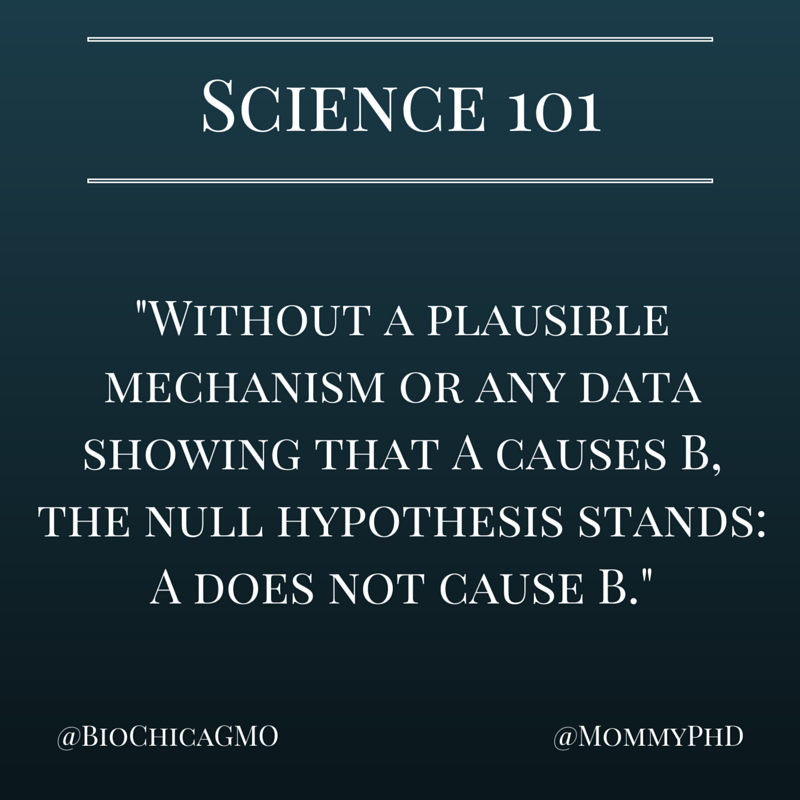
Despite searching for information, we found little to no credible evidence linking sterility or breast cancer to GMOs. It is a basic concept of scientific research that, when examining a cause-effect relationship between two items, the null hypothesis is what you start with - that there is no connection between the two items. This means that until someone comes up with a study showing that A causes B, then the null hypothesis stands: A does not cause B. Without this important principle, you could propose any hypothesis and people would have to “prove you wrong”. Instead, the burden of proof falls on those proposing a relationship between two items; they must provide evidence for that hypothesis.

Additionally, hypotheses are not invented out of whole cloth; they are based on previous knowledge. In considering how seriously to take a hypothesis, scientists consider plausibility, possible mechanisms, and what we already know about the subject. When a hypothesis has no plausible biological mechanism by which A can cause B, based on everything that we already know about biology, the burden of proof is even higher on those proposing the relationship between A and B and these hypotheses are often dismissed. This requirement for proof underlies the popular phrase “extraordinary claims require extraordinary evidence”. In the case of GMOs, breast cancer, and sterility: despite many studies of the health effects of GMOs, there is no evidence for a link to breast cancer or sterility and no plausible mechanism to explain such a link. At a minimum, scientists would need to have seen an increase in these things since the introduction of the first GMO in 1996. However, neither breast cancer rates nor infertility have increased since 1996. Thus, scientists have no evidence that GMOs are in any way associated with breast cancer or sterility and no plausible reason to hypothesize that they are. All the current evidence shows that GMO food is as safe as non-GMO food.

In North America, we have the luxury of having an abundant food supply with many options and choices. This includes the choice of being able to avoid GMOs entirely by adopting an organic diet, which excludes  genetically engineered crops and ingredients derived from them. However, in areas of the world where such abundance does not exist, GMOs can be extremely beneficial. GMOs may not solve world hunger, eliminate global warming, or ward off pests, but these crops will help us as we face these challenges. Disregarding an entire set of tools, based on the fears and privilege of those of us fortunate enough to have these choices, restricts the ability of farmers and scientists around the world to find solutions to real problems in agriculture.

Farmers have written about how they make their choices regarding pesticide use, and we encourage you to check out these resources:

To learn about the benefits of GMOs, see:

Talk to farmers and scientists about genetic engineering

From our original letter:

“Please, don’t co-opt motherhood and wield your fame to oppose beneficial technologies like genetic engineering. Certain celebrities have misled thousands of parents into thinking that vaccines are harmful, and we see the same pattern of misinformation repeating itself here. When GMOs are stigmatized, farmers and consumers aren’t able to benefit from much-needed advancements like plants with increased nutrients, or plants that can adapt to changing environmental stresses.

We, like millions of other Americans, line up to see your movies, and respect your occupation. Though our jobs differ, we share a common goal: to raise healthy, happy, successful kids. As moms we feel it is our responsibility to use the best available information to protect our children’s health, and to let the best science inform the choices we make for our families. We ask you to take the time to learn about how genetic engineering is being used by farmers, and the potential it has to help other moms raise healthy, happy, successful kids.

You have the opportunity to influence millions of people, so please use that influence responsibly, and ensure that your advocacy is supported by facts, not fear.”

We would like to extend the same invitation to you: talk to scientists, talk to farmers, talk to the experts in these fields. Arm yourself with knowledge, not fear, to help you make informed, healthy choices.

Sincerely,
Alison and Layla

About the letter writers:

meme2.png