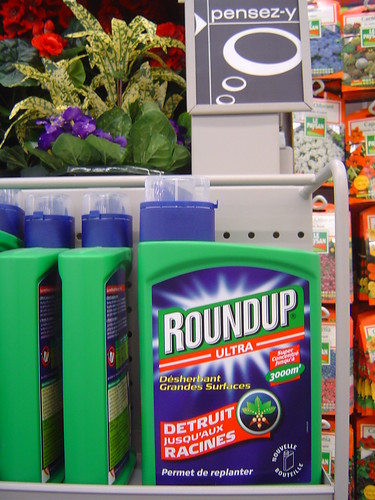
You may have seen bottles of Round-Up at Home Depot and other retail stores. It's a weed and grass killer that many people use to get rid of weeds/grass on driveways, pathways or flower beds. The active ingredient in the herbicide is glyphosate.
 So how does glyphosate kill weeds and other plants (source is here)? It basically interferes with a biochemical pathway which plants need in order to make 3 crucial amino acids (in case you were curious, the name of the pathway is the shikimate pathway). It messes up one of the enzymes needed in the pathway, the amino acids never get made, and the plant dies. The enzyme that gets inhibited by glyphosate is called 5-enolpyruvylshikimate-3-phosphate synthase, but it's been wisely abbreviated as EPSP (phew!). I could only find evidence that this enzyme exists in plants, fungi, and microbes. So it does not seem to be present in animals.
There is a bacteria whose EPSP enzyme is not affected by glyphosate. The EPSP synthase gene from that bacteria has been inserted into specific crops, thereby creating glyphosate resistant crops. As a consequence, growers can spray their fields with glyphosate/Round-Up. Most plants/weeds will die because the EPSP synthase enzyme will be inhibited. But the transgenic crop will continue to grow because it has the bacterial version of EPSP synthase, whose activity is unaffected by glyphosate.
Round-up Resistant crops have been growing long enough that Monsanto's patent on Round-up has expired (note that the patent on the GMO seeds has not expired, so
This week I received requests from two people to review papers that look at glyphosate causing cell death. The most recent paper published on the topic came out last month in the International Journal of Toxicology (as a side-note, it took me forever to get a copy of this paper. We scientists should be more vocal in our demands for open-access journals). Due to this paper, there has been a flurry of articles/blogs highlighting the dangers of GMOs. So what did they do in the paper? Basically, they took liver cell lines and grew them under different conditions. As treatments, they used diluted Round-Up, as well as several components of Round-Up. Then they examined cell death both directly, as well as biochemically (they looked for the presence/absence of proteins associated with cell death). To summarize their results, the cells treated with Round-Up died.
Similar studies had been performed by other groups. A study published in 2009 (which I do not have access to and could only read the abstract) reported similar findings. What was unique about the more recent paper is that they used less Round-Up for their study.
I bet you're wondering if I will stop feeding my family Round-Up Resistant GMOs over this. There are several thoughts going through my head over this.
1) How much glyphosate are you really eating? When I first read these papers, my gut reaction was "hmmm... I should do a better job washing my fruits and veggies". But then it hit me: none of my fruits and veggies are glyphosate-resistant GMOs. Round-Up Ready seeds are cash crops: canola, corn, cotton, etc. Our bananas, apples, delicious peaches, and succulent pomegranates are not GMOs (although I've previously argued for a GMO pomegranate... I'd buy that sucker in a heartbeat). By the time any components from glyphosate-resistant GMOs enter my food, they've been washed, stripped, boiled, pressed and reduced to a compound. So how much glyphosate is actually there? I tried to do a web search to find out how much glyphosate is in processed food, and I had a tough time with that search. Thanks to twitter, it was suggested that I review a report put together by the USDA's Agricultural Marketing Service (thank you @geneticmaize!). This annual report examines the amount of pesticide in our food and water, including items such as baby food. For the analysis, all items are prepared in the way we normally eat them; for example, tangerines are peeled, bell peppers are gently washed under cold water, etc. They examine both imported and national produce, and one of the items they examined in their 2011 report (released in 2013) was the amount of glyphosate in soybean. The results state: "Of the 300 samples tested, 271 (90.3 percent) of samples contained glyphosate at levels ranging from 0.26 parts per million (ppm) to 18.5 ppm." The tolerance of glyphosate is set at 20 ppm, so none of the samples tested exceeded the maximum allowable levels. So we're not eating any more than we should in our food supply. However, one may argue that perhaps the "amount we should be eating" is not set correctly, which is what the papers I originally cited above will argue. That brings us to point #2.
2) In vivo and in vitro studies are vastly different. Spouse: I know you just read that and said "what??" In vitro means tissue culture or lab work. In vivo means live rats, mice, or other model organisms. So what does my statement mean? Here's an example: we use Windex every once in a while (no where near as much as we should, according to My Big Fat Greek Wedding). You probably don't think twice about it. Now, would you ever consider spraying it directly in your eye? Would you consider spraying it on an open wound, even if you water it down? If you were to design an experiment to test the toxicity of Windex, which one is more accurate: to spray Windex, use it as instructed, and measure what it does to you over a period of time? Or would you spray it on an open wound in diluted form and measure what it does over a period of time? You could argue that you should do both. However, scenario #2 is not what happens in the real world. In vitro studies (which are tissue cultures in the lab), are basically cells out in the open. It's difficult to work with them and I'm sure you heard me whine and complain about my cells "dying" when I was back in grad school. They're finicky and they die when you don't shower them with loving care. They're excellent models for many things. But I'm not sure if they're a good model for measuring toxicity, because it's like spraying something directly onto an open wound, but with the effect amplified x1000. Which is why toxicity for EVERY COMPOUND I USE IN THE LAB is measured with in vivo models (that means rats and mice). Check out the Material Safety Data Sheet for water: they tested it on rats. If we are to begin measuring the toxicity of compounds using in vitro assays, then we have to go back and do this for everything we use and eat in our daily lives. I am willing to bet a trip for two to Morocco (which is the next place on my list of places to visit... hint, hint Spouse), that the majority of the compounds we use in our daily lives will kill cells in vitro.
Even the use of in vivo studies can be argued as being too rigorous. I remember that one of the post-docs that did my training would seldom wear gloves in the lab, even when working with Ethidium Bromide, which is a known carcinogen. When I asked him what the hell he was doing, he said that to replicate the rat studies which demonstrate the carcinogenic behaviour of Ethidium Bromide in humans, you'd have to take a syringe-full of the compound and inject it directly into your bloodstream. Of course, I use gloves and goggles when working with that crap because I believe that safety recommendations are put in place for a reason, but I thought that it was an interesting argument (although I don't agree with it). Which brings me to point #3.
4) Is it safer than the alternative? If you believe that there's a lot of glyphosate residue in processed food and that glyphosate in our food supply will harm you, but that it's being covered up Monsanto, then the alternative is to eat certified organic foods. Keep in mind that if you believe that story, then you have to believe that this is a massive cover-up involving hundreds of scientists who want to kill you (in which case, you've uncovered the Oath of all Scientists). Then the question becomes: is it any better? A very common misconception is that organic food crops do not use pesticide/herbicide. They do. I think that the only way to make sure that absolutely no pesticide/herbicide is used is to grow your own food, but it would be incredibly naive to believe that everyone could grow their own foods. The full list of substances that are allowed under US Organic Certification is listed here. For example, if you scan through the list you'll see that hydrogen peroxide is an allowable substance for plant disease control. Here's the MSDS sheet for hydrogen peroxide. If you've ever had it applied to a wound as a disinfectant, I probably don't need to tell you that if you dilute it and put it on cells in tissue culture, they'll probably die.
So, what's my conclusion? I don't think there's enough evidence that sufficient glyphosate is in our food supply to merit any alarm or that there's enough glyphosate in our food supply to be toxic to us. I think that the revision for limits of exposure of chemicals is a good idea if there's any new data suggesting that it should be re-examined. I don't think that the papers on cells dying in tissue culture are enough evidence to merit this re-examination. I think that glyphosate is a chemical that is dangerous at certain limits, but I also don't think that glyphosate should be treated any differently than any other chemical and compound that we're exposed to. I'm of the opinion that there's no global conspiracy to poison us: that scientists are out there doing their job just like you and me. As a consequence, I believe that Material Safety Data Sheets and EPA guidelines are drafted and implemented with a body of data that has been gathered after proper testing. Otherwise, I'm truly SOL given the stuff I work with in the lab all day.
3/23/2015: The International Agency for Research on Cancer recently updated their categorization for glyphosate based on existing research, suggesting that it's a possible carcinogen (group 2A classification). I have to read the papers that they reviewed to determine exactly what studies placed the compound in this category. However, it's important to note that their categorization was extremely specific: risk for non-Hodgkin lymphoma in agricultural exposure, and evidence in animal models, so it meshes with what I've already written above. I'll write up a new post after I've reviewed the papers.