Hi readers! I’m diversifying the “Better Know a Scientist” series to interview farmers as well. The whole idea behind “Better Know a Scientist” was to ask many of the questions I have from experts in the field and to get to know what they do. The same holds true for farmers. So here’s the inaugural “Better Know a Farmer”.
This week, I’m interviewing cattle rancher Meg Brown (follow her on Twitter @MegRaeB). Meg raises cows and hogs in Butte County, California (it looks like a typo for Butter County, but it’s not although it would be AWESOME to have a dairy farm in Butter County!). She holds a degree in agricultural business from CSUC. I met her fairly recently at the IFAL Symposium at UC Davis, and she’s 10x more awesome in person than she is online, so I feel badly for my readers who won’t get to meet her.
As per usual, each question and answer stands on its own, so you can skip around to read about different topics. Here we go!
Q: Can you describe your farm? How many animals do you have?
A: Well our ranch (I tend to think farms are crops and ranches are animals, I don’t know why), is actually two ranches, both ranches are in Northern California. The “winter” ranch is in Butte County, close to Chico. It’s range ground, so its natural grasses and not irrigated. The “summer” ranch is in Indian Valley, in Plumas County. This ranch is in a valley in the beautiful Sierra Nevada mountains. It’s irrigated pasture, with some natural grasses and some planted forage. We move our cattle twice a year for their health and well-being. The winter ranch is just too hot, the feed not as nutritious and the fire danger too high for us to leave them there. By moving them, they get two springs and a mild summer without the bugs and stickers that annoy them and can cause disease. We like our cattle happy and healthy! Our ranch usually runs several hundred black angus mother cows. In addition to the cows, I also raise heritage hogs in an effort to diversify. I love the heritage hog breeds, I think the meat is a totally different experience from what most people are used to. We have enough chickens to keep us from buying eggs. A whole assortment of ranch cats and four border collie/kelpie cowdogs. And last but not least my “teacup” pet pig, Silly.
[Biochica’s note: This is awesome. I saw a couple of pictures of chicken coops on pinterest that looked like they’d match the new water feature in our backyard garden, so I’m pretty sure I’m ready to buy a few chickens and will be giving Meg some pointers on raising chickens whenever we meet.]
 |
| Meg and her pet pig, Silly. |
Q: Why did you decide to pursue a career on the ranch?
A: There was never really a time when I didn’t plan on being a rancher. Of course, I was encouraged to develop marketable skills and attend college, but I’ve always had a passion for ranch life. When I saw how few of my peers planned on returning to their family’s ranches or farms, it only made me more determined to be successful. It’s incredibly hard for someone who does not come from production agriculture to break into this industry. Land is getting prohibitively expensive, it feels like new regulations are constantly being enforced, and it’s a plain tough skillset to learn. This is why I want to use my ranch, and my voice to make my way of life more accessible to our consumers. Taking the mystery out of what we do, helps build a trusting relationship, and I want the people that eat my meat to trust me. I feel like I have two careers now, one is the ranch and the other is having a social media presence. Both keep me very engaged and busy - but they are two very different skill-sets for sure!
[Biochica’s note: I already feel like I share so of Meg’s knowledge and experience! One of my biology courses had a quarter of a semester dedicated to animal physiology, plus I had a dog growing up.]
Q: How do you decide what to feed your animals? How soon after feeding GM-grain to the animals do you see tumors starting to appear?
A: Quality and price are the two biggest factors I use to determine feed. I obviously want the best feed I can get for my animals, but I also have to make a profit. I could feed certified organic to my hogs and grain-finished cattle but it wouldn’t make financial sense to me. My consumers are not willing to pay the extra when they can’t tell the difference taste wise and my animals have no preference. If my hogs had a choice they would prefer to only eat the cookies I give them as treats.
I’ve never seen tumors or any other ill effects in my animals that consumed conventional or GMO feed. The cattle I finish on grain about knock me down during feeding time to get to their rations, it’s like cow candy. And if you’ve ever had the pleasure of feeding hogs, you’d know pigs are very particular about what they eat (that’s a surprise to most people), and won’t eat something if they don’t like it.
Q: Why did you pursue a college degree?
A: My family was adamant that I earned an advanced degree. Neither of my Parents did, so it was really important to the family that I was given the opportunity. Growing up I was urged to develop as many marketable skills as I could and the more money I was paid for them the better, a degree was just part of that. I did briefly consider majoring in computer science, history and culinary school but ultimately I chose Ag Business because the hardest part of ranching can often be running the business side. I got my degree in Agricultural Business so I would have the proper skills to not only raise animals but have a successful business.
The thing about agriculture is you never stop learning. A degree in it doesn’t guarantee you are going to be good at it or even deeply knowledgeable about everything. I learn something new everyday, and that is one of the many reasons why I love it. Agriculture is so different around the United States and the technology seems like it is evolving daily, it’s almost surreal to be apart of. I’m just trying to keep up.
[Biochica’s note: Ag Business degree aside, I think we can both agree that my agricultural degree from the University of Google is second to none.]
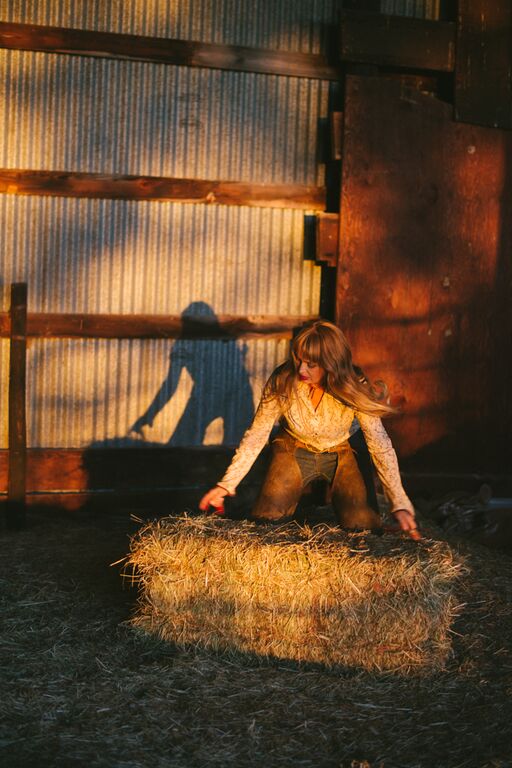 |
| Photo by Shannon Rosan |
Q: How has the drought in California affected your ranch? If you had access to drought-resistant GM alfalfa or grain would you give it to your animals?
A: Well we’ve been living this drought for a few years now. It feels like the rest of the country is finally realizing how serious it is. Since we do run on range ground half of the year, we are dependant on rain to irrigate our cattle’s feed. When there is little rain, we get little feed.
It’s important to us that we don’t damage our natural habitats (our pastures), so we are very careful not to stress our land. That meant selling part of our herd. Selling your mother cow herd is almost like selling your future and past. These are cows whose genetics were planned years before they were ever born. We watched their births, we watched them grow up, we cared for them their whole lives, we watched them, in turn, give birth. Now simply because we aren’t getting rain, they must be sold. It’s been heartbreaking.
I would definitely use drought-resistant GM alfalfa or grain if I could. I believe it is an excellent technology to support. I want to be as sustainable as I can, and I think that could help. Plus, anything I can do to promote it or highlight its safety is something I want to be involved in.

Q: When I envision the life of a rancher who raises cattle or hogs, I think that one of the more difficult parts of it would be having to put an animal down or sending them off to the slaughterhouse. How do you deal with it? Do you just become numb to it after a while or is it emotionally taxing each time?
A: You are right. That is probably the hardest part of what I do. Putting an animal down because of illness is one of the hardest things I do. It means I failed. I take that personally. But I think that makes me a better producer. I work harder at learning how I can be and do better by my animals. When I lose an animal it’s not only emotionally taxing but it hurts me financially too. So I have every incentive in the world to make sure they are as healthy and happy as they can be. That’s why I do get upset when people crassly accuse cattle ranchers of abuse - they really have no idea how hard we work to care for our animals.
However, sending them off to slaughter is a different set of emotions. Of course I have some sadness that a life is ending, but that is also the point of what I do. This is where meat comes from. When I send them off to slaughter that means I did a good job; I did what I set out to do. In some sense I feel a sense of pride knowing I raised a happy, healthy animal, they get a quick and respectful death, and I am feeding my friends, family and community.
A: Well I want to be PC here. I do. But it’s honestly hard, so I’ll just say it, I think it’s bull poo. We have plenty of sustainable beef right here. In fact I can look out my window right now and actually see it. It feels like they are basically saying the US producers aren’t good enough. I think if Chipotle was willing to pay more for their product, they could source locally with little to no problem. I would love to work with them, I’m sure my neighbors would too. I think a lot of what they do is hot air marketing. They are taking advantage of the fact that most 98% of our population is removed from the farm/ranch and doesn’t know our practices. To me, that isn’t showing integrity or being sustainable.
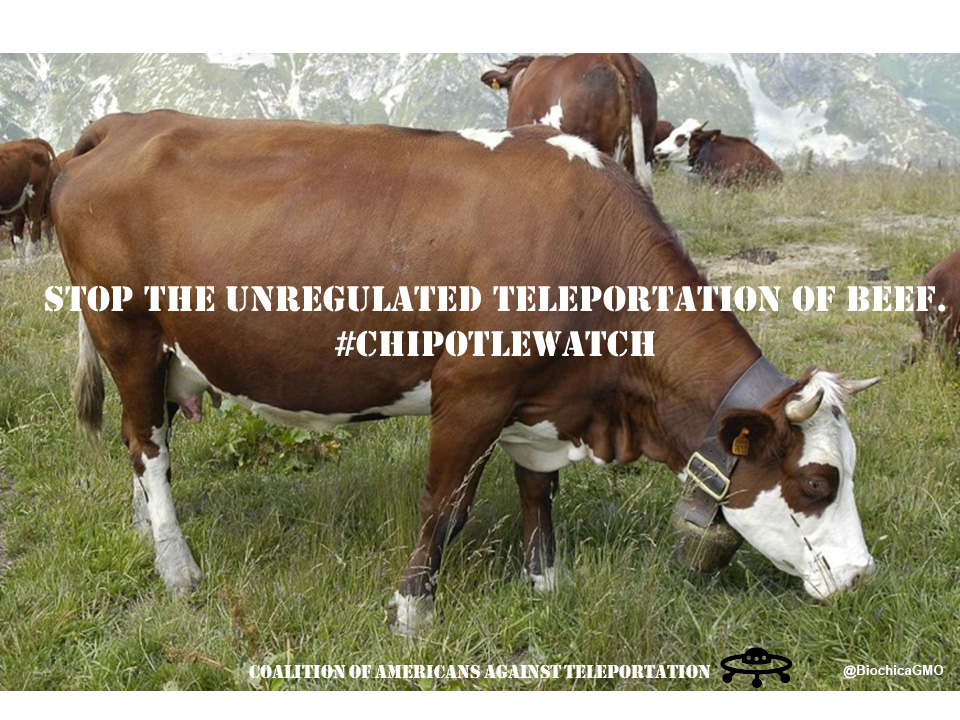
[Biochica’s Note: Meg, didn’t you know that Chipotle has a teleportation system? That’s how they’ve managed to import beef from Australia sustainably and chock-full of integrity-ness. But I think what we should be asking is how we’re going to regulate this. Please consider joining my new movement to put a stop to Chipotle’s unregulated teleportation of sustainable beef:
Q: What is the biggest challenge you face as a farmer? Are there any specific challenges you face as a female in your career path?
A: Being a rancher is challenging no matter what gender. One really does a plethora of skill sets to be successful on a ranch. Everyday is different, one day you could be fixing a lot of fence, or the next you might be working cattle, the next might require some heavy equipment work. It’s dangerous work too, animals can be unpredictable, and accidents do happen.
Being a woman in production ag does have some unique challenges. The main thing I encounter is getting “little ladied”, basically someone tries to treat me like a girl when I’m working here on the ranch. It’s really dangerous because I know my job and I am good at it. When some guy tries to help me, and doesn’t know the cattle or what I am trying to do, I usually end up almost getting hurt. I’ve had to learn how to politely ask guys to get out of my way, and it’s always just a whisper awkward.
 [Biochica’s note to everyone out there: you can follow Meg on Facebook or on her blog, to learn about all the tough crap that she deals with (sometimes literally) on a daily basis on the ranch. I think that I will face similar challenges when I start expanding the number of chickens in my backyard coop.]
Q: What's grass-fed beef? What's grass-finished? Is one better?
A: All beef is grass-fed for about 80% of it’s life. You have cow/calf producers like myself, and what we do is raise calves until they weigh enough to be “finished” at a feedlot. The will enjoy grains, and a mixture of legumes, forages, and by-products from human food waste until they reach their ideal weight. I like to joke that our feedlot cattle have better nutrition and health care than I do.
Grass-finished beef is beef that has never had grains. It’s typically leaner than cattle that have had access to a feedlot ration.
I produce both types of beef. Since we are a commercial cattle ranch, the majority of our calves are sold to feedlots. I keep a handful of calves and finished out on either a grain ration or purely on grass. It depends on my consumer’s taste preference and if I have enough grass. We’ve been in a major drought and it’s been hard to find the extra feed for the past couple of years. Personally I prefer my beef that’s been finished on grain. I think it makes it far more “buttery” and I can get a calf up to finish weight sooner, which means using less resources, something I am constantly trying to do. Grass-finished can be just as good, but you also have less control over the taste of the meat - it can be quite varied in taste and texture from ranch to ranch because of the different grasses and seasons the beef is slaughtered.
[BioChica’s note: I plan on feeding my chickens heirloom quinoa and will provide them with Evian water. They will be finished on organic kale.]
Q: I think of customer demands from industry as a double edged sword: on the one hand, an industry might be slow to change or may not change at all unless customers demand it. On the other, customers may start making demands on topics that are nuanced and require subject matter expertise (I’ve argued against the democratization of science here). How do you feel about customer demands on the farming industry?
A: I completely agree that it is a double edged sword. When I first started my blog, I got industry flack because I was so transparent, they claimed that consumers wouldn’t want to see what I was showing, it would ‘turn them off’. I was talking about topics that were nuanced and did require some understanding of certain processes, but I made sure to explain the why’s of what I was doing. My consumers loved it!
The thing is with farming and ranching, people deserve to know the basics of how we do it, since we all eat. Some sectors of the ag industry have not been quick to offer transparency, and that is a mistake. Acting like we are hiding something is the worst thing we can do. Being open and acknowledging agriculture is a very complex industry with many different niches and styles. Explaining why is what we should be doing.
By providing basic knowledge, we can offer change in our industry, but in a way that hopefully can benefit everyone, and not just push more regulations on us. Plus there is something almost magical when you get to see someone connect the dots with their food - working in agriculture, many of us take that connection for granted.
[Biochica’s note: When I start supplying all of Northern California with eggs from the chicken coop from my backyard, it will be the epitome of awesomeness and I will follow your model of transparency. Perhaps I could install a GPS system on each chicken for tracking purposes along with 24/7 streaming video from cameras that I’m going to trademark as “CluckCams”]
Q: There's much evidence suggesting that raising cows is not the best for the environment: they take up a lot of space, they emit a lot of gas (get it??), and feeding them takes a lot of resources. Personally, I give in to the delights of a T-bone steak, but deep down inside, I think that the responsible thing to do would be to cut back on meat (if only I could!). What are your thoughts on this?
A: I hear many of these arguments often. I think it is very important that we be as environmentally friendly as we can. I sincerely want six more generations of my family on this land.
This is one of those time where I wish I could invite everyone out to the ranch so I could show them why we raise cattle here. We raise our cattle on rangeland. This rangeland is not suited for much else, its clay, rocky and non-irrigated, so planting crops or trees is pretty much out of the question. This ground is best left as natural rangeland, for cattle, and for habitat for the plethora of flora and fauna that call it home. The other option is to sell this land for homes, malls and hobby ranchettes. I think our community gets more value from wide open spaces though.
What much of this evidence has forgotten is how much the beef industry has improved over the past 30 years. When I was a baby we were weaning cattle at 500 pounds, now we are well over 800 pounds, they are the same age - but our understanding of genetics and nutrition has improved vastly, so we are doing more with less.
There are also multiple benefits to raising cattle - we can feed them plant and food waste that would otherwise be put in landfills. And there is the poo and by-product factor. It’s a joke that we use everything but the “moo” when we slaughter a beef. From their poo being used as a fertilizer (less chemical fertilizers is a good thing, right?), to leather, to pharmaceuticals - often these things are overlooked when discussing beef production and sustainability.
Sometimes it feels like we are being punished for improving ourselves. Again, I believe that a lot of that is our own fault because the beef industry historically hasn’t done a good job of being transparent and vocal about our improvements. We’ve been reactive instead of proactive and now we have to make up for that.
[BioChica’s note to Meg: I’m surprised to hear that the gas emitted from the cows isn’t used, though. I think we should be able to capture the gas and use it to power stuff. Meg, you should get on that.]
Q: This question comes from the spouse: How do you save enough money to upgrade equipment, for retirement, or college, given the overwhelming amount of uncertainty that exists in ranching? I can imagine that in a particularly bad year, you might wipe out all your savings. How does that work?
A: Most of us don’t retire. We may slow down, but all of my family worked (or tried to) almost until the day they died. That’s my goal as well. If I could pick a way to go out it’d be while checking cows and riding a horse.
Most of the money we make from the ranch is invested right back into the ranch. When we have a good year, we upgrade equipment or try and make a wise investment. In bad years, you work with what you have or try and borrow stuff from your neighbor. We’re pretty used to getting one paycheck a year, and budget to account for that. We are lucky because we own all our own land. It can be incredibly hard to make a profit while renting ground. But 6 generations of family before me, were looking out for me, so as long as I am smart, I should be able to pass this ranch on to the 7th generation.
I saved and paid for college myself. I was deeply involved in 4-H and FFA, so I was able to save money through the sale of my project animals. I was able to earn many scholarships because of all the agricultural activities I was involved in growing up.
[BioChica’s note: After the water and feed expenses, I calculate I’ll be making 5% profit if I sell each egg for a dollar. So in about 25 years, I’ll be contacting you to see if you can rent me some land for expanding my backyard enterprise.]
Q: Where you live seems pretty remote while more and more people seem drawn to the city life. What do you see as some of the downsides to rural living?
There are several downsides to living in the country and they are pretty much all based on convenience. My biggest gripe, and this is totally a first world problem, so I almost feel bad even saying this, is I don’t have internet in the mountains. I’m dependant on my smartphone, which is a lot more work. I spend a massive amount of time online, oversharing my life. I do this because there is a huge amount of interest in what I do. People do want to know more about their food and how it’s grown. If I want to post a blog or write a well researched response to a question, that means I have to go to the local bar and use their wifi.
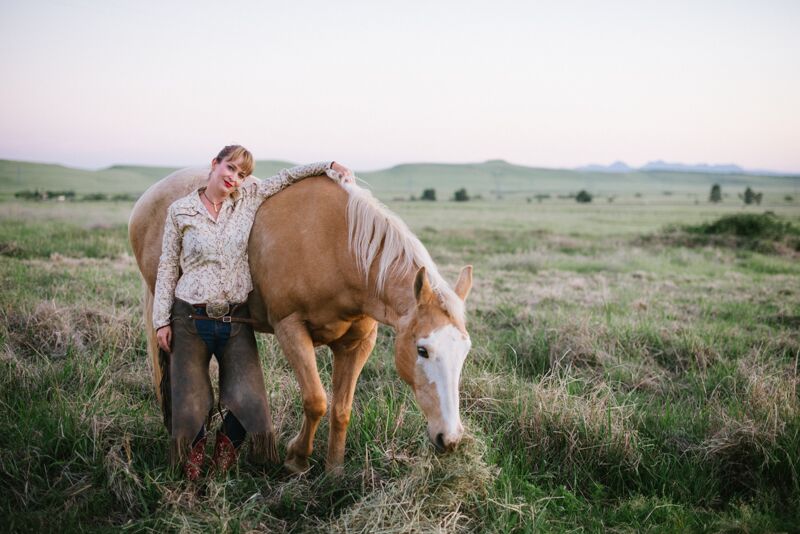 |
| Photo by Shannon Rosan |
Another thing that most people couldn’t cope with is the nearest Starbucks is like, an hour away. And want a pizza delivered? Forget about it. A fancy dinner out? Get ready to drive at least an hour. Grocery shopping is also a challenge, our selection is small and not always the freshest - hence my garden.
If you are young and single, like myself, there isn’t much to do or people to meet. I’m pretty much related to everyone in the valley I live in, so it really limits my dating and going out.
Of course, the positives of living in the country are numerous and far outweigh the downsides, at least for me!
[BioChica’s note: No internet??? How on earth can you know anything if you can’t google it? I think that’s a deal breaker for me…]
Q: If there’s one thing that you’d want everybody to know about raising cattle and hogs, what would it be?
A: It’s not as romantic as everyone thinks it is. So many people tell me they envy what I do. But honestly, I think they have no clue how hard it is to do what I do. It is not “the simple life” like we are told it is. Since I work outside most of the time, I am often dirty, hot, cold, sunburned, covered in poo or other bodily fluids that are not my own, and I usually smell. It’s an emotional job, which most people don’t even think about. We are very connected to the land and animals and when we are in a drought, or we have illness in our herd, it can be very stressful and draining. There are no vacations or even many ways for us to disconnect since we often live on our ranches.
But we love what we do. We have to be passionate and really want this way of life or we wouldn’t do it. The rewards of living this life make up for the stress and the smells. Being on the same land as my great, great grandparents, and doing the same things they did is an amazing feeling, and knowing that at some point, I will be able to offer this lifestyle to my own children is something most people don’t get to experience, and it makes it worth it me.
[BioChica’s note to Meg: well, we’ll just have to see about that. I’ll touch base with you once my Feng Shui consultant does the layout for my chicken coops]