Showing posts with label labeling. Show all posts

Friday, January 22, 2016

Defining the GMO debate: Guest post by Mommy PhD

This is a guest post by a fellow #moms4gmos, Dr Alison Bernstein, aka Mommy PhD. You can follow her on twitter (@mommyphd2) or on Facebook.


An old article from Nathanael Johnson on Grist, What I learned from six months of GMO research: None of it matters, from January 2014 showed up in my feed on various social media platforms recently. You may wonder: if none of it matters, why are we still talking about GMOs two years later? To many people, it may not be immediately obvious why this conversation about GMOs is important.
Here’s why I am talking about GMOs and why I think the public conversation about GMOs is important:
Genetic engineering is an important tool for tackling problems of food security around the world.
In the original article, Nathanael wrote that stakes are low in the GMO conversation. I’ll admit, the implications do seem more remote and less severe than they do for, say, the issue of childhood vaccinations. This is especially true for those of us living in the US and other countries where food is abundant and our choices are varied. However, to say the stakes are unimportant seems naive about the realities of food production, particularly in the developing world. Here are a couple of examples of real world problems for which genetic engineering is an important tool to use to solve these problems.
  • Opposition to GMOs has delayed the testing and use of Golden Rice (rice fortified with beta-carotene, the precursor of Vitamin A) in populations where children are literally going blind and dying from Vitamin A deficiency. According to the World Health Organization, Vitamin A deficiency is the leading cause of preventable blindness in children. Each year, between a quarter and a half a million Vitamin A-deficient children become blind and, of those, half die within 12 months of going blind. This is most common in Southeast Asia, where rice is a staple of the diet.Rice is low in the dietary precursor of Vitamin A, beta-carotene. Golden Rice produces higher levels of beta-carotene that could provide a significant proportion of the daily required amount of vitamin A. However, anti-GMO opposition has prevented testing and development of this product that could have a dramatic effect on the lives of children in Southeast Asia. Is Golden Rice the only option to provide Vitamin A supplementation? Of course not. Is Golden Rice a very good way to provide Vitamin A supplementation? Probably (we need to study that, but anti-GMO opposition has prevented even studying it). Biofortification is important in crops in other areas of the developing world, where people have little variety in their diets and would greatly benefit from additional nutrients. It seems tragic to disregard a tool that has already been developed while children continue to suffer because some people are afraid of or don’t understand the technology.
  • Citrus greening (Huanglongbing) is a disease that kills citrus trees. This is devastating for citrus growers in California, Florida, and other citrus-producing states. In Florida alone, according to a 2012 study from the University of Florida’s Institute of Food and Agriculture Sciences, citrus greening cost Florida $3.63 billion in lost revenues and 6,611 jobs in the first 5 years since citrus greening was detected in Florida. There are non-genetic engineering strategies out there, but there are significant issues in the implementation of those strategies. Despite success with other disease resistant crops (e.g. ringspot-resistant papayas, which saved the Hawaiian papaya industry), researchers and farmers have been unable to move forward with genetically engineered orange trees because of anti-GMO sentiment. In the developing world, disease resistance is especially critical where diseases threaten staple crops that make up a huge proportion of local diets.  As with Vitamin A deficiency, genetic engineering is not the only answer. However, it is a powerful tool that can be used in combination with other tools to address these really serious problems. Ruling out this technology based on fear and misinformation is hurting citrus growers and the economy.
These are just two examples of issues where the stakes are high. While genetic engineering is not the only strategy available to address these problems, other strategies are failing, or not working fast enough. Disregarding an entire set of tools based on fear and ignorance restricts our ability to find solutions to real problems. Using all the tools available to us seems to be the best way to approach these problems.
Pro-GMO: I don’t think it means what you think it means
Many people think “pro-GMO” means pro-everything that biotechnology ever produces. This is not the case, in my experience. “Pro-GMO” is a misnomer in the sense that people who are “pro-GMO” do not typically lump all genetically engineered products together and accept them blindly just because they are genetically engineered. In fact, one of the main reasons for opposition to mandatory labeling is that the proposed  labels group all genetically engineered crops together with no regard to what the product is. This makes a GMO label meaningless. Instead, those who are “pro-GMO” push for the consideration of each product on its own merits, because the method of breeding tells us nothing about the finished product.  
“Pro-GMO” is also somewhat meaningless, because “GMO” itself, as used in the public discourse, is a meaningless term. Genetic engineering is a breeding method, a very precise breeding method. It refers to a specific a set of techniques used to produce a plant with some desired trait. Nearly all the plants (and animals for that matter) that we eat today have been genetically altered by humans through mutagenesis, crossbreeding and artificial selection. The “natural” or wild counterparts of these foods would be unrecognizable to us. To call only food produced by transgenesis “GMOs”, while ignoring all the others makes no sense.  If genetically modified organism means “any organism that has been modified due to human intervention”, then nearly all of our food is a GMO. The method by which that modification occurs is irrelevant. Lumping everything made by transgenesis together creates an arbitrary category that tells us nothing about the end product. The type of breeding used to create a plant tells us nothing about the properties of that plant. An apple is an apple no matter how it was created.
Most people who are “pro-GMO” recognize that not every genetically engineered crop developed will be useful or a good option for every problem. I have never seen someone who is “pro-GMO” say that genetic engineering is the one and only answer to all of the world’s agricultural and food problems. Genetic engineering is just one piece in a larger toolkit for farmers and scientists to address issues of correcting vitamin deficiencies, reducing pesticide use, increasing the sustainability of agriculture, and saving important crops from disease. However, genetic engineering is a powerful technique and to disregard it entirely because a segment of the population doesn’t understand it is shortsighted.
Pro-GMO is really pro-science and pro-evidence-based policy.
To me, the real issue in the GMO conversation is a much broader concern, not exclusive to GMOs or even agriculture. The real issues are not allowing fear and scientific illiteracy to drive policy and promoting evidence-based policies. The GMO conversation is not occurring in isolation. It is part of a larger conversation about science- and evidence-based policy. Those of us who are adamant about GMOs are so because we are advocating for science- and evidence-based decision making in multiple domains. The future of GMOs in agriculture just happens to be a domain that is a matter of considerable public concern at the moment.
We continue to talk about GMOs because to not advocate for evidence-based policies is to allow an environment to persist where it’s acceptable for creationism to be taught in science classes despite overwhelming scientific consensus on evolution; for politicians to do nothing to combat global warming despite overwhelming scientific consensus on global warming; for parents to choose not to vaccinate their children, contributing to outbreaks of preventable diseases, despite overwhelming scientific consensus on the safety and efficacy of vaccines; and for quacks to take advantage of desperate people by selling fake cures and false hope for cancer, autism and other real and fabricated diseases. We advocate for science and evidence-based policy about GMOs because we advocate for this in all areas. Note: This post was originally published in the Sound of Science Blog in October 2015.

Monday, January 4, 2016

GMO labeling arguments are not exclusive to GMOs

When discussing labeling, there are many different reasons to want GMOs labeled: some people want to know if something's a GMO because they want to avoid pesticides, some people want to avoid food produced by Monsanto, etc. The issue with every single argument is that it's never exclusive to GMOs. I made the following infographic to outline the more common labeling arguments I've heard, as well as a non-GMO example that matches the criteria set out for that argument. This expands on my Facebook post (you can follow me on my new page!)

Click on image for full size
1) GMOs are made in a lab (i.e. they are not "natural"): this also holds true for many polyploids, such as seedless watermelons. Many mutagenic crops are also made in a lab (to learn more about different crop modification techniques, see this post). So if "unnaturalness" is one's reason to label GMOs, then many other non-GMO crops, include many that are accepted under the USDA's organic label, should also be labeled. 

2) GMOs use herbicides: many argue that GMOs made to resist "toxic" levels of herbicides should be labeled. The toxicity of the herbicides and the amounts used are a subject for a separate post altogether, but when it comes to labeling, there are mutagenic, non-GMO crops that are also made to resist herbicides, particularly Clearfield crops made by BASF which resist imidazolinone herbicides. So if labeling proponents want crops that use herbicides to be labeled, many non-GMOs will have to be labeled as well.

3) GMOs are patented: as I've outlined in the past, many non-GMO crops, including decorative plants and crops approved for use in organic farming, are patented. For a partial list of patented crops, see here. So wanting GMOs labeled to avoid patented crops should result in many, many non-GMOs being labeled, too. 

4) GMOs have genes from other species: not only do sweet potatoes have bacterial genes, but these were introduced using the same bacteria that scientists have harnessed when creating a new transgenic crop. At the same time, DNA from viruses are found throughout most genomes, including our own. 

5) GMOs are made by Monsanto: if you want GMOs labeled because Monsanto makes them, then some organic crops should also be labeled. Plus, what about all the GMOs that are not made by Monsanto? The non-browing Arctic Apple was made by small company in Canada.

6) GMOs make their own pesticides: all plants make their own pesticides. For example, wheat produces an insecticide known as DIMBOA (wheat is not considered a GMO). This post gives an overview of pesticides naturally produced by quinoa. 


Finally, there's the "right to know". But, again, what is it that you want to know? If you want to know what method was used to generate the crop from which an ingredient was derived, then why not mutagenic crops? Why not polyploids? Why not protoplast fusion? What is it about the method of transgenesis that has driven you to demand your "right to know" that didn't apply in the past for any of these other crop breeding methods? Feel free to comment below.

Updated on January 5th: The graphic had a typo, so I've swapped it with a corrected version.

Friday, November 20, 2015

Dear Christie Brinkley: We Aren’t Guinea Pigs

This letter is co-written by Mommy, PhD and BioChica (Dr Alison Bernstein and Dr Layla Katiraee. For more information about the authors, please see the end of the letter). Dear Christie,

We read this week about your new book and watched your interview on FOX Business. As scientists and science communicators, we are concerned that, while your motivations to help people eat healthy diets is honorable, your knowledge of genetic engineering, pesticide toxicity and the agricultural industry is not accurate. We are part of a group of moms (#Moms4GMOs) who also want to make healthy choices for ourselves and our families. We have previously reached out to other celebrities who are using their public platforms to spread misinformation and fear about the food supply in the US.

In our original letter, we addressed many of the concerns that you and others have raised about genetically engineered crops and pesticides. We hope that you will take the time to read the letter and the references we provided. There are a couple of points that were highlighted in your interview that we would like to discuss briefly here.

Colony Collapse Disorder is caused by many things, but GMOs are not one of them.

As you may know, much of our food relies on pollination by bees, so the health of these insects impacts all of us. Colony collapse disorder affecting honey bees is a topic of much controversy. This phenomenon is defined by the USDA as “a dead colony with no adult bees or dead bee bodies but with a live queen and usually honey and immature bees still present”. There are many theories on what may be causing CCD; the primary culprits seem to be parasites like the Varroa mite and flowerless landscapes, together with other factors, including exposure to pesticides and stress due to transportation. However, exposure to GMOs does not rank among the possible reasons underlying CCD.

Attempts to link GMOs to CCD have commonly focused on two factors: glyphosate and worm-resistant traits. Glyphosate, which is an herbicide used with some varieties of GMOs and is commonly used in gardens and parks around the country, has been examined to determine if it impacts honeybee health. A recent study examined the impact of the commercial formulations of 42 common pesticides on honeybees at concentrations actually used in the field. Due to the popularity of glyphosate, this herbicide was also included in the study. The study concluded that, while some pesticides are extremely toxic to bees, glyphosate was not harmful to their health.

Worm-resistant corn (commonly referred to as Bt-corn) is designed to kill the larval stage of many damaging insects, such as caterpillars, as they chew on the corn leaves. These crops have also been studied to determine if they impact honeybee health: a meta-analysis published several years ago concluded that their research “support[s] safety assessments that have not detected any direct negative effects” of the trait on the honeybee.

For more information on the science of CCD, we recommend these articles:

GMOs are the most tested and regulated food items: we are not guinea pigs.

The term “GMO” is commonly used to denote a crop or ingredient that is made using a laboratory technique known as “transgenesis”. But there are many different types of GMOs: non-browning apples, nutrient fortified rice, virus-resistant papayas, herbicide-tolerant soy, and pest-resistant corn. These cannot all be lumped into a single category. To underscore that the process is irrelevant and it is the trait that is important, herbicide-tolerant sunflowers have also been developed using traditional methods by the German chemical producer BASF and Dupont. By current rules, herbicide-resistant crops developed with targeted genetic engineering undergo extensive testing prior to being sold, while herbicide resistant crops developed by traditional breeding require no testing. In fact, genetically engineered food items are the most tested and regulated food in the market. No other foods undergo premarket approval by the EPA, FDA and USDA.

The sheer volume of data and number of studies on different traits used in biotech crops may surprise you. As a simple exercise, searching the NIH’s database of scientific studies for “MON810”, which is the trait that gives corn resistance to worms, identifies over 170 studies that have examined this trait. These range from multi-generational feeding studies to molecular analyses of the protein that makes the corn resist worms. Thousands of scientists around the world are dedicating their efforts to the development and testing of these crops, which defies notions implying that these crops are released into the market without being thoroughly tested.

For information about studies on GMOs and worldwide approvals of genetically engineered crops, check out these two databases.

The US food supply is safe, regardless of the breeding or farming method used.

We read about your adoption of an organic diet over concerns about possible links between GMOs and pesticides to sterility and breast cancer. Pesticides are important tools in agriculture, which farmers use judiciously depending on many factors including the type of pest and the type of crop, among many others. It is important to know that organic food production uses pesticides as well, and that pesticide residues in the US on non-organic produce are far below safety limits, but we have no data to compare it to for residues on organic produce. Furthermore, there’s no conclusive evidence suggesting that adopting an organic diet is significantly healthier (see meta-analyses here and here, and here and here for discussion of this research). Each pesticide has its pros and cons, and not using any pesticide at all can have significant consequences, including lower crop yields.

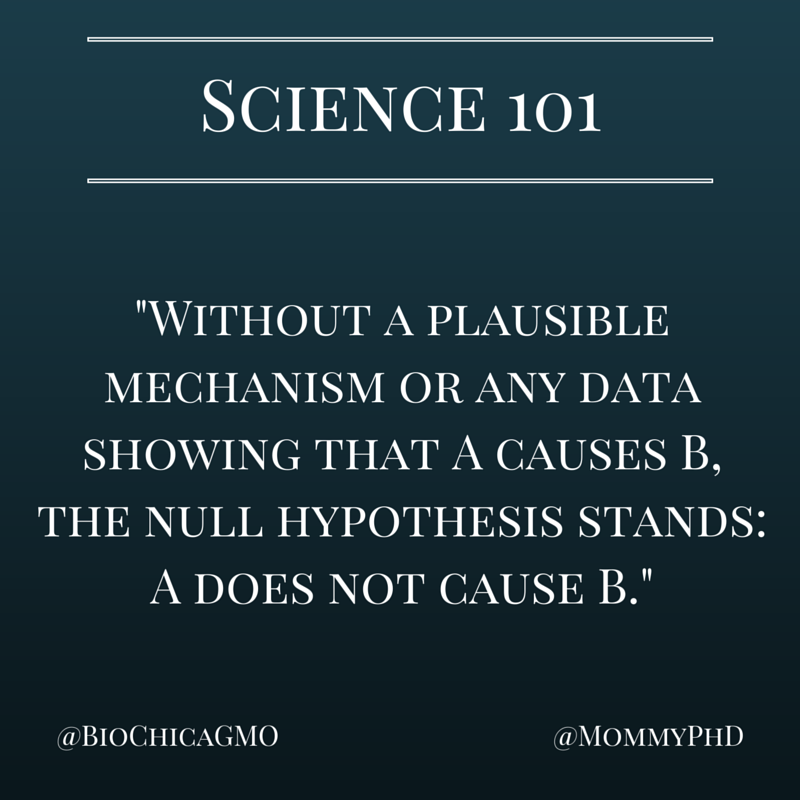
Despite searching for information, we found little to no credible evidence linking sterility or breast cancer to GMOs. It is a basic concept of scientific research that, when examining a cause-effect relationship between two items, the null hypothesis is what you start with - that there is no connection between the two items. This means that until someone comes up with a study showing that A causes B, then the null hypothesis stands: A does not cause B. Without this important principle, you could propose any hypothesis and people would have to “prove you wrong”. Instead, the burden of proof falls on those proposing a relationship between two items; they must provide evidence for that hypothesis.

Additionally, hypotheses are not invented out of whole cloth; they are based on previous knowledge. In considering how seriously to take a hypothesis, scientists consider plausibility, possible mechanisms, and what we already know about the subject. When a hypothesis has no plausible biological mechanism by which A can cause B, based on everything that we already know about biology, the burden of proof is even higher on those proposing the relationship between A and B and these hypotheses are often dismissed. This requirement for proof underlies the popular phrase “extraordinary claims require extraordinary evidence”. In the case of GMOs, breast cancer, and sterility: despite many studies of the health effects of GMOs, there is no evidence for a link to breast cancer or sterility and no plausible mechanism to explain such a link. At a minimum, scientists would need to have seen an increase in these things since the introduction of the first GMO in 1996. However, neither breast cancer rates nor infertility have increased since 1996. Thus, scientists have no evidence that GMOs are in any way associated with breast cancer or sterility and no plausible reason to hypothesize that they are. All the current evidence shows that GMO food is as safe as non-GMO food.

In North America, we have the luxury of having an abundant food supply with many options and choices. This includes the choice of being able to avoid GMOs entirely by adopting an organic diet, which excludes  genetically engineered crops and ingredients derived from them. However, in areas of the world where such abundance does not exist, GMOs can be extremely beneficial. GMOs may not solve world hunger, eliminate global warming, or ward off pests, but these crops will help us as we face these challenges. Disregarding an entire set of tools, based on the fears and privilege of those of us fortunate enough to have these choices, restricts the ability of farmers and scientists around the world to find solutions to real problems in agriculture.

Farmers have written about how they make their choices regarding pesticide use, and we encourage you to check out these resources:

To learn about the benefits of GMOs, see:

Talk to farmers and scientists about genetic engineering

From our original letter:

“Please, don’t co-opt motherhood and wield your fame to oppose beneficial technologies like genetic engineering. Certain celebrities have misled thousands of parents into thinking that vaccines are harmful, and we see the same pattern of misinformation repeating itself here. When GMOs are stigmatized, farmers and consumers aren’t able to benefit from much-needed advancements like plants with increased nutrients, or plants that can adapt to changing environmental stresses.

We, like millions of other Americans, line up to see your movies, and respect your occupation. Though our jobs differ, we share a common goal: to raise healthy, happy, successful kids. As moms we feel it is our responsibility to use the best available information to protect our children’s health, and to let the best science inform the choices we make for our families. We ask you to take the time to learn about how genetic engineering is being used by farmers, and the potential it has to help other moms raise healthy, happy, successful kids.

You have the opportunity to influence millions of people, so please use that influence responsibly, and ensure that your advocacy is supported by facts, not fear.”

We would like to extend the same invitation to you: talk to scientists, talk to farmers, talk to the experts in these fields. Arm yourself with knowledge, not fear, to help you make informed, healthy choices.

Sincerely,
Alison and Layla

About the letter writers:

meme2.png

Thursday, September 3, 2015

The SAFE Act or the DARK Act? Why is it being opposed?

Remember that time I wrote a letter to Gwyneth Paltrow and Lena Dunham? Well, soon after, Ms Paltrow teamed up with a group of her friends and created a video against the Safe and Accurate Food Labeling Act (aka SAFE act).

The SAFE act or HR 1599 seeks to regulate labeling of GMOs. It recently passed the House and is currently in the Senate (as I was learning about all this, I became keenly aware that I should probably start studying for the US Citizenship exam, which will be in a few years). I've read through the bill, whose text you can find here, and I encourage you all to do the same.

The act does a few very important things at the Federal level:
  • Says that GMOs must be labeled if there is a difference in "functional, nutritional, or compositional characteristics, allergenicity" or other material differences between the GMO and its conventional counterpart. It clarifies that just because something is a GMO, it doesn't automatically make the food/ingredient/crop materially different.
  • States that it is unlawful to sell GMOs or food produced from GMOs that are unregulated (with exemptions, such as for research). 
  • Declares that the Department of Agriculture will keep an online registry of all the non-regulated GMOs and their intended uses, petitions made regarding each GMO, and notifications of findings from the Secretary of Health and Human Resources regarding the GMOs.
  • Creates a "National Genetically Engineered Food Certification Program" and establishes standards for labeling something as non-GMO. Interestingly, the certification is based on the supply chain process (i.e, look upstream from the final product to see if any ingredients derived from GMOs were used, as opposed to looking at the final product to determine if the protein or DNA from the GMO can be identified). It also states that food given to livestock must be GMO-free in order for livestock products to be certified non-GMO. It also provides a list of exemptions. Additionally, it establishes an accreditation program, whereby individuals can become certifying agents. 
  • Establishes guidelines for labeling products as genetically engineered. It expressly states that you can't claim that a product is "better" or "safer" just because it's a GMO.
  • Creates penalties and consequences for those who break the laws outlined in the act.
In a post I wrote for Biofortified, I outlined the difficulty inherent in state-level labeling: that there's no definition for a GMO. I gave examples of how proposed labeling legislation in various states differed: "In Vermont, the labeling bill states that you don’t need to label if the amount of GM material makes up less than 0.9% of the total weight of processed food, but in California‘s proposed (and failed) bill the cutoff was set at 0.5%. Perhaps GMOs have more GMOiness in California so the state can’t handle as much of it. Colorado’s proposed (and failed) bill stated that chewing gum was exempt from labeling. In Colorado, Vermont, and California, alcoholic beverages were exempt, but I could find no such exemption in the bill from Connecticut." This act addresses the issue by creating Federal standards. In that same post, I explained that the absence of a single definition for GMOs will give rise to multiple certification/verification labels, each claiming that their own definition of a GMO is the right one. Using the federal standards established in HR1599, this possibility evaporates because there will be a single Federal certification body. 

You'd think that anti-GMO activists would be jumping up and down and celebrating over this one. But for some reason, they aren't. 

Instead, the legislation has been rebranded as the DARK act (Deny Americans the Right to Know). I checked the "Just Label It" campaign, which Ms Paltrow and colleagues want you to visit, to see why they're opposing it. Here are their reasons and my thoughts below:
  • Preempt states from requiring labeling of GMO food.
    No: the act expressly states that GMO foods must be labeled if they are materially different and puts that power into the hands of federal agencies. How does state level labeling make any sense? Why should it be possible for something to be labeled as a GMO in Colorado but not in Vermont? Wouldn't that just highlight the arbitrary nature of the GMO-label? But I digress...
  • Virtually eliminate FDA’s ability to craft a national GMO labeling system.No: the bill does exactly the opposite. It creates a labeling system and certifying bodies for non-GMOs.
  • Codify the current, broken voluntary labeling system.
    Yes, it fixes the voluntary labeling system. What's wrong with that?
  • Create a GMO “safety” review system based on industry science.
    Yes, and again, what's wrong with that? Car manufacturers use industry science to show that their cars are safe and meet Federal guidelines/standards. The same goes for airplane manufacturers. And crib manufacturers. Even drugs: clinical trials are carried out by the company that makes the drug using "industry science" and then the data is reviewed by the FDA. Why would GMOs be the exception to the norm? If you want GMOs to be tested by government labs, then be prepared for a huge tax increase. I'm not saying this isn't the way to go, but if we decide that government agencies should be responsible for the testing of all consumer products, then we have to be ready to bear the cost/burden.
  • Allow “natural” foods to contain GMO ingredients.
    There's no true definition for "natural". From my perspective, I don't see how an Arctic Apple grown in an orchard under the beautiful BC sky could be anything short than 100% natural. Here's an article on how the "natural" label is a marketing gimick. But I'm sure others would disagree.
According to many experts, making companies label GMOs is a violation of the 1st amendment. The amendment which protects freedom of speech, also makes it unlawful to force speech, and this freedom is extended to commercial speech. The limits of this commercial freedom of speech have been loosely outlined in a Supreme Court Case from 1985: "Commercial speech that is not false or deceptive and does not concern unlawful activities may be restricted only in the service of a substantial governmental interest, and only through means that directly advance that interest." It's on this basis that Vermont's labeling law is being appealed in court. It'll be interesting to see how that court case plays out. You can read more about some interesting commercial first amendment cases here and here. 

So HR1599 seems to be the best of all worlds: it establishes a clear definition for a GMO, it doesn't violate the first amendment, it forces companies to label GMOs when needed, it creates a federal registry, and creates a new federal label for non-GMO with very stringent/exclusive definitions. I find it interesting that most groups that are denouncing HR1599 embrace the Non-GMO Project's certification, when these two have adopted the same process-based definition for a GMO. The difference between the two is that the former provides a voluntary label for items that don't have GMOs, whereas the latter forces the labeling of everything that has a GMO. In the end, it's the same thing: I can assume that everything that isn't labeled as "Kosher" is non-Kosher, and it's simpler that way rather than forcing everything that is non-Kosher to be labeled as such. So why the backlash? Why the outcry?

In trying to understand why some groups would oppose this law, I stumbled on a letter that Ben & Jerry's had written to the US House of Representatives about HR1599. As you may know, this ice cream company is one in the leaders in GMO labeling and last year they announced that they would be going GMO-free. In the letter, they state "As a Vermont-based company, we are particularly troubled that H.R. 1599 would preempt Vermont’s Act 120, which beginning in July of 2016, will require labeling of food products with GMO ingredients sold in Vermont. As a food company doing business in all 50 states, we’d prefer a national standard for mandatory GMO labeling, but absent that, we support states like Vermont passing legislation that ensures transparency and consumers’ right to know." Their letter continues to outline the minimal cost that GMO labeling would pose by focusing on the fact that changing packaging is done routinely. The letter ignores the cost that would be associated with segregating GMO from non-GMO ingredients in the supply chain.

What I find interesting is that Ben and Jerry's failed to mention that under HR1599, they would not be able to claim that they're GMO-free. Ben and Jerry's website has this extremely convenient definition for GMOs (I've added the emphasis): "...The fresh Vermont milk and cream that our family farmers supply to us is not organic. This means that in the US, it is common practice for the cows' feed to contain GMO ingredients such as corn. Current regulations in most countries with mandatory GMO labeling requirements do not require milk to be labeled as GMO when derived from cows fed GMO feed. This is also consistent with proposed state-level legislation for GMO labeling, specifically dairy from cows fed GMO feed would not be required to be labeled as containing GMO ingredients. This is the current position that Ben & Jerry's are adopting with regard to animal-derived ingredients. Under these regulations, this does not make the dairy genetically modified."

In contrast, the definition of GMO-free in HR1599 states that cows must not be fed GM-grain for their products to be GMO-free: "in the case of a covered product derived from livestock that is marketed in the United States for human consumption, the covered product and the livestock, products consumed by such livestock, and products used in processing the products consumed by such livestock shall be produced without the use of products derived from genetic engineering".

So Ben and Jerry's supports a State law where it can claim that it's products are GMO-free, but rejects a more stringent definition for GMOs at a Federal level and from my perspective it's because it would cost the company a pretty penny to comply with the Federal definition of GMO-free. Pretty convenient, isn't it?

But what about other organizations? Why are they opposing the SAFE Act?

  • The Just Label It campaign is funded by companies that clearly benefit from forced GMO-labeling: the companies that fund the campaign include a long list of organic food companies/manufacturers.
  • The Non-GMO Project's website explains their concern over HR1599 by stating: "The revised bill also includes a mandate for the USDA to create its own non-GMO certification program. While it won’t remove the Non-GMO Project Verified seal from the marketplace, the bill as written would create a competing label that would confuse shoppers and undermine the tremendous progress we’ve made on setting a high standard for GMO avoidance." Not only would  HR1599 make the Non-GMO Project's certification useless, but all the labs that are used by the Non-GMO Project for its certification would have to seek business elsewhere or seek federal contracts. That includes a company named Genetic ID, who is part-owned by Dr John Fagan, who is also on the Board of Directors for GMO Free USA. So of course, GMO Free USA also opposes the DARK Act.
So with all this in mind, I come full circle: the video that Ms Paltrow and her friends made against the SAFE Act. I'll be honest: the video hurt me. It starred Sarah Michelle Gellar, otherwise known as Buffy the Vampire Slayer. Like a stake through my heart, she joined other celebrities and voiced lines from the "Just Label It" campaign about why this comprehensive law supposedly sucks. I'm a Whedonite and you can probably find lines from Buffy episodes scattered throughout this blog. The collectors' box set of Buffy, along with comic books and other paraphernalia can be found in our home. It was probably the first show that the spouse and I watched from end-to-end in the early days of our marriage. In my despair over SMG's betrayal of her awesomeness, I joined a group of talented, brilliant women (who are also moms) who wrote a letter to the celebrities explaining why GMOs are an important agricultural tool that can benefit our society. I urge you to read our letter and, if you agree with its content, you can add your signature to the letter.