Showing posts with label Patents. Show all posts

Monday, June 8, 2015

I got 99 Problems but a GMO Ain't One

In the past, I’ve written a short list of problems that are attributed to GMOs, but are actually problems with modern agriculture. Well, I’m going to expand the list to “9 Reasons Why GMOs are Opposed that Aren’t Really About GMOs”, or as the spouse aptly entitled this post "I got 99 Problems, but a GMO Ain't One". But it's really only 9 problems. As I've written before, transgenesis, or the method used to make most GMOs, is a tool and it makes no sense to oppose a method with broad applications. It's like opposing electronics as a category because you don't like the fact that your Roomba chews up your computer cable (which is happening this very instant...) or that iPhones cost too much.  In fact, an article was just written in the NY Times about GMOs, and in the comments section, you'll see the reasons below being listed time and time again.

So, here we go.

Success Kid - I got 99 problems But a GMO Ain't One
9) "GMOs are patented". Yes, many of them are patented, but so are many non-GMO crops. Pluots didn't just drop out of the sky: someone had to work for years to develop those tasty treats, so there are patented varieties. Not all GMOs are patented: there are open-source GMOs, and there are also GMOs where organizations have worked with private enterprises to give away seeds on humanitarian grounds, such as Golden Rice. So using the "GMOs are patented" excuse makes no more sense than saying that you don't like electronics because Windows is under a copyright. 

8) "GMOs cause superweeds". GMOs that carry traits for herbicide tolerance can lead to weeds that develop tolerance to the herbicide, known as "superweeds", and I've reviewed this topic here. Superweeds are far from being an issue unique to GMOs, and even pulling weeds by hand can lead to weeds that look like the crop itself (known as mimicry). The issue of superweeds is a serious one, and this database tracks herbicide resistant weeds as they develop across different nations. Reducing it to a "GMO-specific" problem and severely narrowing the scope of the issue, deters the efforts of finding genuine solutions to the problem. So using the "GMOs cause superweeds" excuse makes no more sense than saying that you don't like computers because they can lead to electric shocks, when the issue is much broader in scope.

7) "GMOs are drenched in pesticides". Yes, pesticides (be they herbicides, insecticides, or fungicides) are used on GMOs, as well as any other form of modern agriculture unless it specifically states "pesticide-free". That includes the U-Pick farm I went to last week for cherry picking and the organic peach farm next to it. That includes the fields of corn that we drove by to get there. It took me a while to come to the realization that no form of agriculture is perfect. If we insist on going pesticide-free, crops will be lost which will increase costs to consumers and we will have to dedicate more land to get the same output. Pesticides are expensive. Farmers don't just decide to spray their fields with pesticide because they feel like it, nor do they "drench" their fields in it. There are laws and regulations on how much can be applied, and why on earth would anyone use any more than necessary when its use can cut from your profits? Here's an excellent post written from a farmer's perspective on the topic of pesticides and why they're used. PLEASE read it. Some GMOs are designed to resist pests so that pesticide doesn't have to be applied, such as the Rainbow Papaya which is designed to resist the ring-spot virus and saved Hawaii's papaya industry.

6) "GMOs are monocultures". When I was preggers, the spouse and I went on a road trip around California. I was miserable. I was one of those people who had morning sickness well into the 3rd trimester. Anyway, I was on medication to control it because I was losing weight, but the medication made me horribly drowsy. So the road trip ended up being more of a sleeping trip. Somewhere between Sequoia National Park and Fresno we drove through orange farms. And we drove. And drove. And drove. I don't know how long it was but it felt like every time I woke up, we were still driving by orange trees. And GMO oranges don't exist on the market. So yes, there are vast fields of GMO corn in places across the US, but there are also vast fields of non-GMO spinach and giant orchards of fruit. When I lived in Venezuela, we lived across from a valley that was a giant sugarcane farm. It was enormous and it belonged to the local sugar refinery. Every year, they'd harvest sugarcane about 3 times. It never changed, there was no crop rotation, and it just went on for miles. There's no GMO sugarcane. Monocultures can lead to crop resistant pests, and farmers are encouraged to rotate their crops from one year to the next so that this risk can be minimized. So, again, reducing the issue of monocultures to a GMO-specific one is highly disingenuous.

5) "GMOs are being made by Big Ag to line their pockets". Unless your problem is with making money in general, then this doesn't make much sense. Of course ag-businesses want to make money. Why would any corporate enterprise embark on a project where they think they'd lose money? Again, the "Big Ag" argument doesn't apply to all GMOs. Arctic Apples were developed by a small company up in BC, Canada that only had 7 employees. AquaBounty, which developed the transgenic salmon (not yet commercialized) only had 12 employees on staff in 2012. And of course, many transgenic crops are being developed by public sector scientists, some of which address undernurishment such as biofortified bananas to address vitamin A deficiency. This reason for opposing GMOs is like saying that you oppose electronics because Apple makes too much money from the iPhone.

4) "GMOs place restrictions on seed saving". This is tied to #10 on this list. Farmers who plant GMOs sign a contract where they state that they will not reuse seeds. In the same way that you're not supposed to copy and give away that Maroon 5 song that you just downloaded from iTunes because it's a copyright violation, farmers are supposed to respect the intellectual property rights of the companies with whom they have signed a contract. Many farmers have written about the plethora of choices they have when it comes to seeds (here's one of my favorite articles). Basically, if farmers do not like the restricted seed use, they don't have to buy the seeds. It's as simple as that. The fact that they do and that they buy the seeds on a fairly regular basis suggests that there's something about GMO seeds that they prefer. Not only that, but there are non-GE crops where farmers have to sign agreements as well (this includes non-GE sunflowers, which Chipotle switched to when they adopted more integritiness). So this has little to do with GMOs: it has to do with patents. If you can think of a better way that companies can recover the dollars they spend on making a product after the first year, by all means, make the suggestion. Farmers who do not use GMOs generally buy their seeds from one year to the next, too, because the seeds they plant are often hybrids. Recalling Mendel's pea experiments, this would mean that if farmers reused the seeds, only a portion of the following year's crop would have the traits they want.

3) "GMOs use the carcinogenic Glyphosate". Glyphosate use is not restricted to GMOs. That by itself is enough to earn it a place on my list. In fact, we just used it this week to get rid of a particularly thorny wild blackberry that we couldn't control and was right in Baby Boy's biking path along the driveway. Regarding the label "carcinogenic", I think that Dr Andrew Kniss wrote one of the most balanced pieces I've read on this topic, and I'd like you all to head over there to take a look. An important point to keep in mind is the time at which herbicides such as glyphosate are applied. Think about it: glyphosate is being applied so that corn/soy can grow heartily without getting choked out by weeds. Does it make sense to apply glyphosate when corn is several feet tall? Here's Pioneer's recommendations for glyphosate application, and they recommend using glyphosate when the plants are just a few weeks old. Between that time and harvest, it might rain, the sun will have beaten down on the crops, and the crops will have been watered. So saying that the corn we eat is "drenched" in glyphosate doesn't make sense to me. Regarding the amount of glyphosate used, I love this graphic by Sarah Schultz where she explains that approximately one soda can-sized amount of glyphosate is applied across an entire acre of crop in one season. More importantly, there are MANY GMOs that are not glyphosate resistant: the Arctic Apple or Innate Potato, for example, could be grown using organic practices (without the organic label), and again, all those GMOs that are being made for humanitarian purposes that have absolutely nothing to do with pesticides.

2-1) "Monsanto". I give Monsanto 2 spots on this list, because there are different aspects to the "I hate GMOs because of Monsanto" reason.

2) "GMOs promote a monopoly." Every time I see this, I think that someone over at Dow Agro is cackling. I work in a field in biotech right now where a single company has between 70-80% of the market. Google web searches are used almost 70% of the time. Android has 80% of the market in operating systems for smartphones. But strangely enough, I've never seen a "March against Google". I tried to find out how much of the seed market Monsanto owns, and the numbers are all over the place, because it's such an easy number to rig to portray your point. For example, Monsanto says that it has 5% of the world market in seeds. The Organic Consumers Association says that Monsanto has 80% of the US GM market on corn. However, GMOanswers.com explains the latter by stating that they license the trait to other independent companies, so they're not sold by Monsanto. Commercial licensing agreements are set up between companies ALL the time, so the stat from OCA is blurring the real numbers. This would be equivalent to saying that the Lenovo laptop I'm typing on was sold by Microsoft because it has a Windows OS on it. No: the laptop and the sales go to Lenovo, which then pays Microsoft a licensing fee. So I honestly don't know how much of the seed market Monsanto owns. Keep in mind that organic and non-GM farmers have to buy seeds from somewhere, and Monsanto does sell organic seeds. Unless you know what seeds your local farmers used when you buy your veggies, you have no guarantee that you're boycotting Monsanto if you boycott GMOs.

The problem with monopolies is a tough one and I don't know what the solution might be. Since it takes such a long time to get a GE product through the regulatory process, it's difficult for a small company to last very long. During that time employees need to be paid, logistics need to be taken care of, and the product pipeline needs to continue its development while no revenue is being generated. By no means is this a problem unique to the agricultural biotech sector. Small tech companies are gobbled up by larger behemoths every day. So the issue of monopolies is far from being a problem about GMOs.

1) "Monsanto made (place your favorite scary chemical here)". This is a topic that I'm struggling with myself. I know that Monsanto has a very checkered past, particularly when it comes to Agent Orange. Very briefly, Agent Orange is an herbicide that was used by the US during the Vietnam War to deprive the guerrillas on the ground of food and cover. Agent Orange production during the Vietnam War contained a contaminant which caused severe health problems in the local inhabitants. The US government placed orders from many companies for Agent Orange, and Monsanto was one of them. I don't know how it came to be that Monsanto is exclusively blamed for Agent Orange. As I see it, there are multiple people to blame, primarily the US government. I'm assuming that all the companies involved could have turned down the US government contract, and I'd like to believe that in an ethical world, they would have. But to blame Monsanto for this issue makes no more sense than to blame Boeing for military airstrikes, and I have yet to see a "March against Boeing". The Monsanto that exists today has gotten rid of its chemical division, however there's no denying that the company is built upon the revenue generated by the company that existed back when it made chemicals. There are many companies that exist today that were built decades or centuries ago under very shady circumstances (see the Hugo Boss brand as an example, where they provided uniforms during Hitler's Germany; here's a short list of companies that benefited from slavery. When the spouse read this section, his degree in Political Science kicked in and he started rattling off companies that benefited from times of war, including IBM). I believe that these companies should acknowledge their past and make amends. GMOanswers addresses the topic of Agent Orange and Monsanto, but they have a very PC statement basically pointing the finger elsewhere. Ultimately, this issue has very little to do with GMOs, but is a discussion that we need to have in our society.


In conclusion: there are many legitimate concerns about modern food production. There are many legitimate concerns about the corporate nature of our society and the undue strength they exert over the American political system. These are the things we should be opposing. But whether you realize it or not, when you yell "No GMO!" and list one of the reasons above, the crops that are designed for you and I as consumers, the crops that are designed for humanitarian efforts, all suffer as a consequence. I know it doesn't make for a catchy slogan, but why not try voice your concerns by stating "No to the patenting of all seeds, regardless of technology used for their development!!" or "Increase funding so that our public institutions have the resources to commercialize and license crops!!". I'd recommend focusing your efforts on the REAL reason why you oppose GMOs, and not on the technology as a whole.

Monday, May 25, 2015

A look at the Innate Potato

Oh! Hello there, gentle viewers... Today's episode of "FrankenFoodFacts" is brought to you by the "Innate Potato". This post has 3 sections: an overview of the potato itself, a summary of peer reviewed articles about the potato, and my conclusion including whether I'd consider buying it for my family.

The Spud

The Innate Potato is a GMO that was recently approved for cultivation in the US. It is made by Simplot (or J.R Simplot Company). According to their website, they are a "food and agribusiness empire". They do everything from seeds and fertilizer, to frozen foods. Apparently, they made billions by "commercializing frozen french fries", and later became one of McDonald's major suppliers. So I think it's safe to say that they know their spuds.

The Innate Potato uses RNAi to silence 4 different proteins. RNAi is the same methodology that is used to make the non-browning Arctic Apple. Here's the entry for RNAi from Wikipedia (it's actually a pretty decent overview), but very briefly, RNAi or RNA interference is a naturally occurring
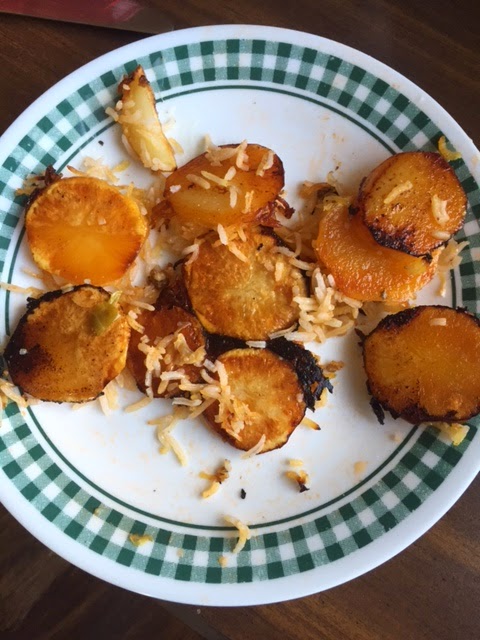
As an Iranian, most of the fried potato in my diet
is in the form of Tahdig: thin potato slices that
are placed on the bottom of the pot
in a layer of oil when rice is steam. It comes out
nice and crunchy. This is Tahdig that I made with
a slight sprinkle of zaffron
process in cells that can turn off or silence specific RNA molecules, and consequently, the proteins that they make. In the past few decades, scientists have harnessed RNAi to turn off genes that they're studying. If you add a properly-designed sequence of DNA corresponding to the gene you're interested in silencing, it will produce an RNA molecule that will trigger RNAi and then, wham!!! The protein gets shut-down.

In the context of our discussion on the Innate Potato, it's important to note that a protein from a different organism has not been added. It's not like the mythical "fish genes in a tomato". The DNA sequence that has been added is from the potato itself, which is why they've called it the "Innate Potato". Thus, this isn't a transgenic crop, where the gene added is from a species distant to the potato. It is a cisgenic crop, where the genes came from closely related species; in this case, either from the potato itself or from a wild potato native to Mexico (Solanum verrucosum).

So what proteins are silenced in the Innate Potato and why? Four different proteins are silenced and these are involved in three different traits:
  1. The first trait is prevention of potato bruising (again, this is very similar to the non-browning Arctic Apple). Potato bruising is caused when damaged cells release an enzyme known as polyphenol oxidase (PPO) which interacts with different compounds creating the black or dark grey color. In the Innate Potato, the PPO enzyme is "turned off" only in the tuber and remains on in the leaves. Currently, many steps are taken in potato farming and handling to prevent bruising, but it doesn't seem to be enough. Potato bruising costs the industry "at least $298 million annually". Keep in mind that those bruised potatoes don't make their way to the store, so that translates to a lot of food waste, too.
    The company claims that the potatoes will not turn brown for several days, compared to just 10 minutes with a normal potato.
  2. The second trait is reduction in the amount of acrylamide produced in the potatoAcrylamide is a chemical compound which is also a known carcinogen at high doses. We use it in the lab fairly frequently. When I started doing lab work, I had the annoying task of making our acrylamide solutions, since I was the lowly undergrad... Fear not, spouse! I took heavy precautions: a full mask, a full lab coat, etc. Once I got into my PhD, our lab had more funding, so we'd buy the acrylamide solutions pre-disolved. Now that I'm in industry, we buy our acrylamide lab items ready-to-use. Such is the nuisance of acrylamide that no-one wants to deal with it.
    So what's acrylamide doing in potatoes? When potatoes are heated, a chemical reaction (known as the Maillard reaction) occurs between the amino acid asparagine and sugars (such as the naturally occurring sugars in the potato). When I was discussing this article with the spouse, he knew all about the Maillard reaction because it's what causes browning in food such as meats or bread, and is not to be confused with caramelizing. He had read about it when doing research on how to cook the perfect steak (He's Texan... It's the only explanation I have). At high temperatures, such as when potatoes are put in a fryer, acrylamide also forms in the reaction. In the Innate potato, the amount of the enzyme that synthesizes asparagine has been reduced, so consequently, less acrylamide is made. The company's website claims that the Innate potato produces up to 70% less acrylamide than other potatoes cooked at the same temperature.
  3. The final trait is improvement in starch quality and potato color. I had a tough time finding a decent description of this trait and relied on information from a Q&A with one of Simplot's VPs over on Biofortified. Basically, they've reduced the amount of sugar in the potato, which can result in "consistent golden color". Their website and the Q&A say "under certain conditions", but do not explain what those conditions are so I'm a bit skeptical. I wish there was more information about this trait.
The Papers

In the first paper (which is freely available via the company's website), the authors attempt to silence 2 genes that synthesize the amino acid asparagine. They had success in greenhouse trials, but to their surprise, the field trials failed: the potatoes were really small and "cracked" (the picture in the paper is worth looking at. The taters definitely look wonky). However, the controls grew fine suggesting that it wasn't something environmental: it was the silencing of the two genes that caused these problems. They went on to do a series of experiments where they silenced the 2 genes individually. They got potatoes with quality equivalent to controls but with reduced asparagine levels by silencing just one of the genes just in the tubers/potatoes (scientists can often control what part of the plant they want to turn a gene off/on in). They managed to reduce amounts of asparagine by 60-80%.

The second paper was behind a paywall (I forgive Simplot for not publishing in an open access journal only because the paper was accepted in 2006, before open access was a popular "thing"). The paper starts by outlining that the Russet Burbank strain of potato is more pest resistant, but is seldom used because it has issues with discoloration and sensitivity to bruising. Additionally, it accumulates high levels of sugar in cold storage which, not only result in higher levels of acrylamide, but also makes french fries less golden. The paper set out to address these issues by a) reducing the levels of the enzyme that causes bruising (explained in the previous section), and b) reducing the amounts of two enzymes associated with starch formation so that fried potatoes have a more appealing hue and have less acrylamide.

As a side note, this sentence in the Materials and Methods was somewhat hilarious: "Sensory evaluations of French fries were performed by a panel of eight professionally trained experts at the optimum time of 3 min out of the fryer." Who is a professionally trained expert on French fries sensory evaluation? More importantly, how can I get that job??

The authors did a series of tests to confirm that the potatoes grown in the field actually had the physical traits they wanted. For example, when testing for bruising, they "physically impacted" the potatoes and after 2 weeks, fries were made out of them to see if they blackened (I'd LOVE to be the grad student on that project... You'd spend your time throwing around potatoes, all in the name of science :) ). They show that the modified potatoes have less acrylamide formed, and they have lots of pictures of French fries showing that the modified potatoes have more of a golden-hue to them. They also performed a few experiments showing that the modified potatoes kept their "agronomic performance": when compared to controls, they weren't more susceptible to blight, they were of the same size, and had more starch content. All in all, the paper's findings suggest that silencing of the 3 genes didn't have a negative impact and had all the desired traits.


Conclusions

So I couldn't find any papers that convincingly indicated that there's enough acrylamide in fried potatoes to be a huge concern. Additionally, no reputable organization states that acrylamide in food causes cancer in humans (here's info from the National Cancer Institute on the topic). In fact, a few studies that have examined the incidence of cancer and dietary acrylamide have failed to find any association (see here and here, and a recent meta-analysis here). Keep in mind that we eat natural toxins everyday, but not in amounts that are of concern. However, dietary acrylamide is enough of a concern to some people that all places that serve french fries in California have the ubiquitous (and therefore useless) warning stating that the location has food known to the state of California to cause cancer or birth defects (i.e. Prop 65). So it seems that this could be a potato of interest to the general public and the food industry.

Many of the usual arguments against GMOs don't hold for the Innate Potato. Here's why I think that the Innate Potato has less GMOiness (and by "GMOiness" I mean that subjective, intangible thing that makes people protest the introduction of any GMO into the market):
-It doesn't need any additional pesticides or treatments
-The sequence added isn't from a virus or bacteria that crosses the species barrier
-It doesn't have Monsantonization
-It doesn't have the DNA sequence for antibiotic resistance.
-It addresses genuine health concerns that some may have (reducing acrylamide in our diet), as well as environmental concerns (reducing food waste)

So I'm not sure what argument people would have against the spud. To be honest, it's not one that I'm terribly interested in as a consumer, because I haven't read anything to suggest that acrylamide in our diet is at levels that cause harm, and we don't waste too many potatoes in our family. But I'd buy them if they weren't much more expensive because they're less wasteful. I do think that the food industry should adopt them because they could make a genuine impact on reducing food waste from the farm to the store (and also because those ridiculous Prop 65 warnings annoy me).

I'm also very curious to see how they're going to handle the labeling of the potato. The potato is designed to be nutritionally different from other potatoes, so it is not substantially equivalent. As you may know, the reason why genetically modified ingredients are not labeled in the United States is because they are nutritionally equivalent to their non-genetically modified counterparts. So technically, the Innate potato should be labeled. Will they just list "Innate Potato" as an ingredient? It'll be interesting to see how this plays out.

That's my take on it. Please leave any questions you may have below! And remember to subscribe to the blog so that you don't miss any posts!

ADDITION May 29th, 2015: Here's a great and recent Q&A with a Regulatory Compliance Specialist from Simplot about the Innate Potato.

Saturday, December 27, 2014

The Life and Times of BioChica as Told Through GMO Legislation Around the World

As you may know, I'm not American. The spouse and Mr Chubby-Cheeks were born in the US, whereas I was born in Canada. But that's not the whole story: my parents are Iranian who fled the Islamic revolution in 1979 due to their religion, I was born in Canada, raised in Venezuela (which is why I've written about dengue), and I actually met the spouse while working for a year in Israel. I don't know where we'll end up: probably wherever I get decent job offers. Until today, my blog has been very US-centric, but this post will have a more international angle.

This article is about different nations' laws and regulations surrounding GMOs. A common argument that you may read about the dangers of GMOs is how different countries around the world have banned them or have legislation around them. Here's an example from the Non-GMO Project's website:


"Most developed nations do not consider GMOs to be safe. In more than 60 countries around the world, including Australia, Japan, and all of the countries in the European Union, there are significant restrictions or outright bans on the production and sale of GMOs."

You can see how this can lead to a conspiracy theory with the following narrative: GMOs aren't properly tested in the United States. In Europe, scientists have discovered that GMOs can be harmful and they've been banned. But in the US, the FDA is in bed with Monsanto, which is why we're eating these toxic poisons and we aren't being told the truth.

To quote Professor Higgins, it's "so deliciously low, so horribly dirty!" Hence the appeal of this particular conspiracy theory. 

In terms of "bans", there's actually only one country in the world that has an outright ban: Kenya. Recently, there have been calls to lift the ban due to farming losses. 

All other countries have laws and regulations surrounding biotech crops. That includes the United States. There's a reason why you can't just make a transgenic crop and have it sold in stores the following season. So, for the rest of this article, I'm going to look at laws surrounding GMOs in 4 different countries: Canada, Israel, Venezuela and Iran. 

It's the "The Life and Times of BioChica as told Through GMO Legislation Around the World". 

GMO Legislation in Venezuela, Iran, Israel, and Canada
Venezuela: Venezuela's story about GMOs is fascinating (in my biased opinion). To understand Venezuela's stance on GMOs, a bit of a background is needed: Hugo Chavez was elected as Venezuela's president in 1999 and remained in power till his death in 2013. He led a "socialist revolution" that took a very hard anti-American, "anti-imperialist" stance (whatever that means...). As such, much of the policies in the country reflect this attitude. In 2002, Chavez passed a "seed law" which included the establishment of an institute that would oversee the testing, development and research of transgenics. However, in 2004 Chavez made the sudden decision of cancelling a contract with Monsanto, which was about to plant 500,000 acres of GM corn. There was no legal ban, yet no one has planted transgenic crops in Venezuela ever since the incident, which was paired with Chavez's public statement: "the people of the United States, of Latin America and the world, should follow the example of Venezuela and be free of transgenics.”

However, Venezuela relies very heavily on imports and food shortages have become increasingly common the last decade and have hit an all-time high in the last 1-2 years. Two of Venezuela's biggest import partners are Argentina and Brazil, who also happen to be global leaders in the number of acres dedicated to transgenic crops. Despite the fact that Venezuela needs a dramatic increase in food production to meet the demands of its growing population, it plans to pass a law that will straight-out ban growing GMOs.

Here's where it gets interesting. This story comes from Dr Felix Moronta (@morontafelix) who generously gave me permission to translate the story from his website. A recent study published in a regional journal examined 12 Venezuelan corn growers in 2011: 10 were government owned and 2 were privately owned, and these represented 70% of the corn growers in the country. Using tests that searched for the transgenic protein as well as for transgenic DNA, the authors were able to determine that a government owned company was actually growing transgenic Bt-corn (for more info on Bt-corn and transgenic proteins, please see previous post). The authors were also able to determine that the crop being grown carried a patented trait (transgenic event TC1507). The journal article, as well it's summary by Dr Moronta, ask the government to 'fess up and to clarify their stance. As Dr Moronta eloquently outlines, the government is banning growing and doing research on GMOs, yet they import tons of GM grains and goods, AND they're growing them on the DL. Makes no sense...

I can only conclude that Venezuela's position has NOTHING to do with the safety of transgenics. If it was legitimately about safety, then there would be laws surrounding their import. In reading articles and news stories, the sense that I get is that Venezuela's ban on transgenics seems to be due to 1) sticking it to "imperialist" big-Ag. 2) striving for food sovereignty and 3) removing GM seeds from the equation so that small farmers can be successful in the socialist revolution. However, there's no evidence that the moratorium on growing GMOs has contributed to any of these goals given the devastating food shortages.

Iran: Unfortunately, I can only read Farsi up to a 1st or 2nd grade level at best, so most of this information came through translated material. Only one transgenic crop has been approved for cultivation in Iran: rice. It makes perfect sense: rice is eaten every day in an Iranian household. According to my dad, it's not real food unless it has rice. A form of Bt-rice was approved in 2004, but when President Ahmadinejad took office in 2005, his administration "decided against the release of GM crops". It's important to note that Iran was the first nation to commercialize transgenic rice and this article outlines how Iran had hoped to quickly follow this success with additional crops. There was no ban or legislation against GMOs. Apparently, the decision to drop the commercialization of GMOs was due to the lack of a "biosafety law in the country, and 2) lack of harmonization among different stakeholders (Ministry of Agriculture, Environmental Protection Organization etc.)". However, the Iranian government now feels that a decent biosafety law is now established, and the law's text states that the government should facilitate the release, research, commercialization, etc of GMOs.

Makes sense:  I don't think that international companies based out of the US would be allowed to trade with Iran due to the current sanctions that are in place, so Iran's probably trying to figure out a way to boost food production. Mmmmmmmm... Tahchin made with GM rice... Drool...

Israel: Before I start this section, I've got to tell you something about Israel. It's a desert. It's hot. It can be really dusty. But despite all this, the local fruits and veggies are spectacular (here's Wikipedia's article on agriculture in Israel). There are no GMOs commercialized in Israel, even though the country is a hotbed for research into GMOs. This comes as no surprise considering the interest that the nation has in drought-resistant crops. Apparently, this is due to the fact that a very large portion of Israel's agricultural exports head to the EU, where they are slow to approve transgenic crops for import and have labelling laws as well. As such, growing GMOs might have financial repercussions if the EU were to decide to be more wary of Israeli produce.

I couldn't find the actual text of any laws. If anyone out there knows where I could find them, please let me know.

Canada: This database lists a slew of GMOs that have been approved for cultivation in Canada. Health Canada's website has a great description of the regulatory process to gain approval for cultivation and/or sale of a new crop. When someone is interested in submitting a new crop, they're encouraged to consult with Health Canada beforehand to determine if there are any potential red flags. Then they submit the paperwork and undergo a scientific assessment. Health Canada can request additional information, will summarize it's findings, prepares a ruling, and then posts the information on the Health Canada website. It seems very similar to the process in the US under the FDA.


What struck me when I was doing research for this article, is how little the science of GMOs were mentioned. I didn't find any evidence to support the Non-GMO projects' statement that "most developed countries do not consider GMOs to be safe", albeit I only looked into 4 countries for this article. However, these 4 countries are extremely diverse in terms of economic status and development, as well as their relationship with the US. Despite these differences, I think that the common thread in this article seems to be the fact that laws for and against GMOs are economic or political in nature, and have little to do with safety. If it were genuinely about safety, then they'd ban the import of GMOs and join the ranks of Kenya.

Happy New Year y'all! Or, Feliz Año!

Sunday, October 5, 2014

Jeopardy Category: "Things that are often blamed on GMOs, but are much broader in scope"

In my discussions about GMOs, I've come to the realization that many of the issues that are raised are not about GMOs at all, rather, are about modern agriculture. Of course, GMOs should be part of the discussion because these crops are an important component of our food, but it's disingenuous to believe that non-GMO and/or organic farming don't cause the same problems and these forms of farming shouldn't be part of the conversation. In the two weeks that I've been working on this while Baby Boy sleeps, two similar articles have been very recently written, supporting the hypothesis of multiple discovery :) One is an excellent piece by @savortooth in Grist, and the second is a thorough analysis of superweeds by @realfoodorg

Before I forget, I just added a subscription to the blog, in case you want to get an email notification when a post gets published.

So here we go: BioChica's List of "Agricultural Issues that are Often Blamed on GMOs". It would be awesome if I could have presented this with a Family Feud animation... Let's do it Jeopardy-style!!

1) Q: This issue is often attributed to GMOs, when critics state that farmers shouldn't be forced to buy seeds. A: What are patented seeds/crops?

As discussed previously, many plants are patented, including decorative plants. Plants generated through traditional methods, including mutagenesis, take years of research to produce and breed, and patents are the only way to safeguard those investments. The author of this Huffington Post article interviewed several farmers and asked them about their seed choice, and the overall conclusion is that farmers can select what they'd like and actually have a lot of options before them, many of which are from companies such as Dow, Monsanto, and Syngenta. If farmers are choosing to grow patented crops, perhaps it's because they like the products (see this excellent post from The Farmer's Life on this topic. This article from GLP, written by a farmer from Iowa, walks readers through the decision process of selecting a seed).

2) Q: This issue is often attributed to GMOs, when critics state that GMOs should be labeled so that consumers can avoid harmful toxins. A: What is the use of pesticides?

Glyphosate-resistant crops (the active ingredient in Round-Up) are among the more popular genetically modified plants. However, even glyphosate use isn't limited to GMOs; it "is utilized in a wide range of applications including weed control in vineyards, olive groves, fruit orchards, grass pastures, forestry, parks, gardens and underwater usage in rivers and lakes". As mentioned in previous posts, organic farming practices do not exclude the use of pesticides, so if consumers are advocating for GMO labeling so that they can avoid pesticides, they've been misled. In fact, none of the so-called "dirty-dozen" fruits/veggies are GMOs (keep in mind that the FDA recommends washing your fruits and veggies under running water as an effective means of removing residual pesticides. In Venezuela, we used to wash and soak our raw vegetables for salad in a vinegar solution, but I think we started that practice during a cholera epidemic...).

3) Q: This practice is often attributed to GMOs, when critics state that growing vast areas of crops without any rotation leading to issues including the depletion of nutrients from the soil and crop-specific pests. A: What are monocultures?

Wikipedia defines monoculture as the "practice of producing or growing a single crop or plant species over a wide area and for a large number of consecutive years". A legitimate issue is the spread of diseases, which is actually what led to the Great Famine due to the potato blight. The idea is that by rotating crops (i.e., planting different things every year), crop-specific pests will die out. But the issue is very far from being a GMO-specific problem. Our house in Venezuela faced a huge valley where sugar cane was grown and was owned by the local sugar-cane refinery. They had 3-4 sugar cane harvests each year and would burn the fields between harvests. Huge strands of ash would fall from the sky and we used to call it "lluvia negra" or "black rain". Field burning is not only used to make sugar cane harvesting easier, but it is also used for pest control. In the +20 years my family lived there, sugar cane was the only crop ever grown, so that giant swath of land was the embodiment of a monoculture. I've thought about this specific example quite a bit, and I'm not sure what the appropriate solution would be. Why would a sugar refinery grow anything other than sugar cane in South America, so how would they rotate their crops? Leasing the land? Many consider monocultures to be a symptom of corporate farming where are food is owned by large, multinational corporations, but in fact, 96% of farms in the US are family farms. Definitely a complex issue, but reducing it a GMO-specific problem doesn't capture the extent of this global issue.

4) Q: These organisms are touted as examples of how GMO-pesticides are failing. A: What are pesticide-resistant insects? An equally valid answer is: What are superweeds?

Superweeds and pesticide resistant insects are examples of evolution in action, and as discussed in question 3, are often a result of monocultures. If you're an avid fan of X-men, you'll know that the very first line in the movie is "Mutation: it is the key to our evolution. It is how we have evolved from a single-celled organism into the dominant species on the planet. This process is slow, and normally taking thousands and thousands of years. But every few hundred millennia, evolution leaps forward." Such a great movie... But I digress!

Given the fact that the life cycle of a bug or a weed is much shorter, particularly when we consider them pests and try to squash them, we don't have to wait thousands of years to see them evolve. If a plant or an insect gains a mutation that gives them a selective advantage (in this case, the ability to survive in the presence of a pesticide), then it will survive and spread. We see the same thing happening with antibiotic resistant bacteria, and of course, viruses. Every year, the formulation for the flu vaccine changes because the little suckers evolve to try to beat us. With HIV, patients use drug cocktails, because the odds of the virus becoming resistant to a variety of different drugs is much, much lower than the odds that it will gain resistance against a single drug.

Again, both issues are not specific to GMOs. This article gives plenty of examples of superweeds that evolved from the use of pesticides in non-GM crops and points out that the issue is not specific to GMOs, yet it's a convenient narrative for GMO opponents to exploit. There's a whole database dedicated to tracking pesticide resistant weeds.

Even handweeding can cause superweeds. This article suggests that handweeding in rice fields in Asia has led to a superweed that closely resembles rice, a phenomenon known as "crop mimicry".

A strategy for beating superweeds is to create crops that are resistant to 2 pesticides (BTW, pesticides is the umbrella term for insecticides, herbicides, fungicides, etc. They all eliminate pests). The idea is that the odds that a plant will naturally evolve to become resistant to 2 herbicides is pretty low (same basic strategy as the HIV drug cocktail). Dow Agro has the Enlist Duo product line, which allows for the use of two pesticides (glyphosate and 2,4-D choline). They're currently waiting for the combination-pesticide to get approved by the EPA. However, there are others that argue that this will also be a short-lived strategy (see last section of this great article from NYT - thanks to @wyoweeds for pointing it out).

When it comes to pesticide resistant insects, farmers generally have insect refuges if they're growing insect-resistant crops (such as Bt-crops, which are resistant to worms). This requirement is outlined in their Stewardship agreement (explained here). Basically, a small area next to the field with the GM crop is supposed to be planted with non-GM seeds. The idea is that if an insect develops resistance to the pesticide, then it will mate with a "normal" bug because they'll be found in abundance in close proximity. Their babies will be "normal" babies, not mutants, so they'll eventually die because of the pesticide and the mutation won't spread too broadly. Here's a diagram outlining how the refuge works (it might bring you flashbacks of Mendel's peas :) ). The worms in blue are the mutants that are pesticide resistant. The red ones are "normal". The example on the left is a farm where there's an insect refuge. The one on the right doesn't have a refuge.


However, Bt-resistant bugs have emerged, partially because some farmers do not grow insect refuges. The onus is on the farmer to abide by their contract, but I do think that biotech companies could do a better job enforcing this. If they have the resources to police seed saving, then they could enforce the refuge requirement as well, particularly since it has a bigger impact on their bottom line in the long term. But even with refuges, it's a numbers game: it's only a matter of time before a pesticide-resistant insect emerges.


All of these questions are legitimate issues and I hope to investigate each one. I imagine that they require coordinated efforts to address, including farmers, scientists, and biotech companies at the table. Reducing it to a GMO-specific issue is not only disingenuous and misleading, but it also deters efforts of finding real solutions.

Monday, August 11, 2014

Learning about GMOs: A reflection on year one

It's been over a year now since I started learning about GMOs and writing this blog. I've learned so much and am humbled every day by how much I have yet to learn. But as I look back and reflect on the knowledge gained, I also see that it's quite a bit, particularly considering all the life-events that have taken place in parallel. I thought that I'd share with you my learnings about GMOs that have surprised me the most.

Some of these were on the level of an M. Night Shyamalan movie-twist for me. Some are not even about GMOs, but just about agriculture and our food in general. Yeah... I kinda feel embarrassed about not knowing a few on the list... Don't judge me!

Corn. But without the syringe in it to depict that it's a GMO,
it's not really scary.
From Wikimedia Commons
1) The vast majority of fruits and vegetables are not transgenics. Before starting this blog, I thought that most of what we ate were transgenic crops, meaning that they had a gene/protein from a different species. I had heard so much about tomatoes with fish genes and strawberries that would never freeze that I just assumed that all that stuff was out on the market. Every time I picked up a fruit in the supermarket that was particularly large, I thought to myself "huh... that's got to be a GMO". You know those grapes that are the size of a tennis ball, and squirt juice everywhere when you bite into them? Every time I ate one, I'd close my eyes and thank the mysterious GMO gods for that sweet delicious nectar. Little did I know that none of these fruits were GMOs. They were genetically modified in the sense that they had been bred and selected to have optimal sweetness and size through cross-breeding. But they weren't transgenic organisms. There are only a handful of transgenic crops such as corn, soy, or cotton. The short list can be found in this database (note that you have to select the type of approval to determine if the GMO has been commercialized or not).

2) Organic food production uses pesticides (EDIT: Not all organic food production and only pesticides that are permitted under the USDA's organic label and approved by the EPA. Which is also true about conventional farming). This one blew my mind. I couldn't believe it! I thought that by definition, organic food production did not use pesticides. Not only that, but some of the pesticides used are more toxic than those applied in conventional farming. The difference is that the pesticides used in organic farming are not synthetic. No idea why that is better... Here's a list of pesticides approved for use in organic farming.

3) Many plant traits are developed using mutagenesis. And can be labeled "Organic". This one melted my brain and the spouse still doesn't get it altogether. Mutagenesis is the use of radioactivity or mutating chemicals to create random mutations in plants, and selecting those with the desired trait (here's my blog post with an overview of various papers, and here's the Wikipedia article on the technique). This article from the New York Times lists wheat, barley and even ruby red grapefruits as crops generated through mutagenesis. Imagine that!! The delicious, organic, grapefruit from my farmers' market was developed using radiation to randomly create mutations, and somehow that's less scary than a GMO. Why the organic food movement isn't fighting for their labeling seems hypocritical, and the fact that they can exist under the umbrella of the organic label is astounding. Again: Mind. Blown.

4) There's lot of peer reviewed research on GMOs, both publically and privately funded. I mean a LOT. I remember the first time I typed in MON810 into PubMed (a database hosted by the NIH), I got over 100 hits. That's 100+ studies that have looked into some aspect, such as identification or safety, on a single seed/trait (MON810 is Monsanto's Bt corn) Since it's a database search, let's assume that some of them are only loosely related to MON810. But even if 50% are discarded, that still leaves us with 50+ studies on a single trait/seed. In a Q&A with the founders of Biofortified.org, they mentioned that the most common misconception about GMOs is that there aren't any studies. Although I didn't think that there were no studies whatsoever, I was blown away by the sheer number/volume of studies, many of which are publicly funded.

Don't get me wrong: just because I haven't read any credible studies suggesting that GMOs pose a health risk does not mean that we should stop studying them, both in terms of technical methods in their generation, as well as safety. Go ahead. Go to pubmed and type in MON810 :)

5) Types of traits used to generate GMOs generally benefit farmers, not shoppers. What I mean is that there aren't many GM crops where the trait introduced was selected because it would make me want to buy it in the grocery store. There are several crops in the pipeline designed for me, such as non-browning apples or soy that has healthy oils (my post about the non-browning apple is here). But at the moment, most crops are designed to benefit farmers, such as Bt crops which help farmers reduce the amount of pesticides sprayed to fight worms, or Glyphosate resistant crops, which help farmers fight weeds using glyphosate (my post about glyphosate is here). I have yet to write on the topic of whether GM crops lead to decreased pesticide use, so I have a lot to learn on this topic. 

It's important not to misinterpret this point: when costs decrease for farmers, the end consumer pays less. But this is an indirect benefit for the shopper. It'll be interesting to see if crops that directly benefit shoppers will impact their perspectives on GMOs.

6) The amount of misinformation surrounding this topic is staggering. And depressing. It ranges from the subtle, where statements are simply taken out of context or the complete findings of a paper are not provided, to outright lies. I expected that there would be misinformation, but I guess I was pretty naïve and didn't think it would be THAT bad. But it's downright awful. For example, the Institute for Responsible Technology's website states "The only published human feeding experiment revealed that the genetic material inserted into GM soy transfers into bacteria living inside our intestines and continues to function." The paper which this statement is based off of actually says "it is highly unlikely that the gene transfer events seen in this study would alter gastrointestinal function or pose a risk to human health" (this topic was reviewed in this post). This is a subtle little white lie, when you contrast it with the downright deceptive (and dangerous) statement that GM insulin poses a health risk (Dr Kevin Folta reviewed this topic here).

I still have a tough time understanding why certain organizations would use such deceptive means to attack a technology. I think Dr Neil DeGrasse Tyson said it best in his recent Facebook post on the topic of GMOs:  "If your objection to GMOs is the morality of selling non-prerennial seed stocks, then focus on that. If your objection to GMOs is the monopolistic conduct of agribusiness, then focus on that. But to paint the entire concept of GMO with these particular issues is to blind yourself to the underlying truth of what humans have been doing -- and will continue to do -- to nature so that it best serves our survival. That's what all organisms do when they can, or would do, if they could. Those that didn't, have gone extinct extinct. In life, be cautious of how broad is the brush with which you paint the views of those you don't agree with."

I was surprised at how many people distrust GMOs because of Monsanto. That's not a good reason for distrusting a technology with broad applications. It's like saying that you don't trust computers because of Microsoft. But conventional food growers buy Monsanto seeds too, and Monsanto doesn't have a monopoly on GM technology. So what do life saving technologies, such as insulin, have to do with Monsanto? What about Golden Rice? What about bananas designed to combat nutritional deficiency in Uganda? I was taken aback at how vehemently these are opposed, just because of the Monsanto-boogie-man.

7) Transgenic seeds are not sterile. I was certain that transgenic seeds could not be replanted, even if a farmer wanted to. I was dead wrong. When farmers buy seeds from a biotech company such as Syngenta, they sign an agreement, and they are not allowed to replant seeds. However, the seed is not sterile or unviable. (The topic of replanting seeds and terminator seeds was covered in my blog post here).

8) Peer review doesn't mean anything these days. Even if you don't factor in the issue of predatory or pay-for-play journals, peer review needs a new paradigm (check out this article for a great expose of predatory journals). In an article that sounds an awful lot like a story about drug trafficking, a "peer-review ring" got recently busted for abusing the academic review process. Although there's a growing number of ways to share concerns or criticisms about a paper, it hasn't led to a change in the review process. There's a whole website dedicated to covering stories about peer reviewed articles getting retracted.

Setting aside the reason behind errors in scientific journals, be they deliberate or not, there needs to be a positive feedback loop.

Personally, I think that scientists in the private sector should be able to provide feedback to the reviewers and editors about one of their products. They provide press-statements anyway once the paper's been published, so wouldn't it make sense to have their feedback and criticism in hand as a non-voting voice in the review process. Do you know who would read every single sentence several times, including the Supporting Materials section, in a paper that suggests that a GM trait is harmful? The scientist who made it and the company who commercialized it. If anyone is going to identify a flaw in a paper, it will be them. I don't think that their statement should carry weight in the decision of whether or not a paper should be published. But I think it will make the reviewer's job easier to have their observations in hand.


For the final point, I interviewed the spouse to find out what had surprised him most from all our discussions:

"9) That the greatest tool in combating misinformation on scientific topics is for scientists to be better communicators and to better educate the public. I was surprised to see that the link between the public's superstition regarding GMOs is directly related to their education or lack thereof. If we had better scientific literacy or better science education, it would cause less freak-outs. As a non-science person, my AHA!-moment came when I finally understood how eating a strawberry-fish smoothie would be same thing as eating a strawberry with a fish gene in it, because we can process and digest proteins from both species. That's such a small-little thing, but it created such a mental barrier."

Well, there you have it. Feel free to comment on the things that have surprised you most on this topic.

Tuesday, April 1, 2014

Monsanto, Patents and Seeds - Part 3

From Wikimedia Commons
It's a Lazy Sunday afternoon. The kid is napping after I caved and gave him the "chupón". And since the Chroni-what!-cles of Narnia isn't playing, it's a perfect time to research patents and lawsuits! YAY!

This is the last post in this series. Previously, I covered agreements between Ag companies and farmers, as well as Terminator gene technology. I also wrote about what is arguably the most famous lawsuit that Monsanto has brought against a farmer (Monsanto vs Schmeiser). Throughout this whole time, I've been investigating the claim that Monsanto sues farmers whose fields get inadvertently contaminated with its seeds.

In my search for a case that Monsanto may have unfairly brought to a farmer, I came across a story that I think seals the deal on this whole question. In a court case from 2013, known as OSGATA vs Monsanto, a coalition of organic farmers, seed distributors and anti-GMO organizations tried to invalidate 23 of Monsanto's patents. The case's background states that these groups do not want to use/sell transgenic seeds or glyphosate. However, their concern is that if they do become contaminated "they could quite perversely also be accused of patent infringement by the company responsible for the transgenic seed that contaminates them".

The intro to the court document explains that in 2011, Organic seed growers went before a judge in the Southern District of New York stating that they had started growing conventional produce since the threat of contamination from GMO was so high. They had to take expensive precautions such as creating a buffer zone, so that they wouldn't be sued by Monsanto. One grower testified to the fact that the only reason why he grows conventional seeds is the threat of a lawsuit from Monsanto, and if this threat didn't exist then he would go back to growing organic seeds. So, these growers requested Monsanto to “expressly waive any claim for patent infringement [Monsanto] may ever have against [appellants] and memorialize that waiver by providing a written covenant not to sue." The main issue was the fact that Monsanto's promise to never sue a farmer whose fields have been (unknowingly) contaminated by their seeds was a statement on their website. It wasn't a law. It wasn't something that they had sworn to under oath. It was just something on their webpage which, at the end of the day, could be false advertising or a PR gimmick. In back-and-forths between lawyers, Monsanto wrote that they have no reason to go after farmers for low level contamination because there's no financial incentive, and that if the motives of the growers/farmers is true (i.e. that they don't intend to use/sell transgenic seeds), then their fear of a lawsuit is unreasonable. The judge threw out the case based on the fact that "these circumstances do not amount to a substantial controversy and . . . there has been no injury traceable to defendants". All this was just in the 2011 district court case.

The case then goes to the United States Court of Appeals for the Federal Circuit, whose court documents are the ones I'm summarizing. The discussion states that “jurisdiction generally will not arise merely on the basis that a party learns of the existence of a patent owned by another or even perceives such a patent to pose a risk of infringement.” It goes on to state that the appellants have to demonstrate that there's a substantial risk that harm may occur or that they have to go through expenses/costs to mitigate those risks.

Now, here's what blows my mind: the Organic growers/seed distributors (OSGATA) concede that Monsanto has never threatened to sue them. OSGATA states that their fear is based on the fact that Monsanto has taken 144 growers/sellers to court and settled 700 additional cases out of court. Monsanto argues that none of these cases have been due to inadvertent contamination.

So OSGATA was not able to demonstrate that Monsanto had ever sued due to the inadvertent use of their seeds. Kuh. Ray. Zee.

However, the court conceded that the way patent laws are written, that using even a small amount of a patented material without authorization could constitute patent infringement. For the purposes of the appeal, the judge proceeded with the ruling based on the assumption that inadvertent contamination constitutes patent infringement, and that inadvertent contamination was inevitable (Monsanto also acknowledged that cross-contamination was a possibility).

The record states that this whole argument is moot if Monsanto really doesn't intend to sue. Apparently, the Supreme Court has recognized that a covenant not to sue nullifies a controversy between parties. Monsanto has a written policy on their website against inadvertent contamination and the court documents record Monsanto's position on this whole argument. Monsanto and the organic growers agree that "trace amounts" means approximately 1% contamination. The ruling states that although this is not a covenant not to sue, it has a similar effect and constitutes a judicial estoppel (I had to look this one up on Wikipedia. It means that you can't contradict something that's been established as truth by yourself or others).

OSGATA stated that Monsanto's refusal to provide a covenant had a "chilling effect" and that farmers/growers would have to forgo the activities that they would have otherwise liked to pursue. The judge stated that a "chilling effect" isn't something tangible, that the appellants need to have something more specific than that, and that the future harm described is speculative and hypothetical.

The court ruling ends with this statement in the concluding paragraph: "the appellants have alleged no concrete plans or activities to use or sell greater than trace amounts of modified seed, and accordingly fail to show any risk of suit on that basis. The appellants therefore lack an essential element of standing."

The organic movement considered this case to be a partial victory because they now had in writing that Monsanto would never sue them for inadvertent contamination. But I'm not sure I understand this... I think you'd have to be so paranoid about what Monsanto might do that you'd be willing to incur massive legal fees to make sure that a hypothetical never happens, even when you can't produce proof that it might.

So how is it that this myth about Monsanto suing farmers still circulates? Based on the 30 minutes that I saw from the movie "David vs Monsanto", you could believe that Monsanto plants evidence and works with testing companies to ensure that you your testing is >1%. You could believe that the 700 court cases that were settled out of court were against farmers who were inadvertently contaminated, but just didn't have the money to fight Monsanto in court. You could believe that all the court cases had judges and witnesses who were paid off by Monsanto. You could also believe that Monsanto is really a modern mafia who will break your kneecaps if you don't buy their seeds.

My perspective on this is that Monsanto is a huge company that has better things to do than to sue the small farmer who inadvertently uses their seeds. Think about the negative publicity that it would mean for them. From a practical perspective, it would probably represent a greater expense to them in legal fees than what they would recoup through the settlement or court case. From a paranoid perspective, they're too busy collecting the teardrops from orphaned field-working toddlers for use in the GMO creation process.

___________________
Edited on Nov 6th, 2015 to clarify that the OSGATA case was considered a partial victory by organic food advocates, not a complete victory. See comments.

Sunday, March 16, 2014

David vs Monsanto - Part 2 of "Patents and Seeds"

File:Brassica rapa (7490648454).jpg
Canola Fields
Image from Wikimedia Commons

This is part 2 of a multi-part series on Patents and Seeds. Previously, I covered the basics, including agreements between farmers and seeds suppliers, as well as the Schwarzeneggar gene (i.e. Terminator). This week, I'll mostly be writing about lawsuits between farmers and the patent holders on seeds.

According to Monsanto, they have never sued a farmer who has inadvertently used their seeds (this is a statement whose validity I'll explore throughout the series). They have, however, sued farmers who have allegedly replanted Monsanto seeds with knowledge of what they were doing. The most famous of these cases is against Canadian farmer Percy Schmeiser, whose story is now the subject of a documentary made by Journeyman Pictures "David versus Monsanto". This movie production company is also behind the documentary "Designer Babies & Gene Robbery", so I'm not sure how unbiased their productions may be. I actually watched a good chunk of the movie (which is just over 1 hour and freely available here) and my comments on it are below.

Anyway, here's a summary of the case as best I could tell based on court documents (see Section II entitled "Salient Facts" in the Canadian Supreme Court Case and the Federal Court Case): Mr Schmeiser had been a farmer in Saskatchewan for over 50 years (if you haven't been, you should go. Saskatoon is lovely). He grew canola, among other crops. He saved seeds from a portion of his field every year for planting the following year. In the mid-90's, a bunch of his neighbours switched to Round-Up Ready (RR) canola. He never purchased a license to plant the crop. In 1998, testing revealed that >90% of his 1000 acres were Round-Up Ready. The Federal court case states that Mr Schmeiser did not deny the presence of GM canola on his field but he claims that he did not deliberately plant or deliberately cause the planting of the seeds (see paragraph 11 of the document). Mr Schmeiser additionally stated that he had suffered substantial damage and loss due to the GM canola, because his own strain that he had been developing over the course of many years got contaminated. Additionally, he argued that in order to have infringed upon the patent, he must have sprayed his fields with Round-Up, and he claims that he did not do this. Finally, Mr Schmeiser's defense team argued that by releasing the gene into the environment in an uncontrolled manner, Monsanto had lost or waived their rights to an exclusive patent.

So Mr Schmeiser found out that there was Round-Up Ready growing on his field in 1997. He routinely sprayed the area around power-poles and ditches, and he noticed that a portion of the plants he had sprayed had survived the spraying, i.e. were Round-Up resistant (keep in mind that Round-Up is used to kill grass and plants - see previous post for more info on Round-Up). So he then conducted a test. He sprayed 3-4 acres of field along the roadside with Round-Up, and he noticed that about 60% of them survived, with a higher density along the roadside. This road is used by his neighbours for delivery/transport of canola seeds. He then used the seeds from that field, including the swath tested for Round-Up, to plant the following year's crop.

Mr Schmeiser's canola was tested by a private firm who conducts random audits of canola crops. The farms are either identified by Monsanto among their licensed farmers, or they receive anonymous tips/complaints. The private firm received an anonymous tip from someone who claimed that Mr Schmeiser was growing Round-Up Ready canola, when he didn't have the license for it.

Seriously... Wouldn't this make a fantastic whodunnit movie?? I can just imagine Clint Eastwood as Mr Schmeiser. And that anonymous tip would be left by someone who's face you can't see and is muffling their voice with a handkerchief, and later on in the trial you recognize the handkerchief sticking out of the Monsanto lawyer's pocket (played by Kevin Spacey). But the next-door neighbour also has the same handkerchief, so who was it??? But let's continue investigating this fascinating saga!!

Between 1997-1998, a series of samples were taken and tested. Some were by court order, but the first series were just from road-side samples (allegedly taken without trespassing, although this is heavily contested in the documentary). The samples showed from 0-98% Round-up tolerant canola. In 1999, Mr Schmeiser was advised to buy new seeds, since the lawsuit had started.

The judge in the Federal Court Case wrote that Mr Schmeiser's argument that Monsanto cannot control their patent/products defies all evidence, including the fact that Monsanto tests crops/fields, and removes "plants from fields of other farmers who complained of undesired spread of Roundup Ready canola to their fields." Two farmers testified that they had called Monsanto to have unwanted crops removed from their field, which had been done (in the documentary, Mr Schmeiser said that all the witnesses had been paid off by Monsanto). The judge also stated that Mr Schmeiser himself admitted to have kept seeds that had been shown to be Round-Up Resistant for replanting. The judge agreed with expert testimony that the wind/birds/bees alone would not account for the high concentration of GM crop found on the field, therefore, the patent had been infringed upon. He dismissed Mr Schmeiser's claim that in order for Monsanto's patent to be infringed upon, it would have required his fields to be sprayed with Round-up.

When it came to the all-important topic of money, the judge took middle ground. He threw out Monsanto's claim for exemplary damages. Monsanto was also seeking $105,000 representing the profit that Mr Schmeiser made on Monsanto's seeds/patent. The judge said that this was too high and asked for Mr Schmeiser and Monsanto to agree to a mutually beneficial amount within a given time period.

That's the Federal case. In the movie version that I'm writing in my mind, there's a fictional character (Mr Schmeiser's daughter) played by Emma Stone. She's a sassy, high-strung girl who always speaks her mind, and oddly enough, her lines in the movie sound a lot like my opinion. At some climactic point in the movie, she turns to her dad and says "Seriously Dad? You replanted those seeds and you're going to put up a fight? Why not just settle?? Do we really need this?"

But somehow, Clint Eastwood, aka Mr Schmeiser, keeps fighting and takes it all the way to the Supreme Court of Canada. Cut to a screenshot of Parliament Hill with the Canadian flag flying, and the tulips in full bloom. Ottawa's a beautiful place if you haven't visited. You should go. And yes, you're all thinking it so let's just get it out in the open: I'm a shill for Travel Canada :)

So what happened at the Supreme Court? The ruling was in favor of Monsanto, but when you read the court document, quite a few of the judges wrote partially in favor of Mr Schmeiser. The word "partially" is important here, because they didn't agree with all his arguments. The biggest issue that the judges had was whether or not higher life forms are patentable. Mr Schmeiser's team had argued that the patent was over the gene and the seed, not over the plant because plants are not patentable as higher life forms. Mr Schmeiser had ultimately "used" the canola plant and not the seed (at least I think that's what the court documents say... All this legalese is pretty new to me). A few of the Justices agreed with this argument, but not the majority. Ultimately, the majority of the Justices ruled that Mr Schmeiser had infringed on the patent by keeping and replanting the seed.

To better understand Mr Schmeiser's point of view, I watched the documentary. Actually, I only watched 30 minutes of it, because so much of what was said contradicted the official court documents. Within the first 5 minutes, Mr Schmeiser says (I transcribed the following quote from the movie): "This is what the judge ruled. Number One: If you are contaminated against your wishes by Monsanto's GMOs, you no longer own your seeds or plants, they become the ownership of a corporation, in this case Monsanto. He also ruled we were not allowed to use our seeds or plants again. He also ruled that all our profit from our 1998 canola crop goes to Monsanto."  Mr Schmeiser's point of view is that Round-Up resistant canola was introduced without much testing and that government officials were blinded by Monsanto's promise of better yields and more nutritious crops (which isn't factual, since Round-Up Ready's whole premise is that it is nutritionally equivalent). Mr Schmeiser also stated that he had developed his own strain of canola, which had taken him 50 years to develop, and that Monsanto's contamination of his fields destroyed all his work and effort (his claim to this unique strain was also in the Federal court case). I have to be honest: if you like conspiracy theories, you'll be drooling throughout this entire film. It's a goldmine. The documentary also interviewed a few other farmers, but I can't comment on their cases since I haven't read their court documents.

There are quite a few misleading "facts" in the documentary. In the 30 minutes that I watched, not once did it mention that Mr Schmeiser had replanted the Round-Up Ready seeds with full knowledge of what they were. It makes you doubt the awesomeness of his own canola strain. In the court documents that I read, no where did it state that if a farmer's field is contaminated against his wishes, then the seeds/profits go to Monsanto. If this is in a separate court document or perhaps in a section of the proceedings that I glossed over, it would be great if someone could send it to me. The documentary fails to address the laws surrounding patents. The fact of the matter is that Monsanto's seeds are patented, and if you're a farmer and you don't like Monsanto's business practices, then you don't have to plant Monsanto's seeds.

Well, I'm not sure how my movie would end. Maybe with a scene of Clint Eastwood staring over his field of canola and watching in despair as the wind from his neighbour's fields sweep towards his own? So, here's a thought, which I know many people out there also share. Monsanto has promised not to use its Terminator gene technology out of pressure from many groups. I understand that one of the arguments against Terminator technology is the fact that it would force farmers in developing nations to repurchase seeds, even if it's being used for subsistence farming.  But most farmers in developed countries already buy new seeds every year, whether these seeds are genetically modified or not. So why not create a strain of genetically modified crops with Terminator technology and market it only in developed nations? Wouldn't this be easier for both farmers, those growing conventional crops as well as organic farmers? These would decrease the amount of "genetic contamination" and all the hassles that come with it for both sides, and improve the success of co-existence? What are your thoughts on this?

So that's just a single case. For my next post on this topic, I'll keep exploring the topic of whether Monsanto has ever sued a farmer who inadvertently used their seeds.

On a personal note, the web (also known as a series of tubes) turned 25 this week, so I want to wish it a very happy birthday and acknowledge that I wouldn't be able to write this blog or even do research if it weren't around. It's pretty awesome that I can access Canadian Federal Court cases out in Northern California. But, the web can definitely be obnoxious and a pain in the rear. However, in the end, I've lived in 3 different continents and don't live anywhere close to my family, and its the interwebz that has made it possible by making it less lonely. My nephew thought that I lived in a place called "Skype" for the longest time, and my kid is headed in the same direction. Here's hopin' that the next 25 years fill it with more of the useful stuff than the toxic guck :)