Showing posts with label natural carcinogens. Show all posts

Saturday, May 13, 2017

A GMO pineapple with a blush

A couple of months ago, I saw an article about a new "pink pineapple" that was being approved by the FDA and was a GMO. I've wanted to learn more about the variety, so in this blog post I'll be exploring the topic.

The pineapple was developed by Del Monte Fresh Produce (not to be confused with Del Monte Foods). The company plans to label it as "extra sweet pink flesh pineapple" and it will be grown in Costa Rica. In addition to pink flesh, it has a few other traits and we'll go through these one-by-one. Much of the information below came from the FDA submission documents.

Pink Flesh

To understand how the pineapple's flesh was made pink, we have to review how beta-carotene is made in plants. Beta-carotene is a pigment that has an orange color and is essential to us for vitamin A synthesis. We usually associate it with carrots. Its synthesized in plants in a multi-step process involving several enzymes. One of the intermediates in this pathway is lycopene, which is also a pigment but is bright red. Watermelon, tomatoes, and grapefruit are all fruits that are rich in lycopene. It is due to the accumulation of this pigment that the pineapple turns pink.

How was this accomplished? To make a pink pineapple, two things need to happen: a lot more lycopene needs to be made and its conversion to beta-carotene needs to be halted. To make more lycopene, the gene for phytoene synthase from a tangerine was added and was over-expressed (meaning that it was regulated in a such a way that the gene produced a lot of the phytoene synthase protein). This means that the crop can produce a lot more lycopene and beta-carotene.

However, the developers of the crop wanted lycopene accumulation without its conversion to beta-carotene. To achieve this, they silenced the lycopene β-cyclase (b-Lyc) and lycopene ε-cyclase (e-Lyc) genes in the pineapple using RNA interference. This is a naturally occurring defense mechanism that scientists have harnessed to silence genes by using the sequence of the gene itself. It triggers a pathway within the cell that chews up the RNA for the targeted gene. In this case, scientists added snippets of the b-Lyc and e-Lyc genes from the pineapple in a specific configuration. Once these snippets were turned on or expressed, it triggered the degradation of the lycopene-cyclase enzymes which are needed to convert lycopene into carotenes. Without this conversion, lycopene accumulates and the pineapple gets its beautiful pink colour.

File:Ghana pineapple field.jpg
Pineapple farm in Ghana
Image from Wikimedia Commons
By now you're probably wondering "Ok, pink pineapples are cool. But why?" Good question. The patent on the pineapple, which was published in 2013, claims "Carotenoids may contribute fundamentally to human health and in recent years there has been considerable interest in dietary carotenoids with respect to their potential in alleviating age-related diseases in humans." With a quick google search you can find tons of websites claiming that lycopene can do everything from preventing cancer to preserving bone health. Since lycopene is an antioxidant, there are a lot of websites that sell antioxidant supplements with information about the compound. However, there's little evidence supporting this.  The CDC states,"research studies have shown inconsistencies in the relation between carotenoid intake and protection from cancer." Regarding antioxidants, multiple studies have been conducted using dietary supplements and the NIH summarizes these findings by stating that "antioxidant supplements did not help to prevent disease."

Consequently, regarding this particular trait, I think that we should consider it as part of our diet rich in fruits and vegetables. As part of such a diet, it may help prevent disease. However, it's not a panacea that will cure you of your ailments. It's also a very stunning fruit from a visual perspective. Pineapple is a favorite in our house, so having a pink pineapple would be very nice to have on a fruit platter. And if that helps us eat more fruits, then why not have it as an option in our food supply? But if I'd had my choice in traits, I would have picked a pineapple that's easier to cut and handle :)

Alrighty, moving on to the next trait...

Controlled flowering


The second trait in the pineapple is controlled flowering. According to this paper: "A major limitation that afflicts pineapple growers is the phenomenon of natural flowering, which results in unscheduled fruiting. The percentage of natural induction is highly unpredictable and the incidence may vary from 0% to 100% in any given year (Kuan et al., 2005), which causes serious scheduling problems for growers and, in particular, fresh market growers".

Ethylene is a plant hormone that controls pineapple flowering, among many other things. According, to the same paper cited above, farmers currently use ethylene to "force" flowering which has been practiced for decades. This paper, which compared natural vs forced flowering, highlights that forced flowering "(a) advances flowering, (b) improves uniformity of flowering, (c) makes the harvest moment predictable, and (d) makes harvesting more uniform". The paper found that natural flowering was much more costly, but fruits produced by forced flowering were not as high quality as pineapples produced through natural flowering.

In 2006, a paper was published outlining that by silencing an enzyme involved in the synthesis of ethylene, they could delay natural pineapple flowering. The same idea was carried out in the making of the pink pineapple: an enzyme involved in the biosynthesis of ethylene (1-aminocyclopropane-1-carboxylic acid synthase) was silenced. This allows farmers to use ethylene to force flowering whenever they'd like so that all the pineapples can produce fruit at the same time.

I was left with a lot of questions about this trait, and I can only speculate on the answers. I imagine that the trait could reduce food waste on the farm. I do not know whether the need to apply ethylene increases the carbon footprint, if this is done mechanically. Ethylene ripens some fruits, however, the pineapple does not produce much ethylene to begin with, so I don't know what the silencing of ethylene synthesis does in this regards. 

Regulation

The regulatory documents state that the GM pineapple is substantially equivalent to its control, with the exception of increased lycopene (which is expected) and decreased beta-carotene (which is also expected). The amount of lycopene present matched those of other fruits, such as watermelon. There were a couple of other metrics that were significantly different between the GM and the control, however, these were within the range of natural variation for the crop.

The crop will be labeled as "“Extra Sweet Pink Flesh Pineapple”. According to this article, the regular Del Monte pineapple is labeled as "extra sweet", so the pink one isn't any sweeter than "normal".

Conclusions

So, will I buy this pineapple? If I were to guess, I'd say that the company started working on this pineapple about 10 years ago when the antioxidant craze was at its peak. But 10 years later, that craze has fizzled away. I think the company has a pink pineapple that's visually beautiful, but has no real health benefit. I'd buy this pineapple if it doesn't cost more than usual. I'd like to know whether the controlled flowering trait reduces food waste, because if that's the case it would be worth paying a small premium. Otherwise... meh?

Man, I learned a crap ton about pineapples by writing this post... Let me know if you have any questions below.

Monday, August 29, 2016

I Expose My Family to Carcinogens Everyday And So Do You

Last year, the International Agency for Research on Cancer (IARC) classified glyphosate, a common herbicide, as a probable carcinogen. I've been asked how it is that I can ingest "a known carcinogen",
"The Globally Harmonized System sign for carcinogens,
 mutagens, teratogens, respiratory sensitizers
and substances which have target organ toxicity." Wikipedia
so I'm going to take the time to outline what the IARC does, the difference between the IARC's ranking and risk, and why I expose myself and my child to known carcinogens everyday (a shout out to @mommyphd for editing this post).


First, it's important to note that the IARC's categorization of glyphosate contradicts statements from many other organizations including the European Food and Safety Authority. Second, the IARC's ranking has been controversial due to potential conflicts of interest. Third, to explore the data behind the IARC’s categorization, I highly recommend this blog post by Dr. Andrew Kniss. For the sake of simplicity, I'm writing this piece assuming that the IARC's ranking is correct and ethical.

What is the IARC?

The IARC is an agency of the World Health Organization and it reviews data regarding a substance's carcinogenicity to identify hazards. Their job is to answer these questions: Is there any evidence that substance X causes cancer? How much evidence is there? Based on the strength of data, not the likelihood of harm (the actual risk), it categorizes substances as "probably not a carcinogen", "not classifiable", "possibly a carcinogen", "probably a carcinogen", and "a known carcinogen". The IARC has only ever classified one substance as "probably not a carcinogen". If you’re not sure about the difference between hazard and risk, here’s an extreme example: is a meteor striking me a hazard? Yes… It is. I’d probably die or get injured if it struck me. Is it a risk? No. Apparently, there’s only a 1 in 1,600,000 chance that I’d get hit by a meteor in my lifetime and die.


That is the extent of the IARC's role: to determine the level of evidence for whether a substance has the potential to cause cancer. It doesn't tell you the level of risk or what you can do about it. That's why the IARC's classification is so confusing: it lumps processed meat in the same category as smoking. But does that mean that your risk of getting cancer from smoking two packs a day is the same as your risk of getting cancer by eating a pastrami sandwich? No, it doesn't. Does it tell you if your risk is the same if you smoke a cigarette once in your lifetime or if you eat 3 pastrami sandwiches a day? No, it doesn't. For that, we need to assess the risk of the substance and that is often done by public health organizations.

The Carcinogens We Encounter Every Day
Whether you're aware of it or not, every day you're choosing to expose yourself to at least one known carcinogen. That's because UV rays from sunlight are carcinogens. One of my son's favorite lunches is a sliced ham sandwich. And that's a carcinogen. There are many other possible and probable carcinogens that we knowingly expose ourselves to: my husband and I have cell phones, we eat red meat and french fries (the latter have acrylamide), and some of our lotions have aloe vera extract. Even hot beverages that we drink were recently classified as “probably a carcinogen”.


But thanks to public health officials that have assessed the risk and provided guidelines on mitigating risks in my life, my kid uses sunscreen when he's out in the sun and we try to stay in the shade. We don't eat red meat every day, and there are no public health guidelines on avoiding aloe vera extract because the evidence for actual risk of carcinogenicity is weak.

What About Glyphosate? What Should I do?

In the case of glyphosate, the World Health Organization has stated that the amount of glyphosate residues found in our food is unlikely to be carcinogenic. In other words, the risk to my family is negligible. The risk to pesticide appliers may be higher and worker safety organizations may provide recommendations specific to pesticide application for such individuals to mitigate their risks.

So many things around us are potential hazards and could possibly kill us some way or another. However, it’s more important to understand the level of risk that something poses in making decisions about how to keep ourselves and our families safe. It’s also important to note that we cannot avoid hazards: even something as simple as eating a salad, be it organic or conventional, has the risk of a foodborne illness. What’s important is that we make informed decisions based on genuine risk, otherwise we live our lives unnecessarily fearing our environment and our food. We could live cooped up inside our houses, in a "chemical-free" bubble with UV-reducing windows or shut-out curtains, but that's not what our public health officials recommend. Following their recommendations ensures that we reduce the risk for the things that can harm us by using sunscreen, eating plenty of properly washed fruits and veggies, getting our vaccinations on schedule, using seat belts and having car seats installed properly, etc. We should focus our efforts on following guidelines put forth by our public health officials and medical institutions, rather than creating boogie-men out of low-risk items in our environment.

Monday, May 25, 2015

A look at the Innate Potato

Oh! Hello there, gentle viewers... Today's episode of "FrankenFoodFacts" is brought to you by the "Innate Potato". This post has 3 sections: an overview of the potato itself, a summary of peer reviewed articles about the potato, and my conclusion including whether I'd consider buying it for my family.

The Spud

The Innate Potato is a GMO that was recently approved for cultivation in the US. It is made by Simplot (or J.R Simplot Company). According to their website, they are a "food and agribusiness empire". They do everything from seeds and fertilizer, to frozen foods. Apparently, they made billions by "commercializing frozen french fries", and later became one of McDonald's major suppliers. So I think it's safe to say that they know their spuds.

The Innate Potato uses RNAi to silence 4 different proteins. RNAi is the same methodology that is used to make the non-browning Arctic Apple. Here's the entry for RNAi from Wikipedia (it's actually a pretty decent overview), but very briefly, RNAi or RNA interference is a naturally occurring
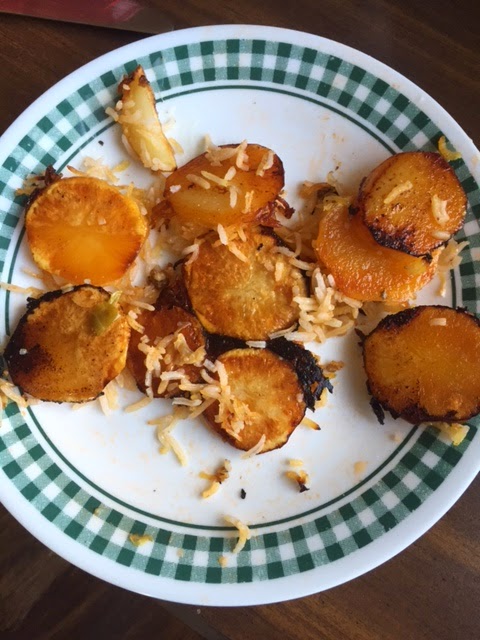
As an Iranian, most of the fried potato in my diet
is in the form of Tahdig: thin potato slices that
are placed on the bottom of the pot
in a layer of oil when rice is steam. It comes out
nice and crunchy. This is Tahdig that I made with
a slight sprinkle of zaffron
process in cells that can turn off or silence specific RNA molecules, and consequently, the proteins that they make. In the past few decades, scientists have harnessed RNAi to turn off genes that they're studying. If you add a properly-designed sequence of DNA corresponding to the gene you're interested in silencing, it will produce an RNA molecule that will trigger RNAi and then, wham!!! The protein gets shut-down.

In the context of our discussion on the Innate Potato, it's important to note that a protein from a different organism has not been added. It's not like the mythical "fish genes in a tomato". The DNA sequence that has been added is from the potato itself, which is why they've called it the "Innate Potato". Thus, this isn't a transgenic crop, where the gene added is from a species distant to the potato. It is a cisgenic crop, where the genes came from closely related species; in this case, either from the potato itself or from a wild potato native to Mexico (Solanum verrucosum).

So what proteins are silenced in the Innate Potato and why? Four different proteins are silenced and these are involved in three different traits:
  1. The first trait is prevention of potato bruising (again, this is very similar to the non-browning Arctic Apple). Potato bruising is caused when damaged cells release an enzyme known as polyphenol oxidase (PPO) which interacts with different compounds creating the black or dark grey color. In the Innate Potato, the PPO enzyme is "turned off" only in the tuber and remains on in the leaves. Currently, many steps are taken in potato farming and handling to prevent bruising, but it doesn't seem to be enough. Potato bruising costs the industry "at least $298 million annually". Keep in mind that those bruised potatoes don't make their way to the store, so that translates to a lot of food waste, too.
    The company claims that the potatoes will not turn brown for several days, compared to just 10 minutes with a normal potato.
  2. The second trait is reduction in the amount of acrylamide produced in the potato. Acrylamide is a chemical compound which is also a known carcinogen at high doses. We use it in the lab fairly frequently. When I started doing lab work, I had the annoying task of making our acrylamide solutions, since I was the lowly undergrad... Fear not, spouse! I took heavy precautions: a full mask, a full lab coat, etc. Once I got into my PhD, our lab had more funding, so we'd buy the acrylamide solutions pre-disolved. Now that I'm in industry, we buy our acrylamide lab items ready-to-use. Such is the nuisance of acrylamide that no-one wants to deal with it.
    So what's acrylamide doing in potatoes? When potatoes are heated, a chemical reaction (known as the Maillard reaction) occurs between the amino acid asparagine and sugars (such as the naturally occurring sugars in the potato). When I was discussing this article with the spouse, he knew all about the Maillard reaction because it's what causes browning in food such as meats or bread, and is not to be confused with caramelizing. He had read about it when doing research on how to cook the perfect steak (He's Texan... It's the only explanation I have). At high temperatures, such as when potatoes are put in a fryer, acrylamide also forms in the reaction. In the Innate potato, the amount of the enzyme that synthesizes asparagine has been reduced, so consequently, less acrylamide is made. The company's website claims that the Innate potato produces up to 70% less acrylamide than other potatoes cooked at the same temperature.
  3. The final trait is improvement in starch quality and potato color. I had a tough time finding a decent description of this trait and relied on information from a Q&A with one of Simplot's VPs over on Biofortified. Basically, they've reduced the amount of sugar in the potato, which can result in "consistent golden color". Their website and the Q&A say "under certain conditions", but do not explain what those conditions are so I'm a bit skeptical. I wish there was more information about this trait.
The Papers

In the first paper (which is freely available via the company's website), the authors attempt to silence 2 genes that synthesize the amino acid asparagine. They had success in greenhouse trials, but to their surprise, the field trials failed: the potatoes were really small and "cracked" (the picture in the paper is worth looking at. The taters definitely look wonky). However, the controls grew fine suggesting that it wasn't something environmental: it was the silencing of the two genes that caused these problems. They went on to do a series of experiments where they silenced the 2 genes individually. They got potatoes with quality equivalent to controls but with reduced asparagine levels by silencing just one of the genes just in the tubers/potatoes (scientists can often control what part of the plant they want to turn a gene off/on in). They managed to reduce amounts of asparagine by 60-80%.

The second paper was behind a paywall (I forgive Simplot for not publishing in an open access journal only because the paper was accepted in 2006, before open access was a popular "thing"). The paper starts by outlining that the Russet Burbank strain of potato is more pest resistant, but is seldom used because it has issues with discoloration and sensitivity to bruising. Additionally, it accumulates high levels of sugar in cold storage which, not only result in higher levels of acrylamide, but also makes french fries less golden. The paper set out to address these issues by a) reducing the levels of the enzyme that causes bruising (explained in the previous section), and b) reducing the amounts of two enzymes associated with starch formation so that fried potatoes have a more appealing hue and have less acrylamide.

As a side note, this sentence in the Materials and Methods was somewhat hilarious: "Sensory evaluations of French fries were performed by a panel of eight professionally trained experts at the optimum time of 3 min out of the fryer." Who is a professionally trained expert on French fries sensory evaluation? More importantly, how can I get that job??

The authors did a series of tests to confirm that the potatoes grown in the field actually had the physical traits they wanted. For example, when testing for bruising, they "physically impacted" the potatoes and after 2 weeks, fries were made out of them to see if they blackened (I'd LOVE to be the grad student on that project... You'd spend your time throwing around potatoes, all in the name of science :) ). They show that the modified potatoes have less acrylamide formed, and they have lots of pictures of French fries showing that the modified potatoes have more of a golden-hue to them. They also performed a few experiments showing that the modified potatoes kept their "agronomic performance": when compared to controls, they weren't more susceptible to blight, they were of the same size, and had more starch content. All in all, the paper's findings suggest that silencing of the 3 genes didn't have a negative impact and had all the desired traits.


Conclusions

So I couldn't find any papers that convincingly indicated that there's enough acrylamide in fried potatoes to be a huge concern. Additionally, no reputable organization states that acrylamide in food causes cancer in humans (here's info from the National Cancer Institute on the topic). In fact, a few studies that have examined the incidence of cancer and dietary acrylamide have failed to find any association (see here and here, and a recent meta-analysis here). Keep in mind that we eat natural toxins everyday, but not in amounts that are of concern. However, dietary acrylamide is enough of a concern to some people that all places that serve french fries in California have the ubiquitous (and therefore useless) warning stating that the location has food known to the state of California to cause cancer or birth defects (i.e. Prop 65). So it seems that this could be a potato of interest to the general public and the food industry.

Many of the usual arguments against GMOs don't hold for the Innate Potato. Here's why I think that the Innate Potato has less GMOiness (and by "GMOiness" I mean that subjective, intangible thing that makes people protest the introduction of any GMO into the market):
-It doesn't need any additional pesticides or treatments
-The sequence added isn't from a virus or bacteria that crosses the species barrier
-It doesn't have Monsantonization
-It doesn't have the DNA sequence for antibiotic resistance.
-It addresses genuine health concerns that some may have (reducing acrylamide in our diet), as well as environmental concerns (reducing food waste)

So I'm not sure what argument people would have against the spud. To be honest, it's not one that I'm terribly interested in as a consumer, because I haven't read anything to suggest that acrylamide in our diet is at levels that cause harm, and we don't waste too many potatoes in our family. But I'd buy them if they weren't much more expensive because they're less wasteful. I do think that the food industry should adopt them because they could make a genuine impact on reducing food waste from the farm to the store (and also because those ridiculous Prop 65 warnings annoy me).

I'm also very curious to see how they're going to handle the labeling of the potato. The potato is designed to be nutritionally different from other potatoes, so it is not substantially equivalent. As you may know, the reason why genetically modified ingredients are not labeled in the United States is because they are nutritionally equivalent to their non-genetically modified counterparts. So technically, the Innate potato should be labeled. Will they just list "Innate Potato" as an ingredient? It'll be interesting to see how this plays out.

That's my take on it. Please leave any questions you may have below! And remember to subscribe to the blog so that you don't miss any posts!

ADDITION May 29th, 2015: Here's a great and recent Q&A with a Regulatory Compliance Specialist from Simplot about the Innate Potato.

Thursday, March 5, 2015

What's "Natural"?

Two recent surveys have had the wheels in my brain churning. The first is a survey finding that 80% of Americans want food containing DNA to be labeled. The second is a survey from the American Association for the Advancement of Science, where scientists and non-scientists were surveyed on a variety of topics, and 88% of scientists said that GMOs were safe compared to 37% of non-scientists surveyed. It was the single question with the broadest gap in results.

I've been thinking a lot about these and I've shared my thoughts on the importance of education to address the knowledge gap in a previous post. But I was stumped in trying to understand exactly what it is that concerns people about GMOs. Sure, I've seen all the crazy memes about GMOs and cancer, but there's got to be some deep fundamental fear or concern that leads people to believe these memes in the first place.

In an attempt to better understand concerns and to share what I've learned, I reached out to the local high school where I live, provided my credentials, and told the head of the science department that I'd be happy to chat with students about biotech crops. Two teachers took me up on the offer and over the last month, I had the opportunity to chat with students from freshman and senior classes about biotech crops. I also chatted with them about my career in human genetics and encouraged them to consider careers in STEM.

It was fantastic and I learned a lot. In talking with them, one point really stood out in terms of concerns/fears about GMOs: the word "natural". Some of the freshmen stated that they didn't like the concept behind GMOs because it wasn't "natural". This stood in stark contrast with the discussions I had with the seniors, where the word "natural" was never mentioned. Furthermore, as the seniors debated the topic, we were forced to create an arbitrary definition for the term GMO to focus our discussion because multiple times the students brought up the fact that "everything is modified" or "what's the difference between a GMO and a seedless watermelon if they're both made in the lab". The seniors had tons of questions about pesticides, biofortified crops, and labeling, but I think that the freshmen left terrified about our conversations on mutagenesis. One of them stated "it just doesn't seem right. It's so unnatural".

Natural. If you think about it, it's entirely subjective. What's natural to you might not be to me. My mom is an orchid lover and she had dozens of orchids growing on hanging coconut mats in our courtyard in Venezuela. She'd probably say that the orchid I have growing in the pot on my counter isn't natural. Someone else could have pointed to her flower collection and stated that it wasn't natural compared to the orchids growing on trees in the wild. Who's to say that these perspectives aren't right/wrong?

I think that each one of us has a subjective notion of what's "natural" in our minds, and if it doesn't fit within that framework then we tend to reject it. Vaccines are a great example: it seems "unnatural" to have a needle go into your arm and to inject a substance. I actually heard an individual on a radio talk show describe how she wasn't going to get the flu shot for this very reason.

It turns out that rejecting what's unnatural is actually a "thing" used in arguments and is known as "appeal to nature", whereby one states that what is natural is better. In a previous post, I explained how most of the "toxins" and pesticides we ingest are naturally occurring substances found in our food, some of which are known carcinogens (see! I used the word "natural"!!). Yet we're MUCH more concerned about synthetic pesticides and other "artificial" substances found in our food. I think the same is true about GMOs: we deem these to be unnatural and therefore "worse". They were made in a lab and are therefore artificial and not "as good".

This "appeal to nature" is what drives the use of the term "natural" plastered over hundreds of food items, and there's even debates to determine what can/should be deemed natural for a food label. When something says "all-natural ingredients", what does that even mean? After all, it was processed in a factory since it's in a container, so doesn't that make it "unnatural"? As person who had gestational diabetes during her pregnancy and was able to control it through diet and exercise, let me tell you that our bodies can't tell the difference between a bite of candy that has X grams of sugar and an orange that has X grams of "natural sugar" (of course, the orange has more vitamins/nutrients, but I'm focusing exclusively on the sugar content for this analogy). So when I see items that say "made from natural cane sugar", I get pretty irritated because somehow that label is trying to convey that it's healthier or better than ingredients made from what must be "unnatural" sugars.

The spouse is watching Downton Abbey on the laptop next to me, and I'm reminded of the episode where they brought in a phonograph. It created such a kerfuffle because it was against tradition and not the way things had always been done. It's similar to our discussion here about what's "natural".

What surprised me in chatting with the students was the immense difference that just a few extra years of high school biology made, and it honestly gave be a bit of hope that with scientific education and communication, we might be able to make a difference in the discourse surrounding biotech crops.

Also, if there any topics/papers that you want me to review, please send me a note. And if you haven't subscribed to this blog, please add your email to the subscription list. You won't get spammed :) I don't post frequently enough for that!

Monday, December 1, 2014

Natural pesticides: what have I been eating?!?!

Several months ago, there was a thread on the GMO Skeptiforum on Facebook about natural pesticides. It's one of the threads I learned from the most, so I thought I'd share some of it here along with the papers to back it up.

So, what are "natural pesticides"? Plants and animals have evolved mechanisms to fight against their predators. Some of them are mechanical, like thorns or spines on a puffer fish, but some are chemicals or natural pesticides.

It's important not to let the term "pesticide" confuse you. When the spouse read this article, he said that he didn't get why I used the term "pesticide" to describe a component/chemical in a plant. We're used to thinking of pesticides as the stuff we spray on plants or around our house to get rid of bugs. But the term "pesticide" is much broader than that: it's any substance that gets rid of or repels a pest. The term encompasses many different -cides: herbicides (to get rid of plants), fungicide (to get rid of fungi), insecticides (to get rid of insects), etc, etc. A natural pesticide can be toxic to the pest that its evolved to target, so I use the term "toxin" in this piece as well. These pesticides or toxins can be very specific in the organisms that they target: for example, the Bt-toxin which is found in different GMOs is actually from a bacteria in the soil and it is toxic to various insects, but the way it works doesn't impact mammals; chocolate is toxic to dogs, but not to humans; etc.

I first became aware of natural pesticides in my teens when my mom told me that I shouldn't buy green potatoes because they can make you sick. Back when we lived in Venezuela, every Friday morning my mom would go to the market to buy our fresh produce for the week. In my last two years of high school, I was lucky enough to not have morning classes on my schedule, which turned out to be unlucky for me because I'd get dragged out to the market. Unlike the fru-fru-shee-shee farmer's markets we've got in California, the market in Barquisimeto, Venezuela was dirty and really crowded. I always got stuck buying the potatoes, tomatoes, and passion fruit, while my mom bought the greens, papayas and melons. The potatoes were caked with dirt, so I'd have to smack them to see if they were green or not. Most of the time they were. As I got older, I wondered if my mom's advice was a mythical Persian legend or if it was legit, and Wikipedia helped me find the answer.

All plants should bear a warning symbol
given the amount of toxic substances they contain
Potatoes are a member of the nightshade family which have a poison called solanine present in different parts of the plant. This paper from Lancet published in 1979 states that potatoes have small amounts of solanine in the peel and none in the flesh, but when the potato starts to green or sprout (i.e. the 'eyes' start growing), then the amount increases significantly. Solanine levels also increase in potatoes when they're diseased, such as with the blight, and is probably part of the plant's defense system. The Lancet paper documents several cases of solanine poisoning from eating potatoes, but they were not typical cases (for example, individuals may have been malnurished). Current guidelines from the NIH state that eating solanine in very small amounts can be toxic and recommends throwing out spoiled potatoes or those that are green below the skin.

But solanine is just the tip of the iceberg when it comes to natural pesticides. Here are a few others:
The list is virtually endless. In 1990, Bruce Ames published a paper entitled "Dietary pesticides (99.99% all natural)". In it, he and his coauthors outline that we eat an estimated 1.5 grams of natural pesticides a day, "which is about 10,000 times more" than the amount of synthetic pesticide residues we eat. This amount would be significantly higher in vegetarians and vegans. As an example, the authors provide a list of 49 different pesticides found in cabbage alone. The concentrations of these pesticides are in parts per thousand or parts per million, whereas the amount of synthetic pesticides we find on our food are in the parts per billion range.

Despite the vast amount of toxins in our diet, only a handful of these have ever been tested (note that the paper was written in 1990, but the point still stands). The paper highlights that of all the chemicals tested for chronic cancer tests in animals, only 5% have been natural pesticides and half of these were carcinogenic.

Think about that for a moment. While there's an uproar about parts per billion amounts of synthetic pesticide, there are more concentrated compounds in fruits and veggies known to cause cancer (at much higher doses). In addition, some pesticides used in agriculture have mechanisms of action that are specific to the pests their targeting. I've already given the example of Bt-toxin, but glyphosate shuts down a biochemical pathway in plants that simply doesn't exist in mammals. For some reason, we're far more concerned about these two compounds than we are about natural formaldehyde in pears. Check out the FANTASTIC graphic at the end of this article that highlights this point: we fear anything that's synthetic because we assume that it's "bad for us", but there's plenty of stuff that's "natural" that can be harmful at the appropriate dose (I wanted to entitle this article "The Hidden Carcinogens in Your Food", but it seemed too click-bait-y).

I've read  a lot of arguments from anti-GMO groups about how transgenic crops that have the Bt-toxin will kill us all, because it's a registered pesticide with the EPA. "Do you want to eat something that's a pesticide???" is what I've read time and time again. There are plenty of "natural chemicals" that are registered pesticides, as I've noted above, but no one seems to be freaking out about basil and mustard seeds. Additionally, what many GMO-advocates will point out is that the cross-breeding and "natural" hybridizations we've been doing for centuries has undoubtedly impacted the levels of some of these pesticides by unknown amounts, because no one examines them. Going back to solanine, in the '60s a new strain of potato known as the "Lenape" potato was developed through "natural" methods, but was found to be toxic due to increased levels of solanine: it had ~2-4x the amount of solanine found in other potato varieties and it had to be pulled off the shelves. But no one seems to be screaming about "unintended consequences" of traditional crossbreeding.

Well, 'tis my bed time. I hope all had a great thanksgiving. You can probably thank natural pesticides for half the flavors in the delicious food you ate!!

Natural vs Man Made Synthetic Chemicals Toxicity
http://www.compoundchem.com/2014/05/19/natural-vs-man-made-chemicals-dispelling-misconceptions/