Two recent surveys have had the wheels in my brain churning. The first is a survey finding that 80% of Americans want food containing DNA to be labeled. The second is a survey from the American Association for the Advancement of Science, where scientists and non-scientists were surveyed on a variety of topics, and 88% of scientists said that GMOs were safe compared to 37% of non-scientists surveyed. It was the single question with the broadest gap in results.
I've been thinking a lot about these and I've shared my thoughts on the importance of education to address the knowledge gap in a previous post. But I was stumped in trying to understand exactly what it is that concerns people about GMOs. Sure, I've seen all the crazy memes about GMOs and cancer, but there's got to be some deep fundamental fear or concern that leads people to believe these memes in the first place.
In an attempt to better understand concerns and to share what I've learned, I reached out to the local high school where I live, provided my credentials, and told the head of the science department that I'd be happy to chat with students about biotech crops. Two teachers took me up on the offer and over the last month, I had the opportunity to chat with students from freshman and senior classes about biotech crops. I also chatted with them about my career in human genetics and encouraged them to consider careers in STEM.
It was fantastic and I learned a lot. In talking with them, one point really stood out in terms of concerns/fears about GMOs: the word "natural". Some of the freshmen stated that they didn't like the concept behind GMOs because it wasn't "natural". This stood in stark contrast with the discussions I had with the seniors, where the word "natural" was never mentioned. Furthermore, as the seniors debated the topic, we were forced to create an arbitrary definition for the term GMO to focus our discussion because multiple times the students brought up the fact that "everything is modified" or "what's the difference between a GMO and a seedless watermelon if they're both made in the lab". The seniors had tons of questions about pesticides, biofortified crops, and labeling, but I think that the freshmen left terrified about our conversations on mutagenesis. One of them stated "it just doesn't seem right. It's so unnatural".
Natural. If you think about it, it's entirely subjective. What's natural to you might not be to me. My mom is an orchid lover and she had dozens of orchids growing on hanging coconut mats in our courtyard in Venezuela. She'd probably say that the orchid I have growing in the pot on my counter isn't natural. Someone else could have pointed to her flower collection and stated that it wasn't natural compared to the orchids growing on trees in the wild. Who's to say that these perspectives aren't right/wrong?
I think that each one of us has a subjective notion of what's "natural" in our minds, and if it doesn't fit within that framework then we tend to reject it. Vaccines are a great example: it seems "unnatural" to have a needle go into your arm and to inject a substance. I actually heard an individual on a radio talk show describe how she wasn't going to get the flu shot for this very reason.
It turns out that rejecting what's unnatural is actually a "thing" used in arguments and is known as "appeal to nature", whereby one states that what is natural is better. In a previous post, I explained how most of the "toxins" and pesticides we ingest are naturally occurring substances found in our food, some of which are known carcinogens (see! I used the word "natural"!!). Yet we're MUCH more concerned about synthetic pesticides and other "artificial" substances found in our food. I think the same is true about GMOs: we deem these to be unnatural and therefore "worse". They were made in a lab and are therefore artificial and not "as good".
This "appeal to nature" is what drives the use of the term "natural" plastered over hundreds of food items, and there's even debates to determine what can/should be deemed natural for a food label. When something says "all-natural ingredients", what does that even mean? After all, it was processed in a factory since it's in a container, so doesn't that make it "unnatural"? As person who had gestational diabetes during her pregnancy and was able to control it through diet and exercise, let me tell you that our bodies can't tell the difference between a bite of candy that has X grams of sugar and an orange that has X grams of "natural sugar" (of course, the orange has more vitamins/nutrients, but I'm focusing exclusively on the sugar content for this analogy). So when I see items that say "made from natural cane sugar", I get pretty irritated because somehow that label is trying to convey that it's healthier or better than ingredients made from what must be "unnatural" sugars.
The spouse is watching Downton Abbey on the laptop next to me, and I'm reminded of the episode where they brought in a phonograph. It created such a kerfuffle because it was against tradition and not the way things had always been done. It's similar to our discussion here about what's "natural".
What surprised me in chatting with the students was the immense difference that just a few extra years of high school biology made, and it honestly gave be a bit of hope that with scientific education and communication, we might be able to make a difference in the discourse surrounding biotech crops.
Also, if there any topics/papers that you want me to review, please send me a note. And if you haven't subscribed to this blog, please add your email to the subscription list. You won't get spammed :) I don't post frequently enough for that!
Thursday, March 5, 2015

Wednesday, February 18, 2015
Better Know a Scientist: Interview with Entomologist Erfan Vafaie
A few people have asked me to review papers about bugs. I started reading papers about butterflies and I kept falling asleep. So I decided to do the next best thing: interview an entomologist. I’m going to be interviewing my friend, Erfan Vafaie (@sixleggedaggie), who also has a blog up on sixleggedaggie.com We’ve sent each other papers that we’ve found interesting over the past few years, and I’ve asked him about bugs and GMOs in the past to get his insights and perspectives. Like me, he is also an Iranian-Canadian, but lives in Texas. This will hopefully be the first in many interviews with people whose research I know nothing about in a series entitled “Better Know a Scientist”. Here we go!
Q: Most people spend a lifetime trying to avoid bugs yet you chose to study them. Why?
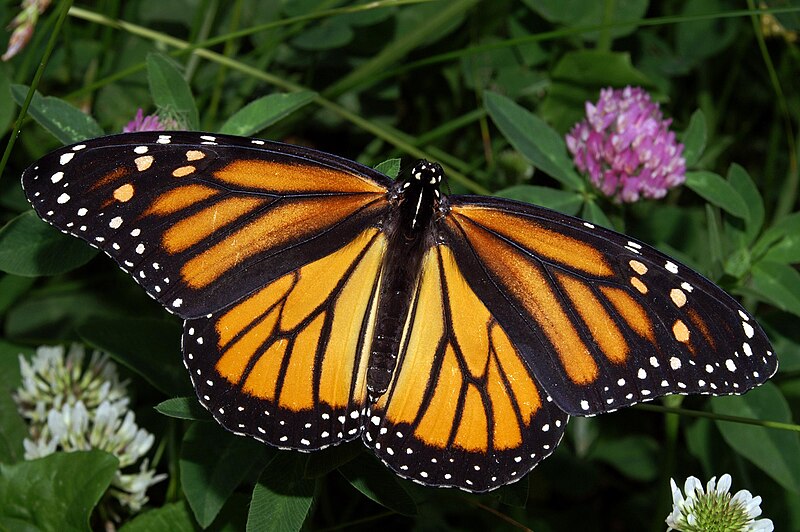 |
| Monarch Butterfly. Image from Wikimedia Commons. Kenneth Dwain Harrelson. |
Oh boy! Because insects are super cool? Whether looking at how bees communicate with their colony-mates where a good nectar/pollen source is via a bee dance, or ants building intricate networks under the ground including graveyards, or the ability of a woolly bear caterpillar to tolerate freezing at temperatures as low as -70ºC, insects are incredibly fascinating in their behaviors, lifecycles, and physiology. One of my favorites are parasitic wasps, which kill their host by laying an egg inside it (endoparasitoids). That egg becomes a larva that slowly feeds on the insides of the host insect, while the host continues to feed and live normally. After a while, the larva will eat everything on the inside, metamorphose inside (similar to a caterpillar to a butterfly), and become a new adult parasitoid - That’s basically the movie Alien happening EVERYWHERE in your garden!
But it’s the combination of my fascination with insects and their importance in sustainable and fruitful agriculture (pun intended) that really motivates me. Farmers are some of the hardest working and under-appreciated individuals in our society. So what better job than to be able to help them whilst studying these mini-aliens we call insects?
Q: What bugs are you currently studying?
At this moment, the crape myrtle bark scale, which is an invasive insect of crape myrtles in Southern US. We are currently studying their population dynamics throughout the summer, as well as best management practices in the landscape and nursery. I also just finished up some work on aphids and will be doing some work on thrips and mosquitoes soon. Being in my position, you tend to work on a wide variety of insects on different commodities, depending on the needs of the industry in your area at the time.
Q: How does it make you feel that you’re not the only Iranian-Canadian-Baha’i living in the US with a blog about science? Does it make you want to take out my kneecaps so that you can claim the keys to the blog-dom?
Kneecaps would be unnecessary, seeing as how I’m the tallest Iranian-Canadian-Baha’i living in the US with a blog about science. I actually really admire your blog, writing style, and ability to relay information to a wide audience!
[Biochica’s note: I think that Erfan is trying to make me lower my defenses with this response. Well played, sir, well played.]
Q: A common criticism I’ve read is that studies on transgenic crops only examine health impacts in mammals, and not the impact on non-target bugs and critters. Do you think this is fair criticism?
I’m not so sure that’s fair. There are many studies on the subject and the research continues to investigate the impact of transgenic crops on non-target insects. Wolfenbarger and friends assimilated and analyzed results from several other research articles (meta-analysis) and found hundreds of studies with specific criteria related to the impact of transgenic crops (Bt specifically) on non-target organisms of cotton, maize, and potato. So there’s a substantial amount there and research continues being done in that area.
[Biochica note: the Bt trait will be mentioned throughout this interview. It is a bacterial protein in some transgenic crops that targets specific insects. It is also a common pesticide used in organic farming. For more information on the trait, please see this post.]
Q: Why do you think that the topic of neonicotinoid pesticides has gotten confounded with the issue of GMOs? As I understand it, they’re two separate issues.
I agree, they are two very separate issues. Neonicotinoids are a class of insecticides that were first born in the commercial market in 1985 in response to older chemistries (i.e. organophosphates and carbamates) that had higher mammalian, avian, and environmental toxicity compared to neonics (short for neonicotinoids). Neonics have since become one of the most popular insecticide classes used. They do not need to be used in conjunction with GMOs, nor do I know of any GMO seeds that depend on the use of neonics; thus making the two issues unrelated. There are activists that would name neonics as the primary factor responsible for bee colony collapse disorder, whereas other activists accuse GMOs for causing a completely different set of consequences.
People may be confounding the two issues because neonics have often been used as a ‘seed treatment’; the seeds are coated in neonics, and as a result, are taken up by the plant and protect it for the first 3 - 4 weeks of growth, which can be thought of as being similar to introducing a gene, such as the transgene in Bt-corn that protects the plant from within. The EPA has since published a document (‘Benefits of Neonicotinoid Seed Treatments to Soybean Production’) demonstrating that neonic coated seeds are ubiquitous in nature and not very advantageous in most situations. That’s the only reason why I can think the two may have been confounded in the past.
Q: I think it’s fair to say that you’re very tall. So tall, in fact, that it seems “unnatural”. How should my readers know that you’re not a genetically modified human being, who is advocating the safety of transgenic crops as the first step in some quest for eventual world domination?
Standing at 6 foot 7 on a good day (depending on atmospheric pressure, humidity, and sock thickness), the daily fight to prove that I’m 100% natural and organic has been a losing battle. Let us thus assume, for the sake of argument, that I am genetically modified or genetically enhanced in some manner. We can draw on the great anecdotal and scientifically accurate example of the mutants from the Marvel Universe and X-Men.
In that arena, there are genetically enhanced humans that continue to promote the welfare of humanity (i.e. Xavier and his school gifted youngsters) and those that are selfish and desire for the world to crumble (Magneto and his hard-headed goons). We can differentiate between the will to do good by viewing the actions, motivations, and thoughts of the person as a whole. Xavier continues to build strong and positive ties with common-folk, empowers the younger generation to embrace their inner powers, and shows integrity in goodwill towards mankind. Magneto, on the other hand, continues to harm humans and expresses that “Nature has made us superior. We are the living future of this mighty planet. This world is ours world now! Take it!” (X-Men: Graduation Day, S.5.E.4, 1997). I think those who know me personally would agree that my actions are more in line with the Xavier team than Magneto’s.
[Biochica’s note: Again, I think that Erfan is trying to portray himself as the “good guy” with this amazing response. That’s exactly what a genetically modified alien would try to do. Erfan 2, Biochica 0]
Q: If there’s one thing that you want people to know about bugs and GMOs, what would it be?
There’s a common misconception that the use of GMOs promotes more insecticide use and can hurt more non-target insects (i.e. beneficial insects like butterflies and honeybees) than conventional agriculture . Brookes and Barfoot estimated a drop in global herbicide and insecticide use as a result of GM adoption to be 172.5 million kg (between the years of 1996 - 2004), with cotton crops specifically decreasing just over 14% in total herbicide and insecticide applications.
Gianessi and Carpenter (2001) calculated that between 1995 (year before Bt varieties were introduced) to 1999, the amount of insecticides used decreased by 2.7 million kg of formulated product in just six states (AR, AZ, CA, LA, MS, and TX), which represents 14% of all insecticides used in those six states. In addition the number of spray applications/ha was reduced by 15 million which represented a 22% reduction in spray applications. The Arizona Cotton Research and Protection Council (2000) has stated that Bt cotton has helped to reduce insecticide use in Arizona cotton to the lowest levels in the past 20 years! That’s a win for reduction of pesticide use.
In addition, incorporating the insecticide into the crop is an intuitive way to keep the non-target organisms safe; by integrating the insect toxin into the plant, you’re effectively targeting the insects that are eating your crops! Marvier and her friends analyzed several studies (meta-analysis) and found non-target insects to be more abundant in fields where GM crops were used compared to non-GM crops with insecticide sprays (using pyrethroids). It should be noted, however, that fields without GM crops and were not sprayed had higher numbers of non-target organisms than fields with GM-crops, so the GM crop does have some impact on non-target organisms, whether it be directly or indirectly (i.e. killing the insect that carnivorous insects eat).
Q: The spouse is from Texas, so we’ve been to quite a few country concerts. Have you been to one yet? If so, who? (You cannot lie on my blog, so you have to admit if it was Taylor Swift). If not, whose show would you go to?
Unfortunately, I have not been to any concerts in Texas as of yet. I have been to some local gigs/musical performances in Tyler Texas. They have some good talent here! I have, however, been to an A&M football game, with just over 109K people there. Let me tell ya - that was insane!
[Biochica note: As a country music fan who has shaken hands with Tim McGraw and has had a cowboy hat signed by Alan Jackson, this response is completely unacceptable. Erfan 2, Biochica 10000]
[Erfan note to Biochica note: Can we review how the point system works here?]
[Biochica note to Erfan: No. My interview, my rules :P]
Q: Are you aware of any evidence indicating that transgenic crops are responsible for CCD (colony collapse disorder) in bees? What about the decline of butterflies?
Colony collapse disorder, a very specific set of symptoms that have characterized large losses of honeybee hives since 2006, may be caused by several different factors: environmental stress, transportation of the bees, malnutrition, varroa mites, insect pathogens, and pesticides. Insect-resistant GMO crops incorporate genes from the bacteria Bacillus thuringiensis, which produce toxins that have relatively specific binding sites in the gut of lepidopteran (i.e. moth and butterfly larva/caterpillars) and some coleopteran (i.e. beetle) insects . As such, insects like honeybees are left unharmed. A meta-analysis (i.e. research article that looks at many studies) by Duan and friends analyzed 25 studies and found there to be no negative impact of Bt on honeybees in a lab setting. A more recent study by Dai and friends looked at the impact of Bt corn on honeybees in the field and found there to be “no difference in immature stages, worker survival, bee body weight, hypopharyngeal gland weight, colony performance, foraging activity or olfactory learning abilities”. So it appears that the current consensus is that transgenic crops are not a player in the whole CCD dealio.
Butterflies are a slightly different story, because as I mentioned just above, the toxins from Bt are specific to moth and butterfly larva/caterpillars. The very intent of the incorporated gene is to control/kill the younger stages of butterflies… so of course it’s going to kill them! The question we should ask, however, is whether the Bt is killing non-target butterflies on neighboring plants (i.e. milkweed) that we don’t want killed - afterall, monarch butterflies feed specifically on milkweed, which is often considered a weed in the context of agriculture. A study by Losey and friends found that Bt pollen can reduce the growth, survival, and leaf consumption of monarch butterfly caterpillars. This study was trying to investigate what is referred to as “pollen drift”, which in the transgenic world means - “is the pollen from the transgenic crop drifting onto neighboring plants and causing unforeseen consequences?”. However, this study was done in a lab (i.e. unrealistic environmental factors), the pollen was artificially introduced to the monarch’s host plant in an amount that ‘seemed’ equivalent to the field, and there was no comparison to alternatives (i.e. Bt spray), so the jury is still out on whether Bt crops are a major concern for non-target insects. One thing to consider, however, is that an entire corn field may take only up to two weeks to release all of its pollen, which is a very short exposure time to Bt-pollen compared to a weekly spray of Bt (or some other insecticide), which was the norm pre-Bt transgenics.
[Biochica note to Erfan: nobody's used "dealio" since 2002. There aren't enough points to subtract from your score to make up for this offense.]
Q: Do you secretly wish that you were a human geneticist like me? Do you want to join the private industry and swear a secret oath in exchange for never-ending wealth? I can put in a good word with my overlords for you at our next sacrificial ritual.
No. Certainly not.
(But secretly, yes! I submitted an online query to the League of Villainous Scientists through their contact page, with a full cover letter of why I’d like to do evil things to people and our planet for never-ending wealth, but haven’t heard back. A ‘good word’ would be most appreciated!)
Erfan and I would like to close with a more serious note: had our parents not immigrated out of Iran, both of us would have been barred from receiving education due to our religious background, and the world would be two scientists shorter. We’d like to bring awareness to the fact that many Baha’is in Iran are being excluded from receiving higher education and dozens are imprisoned for their beliefs. Please join the #educationisnotacrime campaign on Twitter and Facebook. For more information, please visit www.educationisnotacrime.me
Monday, February 9, 2015
Gene editing and GMOs
This month, I'm tackling gene editing. It's finally time I read papers on the topic because I got an email advertisement announcing a new gene editing kit and I realized that I don't know the mechanistic details of the system (yes... There's science email spam...).
I'll be summarizing a 2014 review from the journal Cell. The title of the review is "Development and Applications of CRISPR-Cas9 for Genome Engineering" (unfortunately, the review is behind a paywall).
As you can imagine, gene editing is somewhat of a holy grail. To be able to erase undesired mutations in DNA would be a dream for many clinicians/doctors. But there are many different applications that don't necessarily have to do with erasing what we don't want, rather, we could introduce variations that we want: creating an animal model for a disease, developing crops with desired traits, etc.
The paper starts by providing a brief overview of how genome engineering has been done in the past (focusing primarily on mammalian cells), outlining the pros and cons of each method. The difficulties inherent in current methods has led to the development of programmable gene editing technologies, the most promising of which is the CRISPR-Cas9 system which is the focus of the paper.
Spouse: I need to clarify something before I continue. The system isn't quite as simple as I'll describe below. There are additional DNA/RNA sequences and enzymes that are part of the complex, and I'll be omitting them because I could hear your voice in my head complaining about all the acronyms and jargon. So consider this to be the uber-abridged Cliffs Notes on gene editing.
Cas9 is an endonuclease, meaning that it's an enzyme that can cut both strands of DNA's double helix. Endonucleases can be random, meaning that they can cut anywhere along the length of the DNA. In fact, one of the fears of scientists working with DNA is nuclease contamination, which can render your samples to DNA dust. Other endonucleases, such as restriction enzymes, search for a specific DNA sequence and cut at that site. However, the cut site cannot be specified and can be found frequently in a genome (i.e. restriction enzymes can cut thousands of times).
Unlike restriction enzymes, the bacterial Cas9 cuts at a specific site but the DNA sequence where it cuts can be specified. Cas9 is associated with the CRISPR system, which guides Cas9 to its target using a small piece of RNA. In nature, this small piece of RNA generally encodes for a viral (phage) sequence. Cas9 searches for the viral sequence and then hacks it up, which is why the CRISPR system is part of the bacteria's antiviral defense mechanism. However, the small piece of RNA that guides Cas9 can be replaced with a sequence of the researcher's choice. Part of the system's benefit is the fact that you can provide more than one guide molecule, meaning that you could direct the system to cut more than one place, if desired. The system can be specific in the DNA sequence that it cuts, however, as this paper highlights, off-target edits can occur and are an area of ongoing study/research.
The paper provides a history of the many discoveries surrounding CRISPR-Cas9. There are different mechanisms by which the CRISPR system gets activated, and after many years of research, it was decided that the CRISPR-Cas9 was the most promising in terms of trying to find a programmable system for gene editing. By 2013, researchers successfully engineered the CRISPR system from two types of bacteria, including the one used to make yogurt, to edit genes in mammalian cells.
So far, I've described how to get the system to cut where you want it to cut. But then what? If you think of editing as deleting something that's incorrect and typing in something else, how do you get "what's right" or "what you want" into DNA?
Once the DNA is cut, the cell's natural repair mechanism kicks in and one of two things can happen (see my bee-u-ti-ful graphic below):

CRISPR-Cas9 can also be modified so that the "search" function of the system remains intact, but the cutting function is disabled. As such, researchers can create a complex where they guide their enzyme of choice to a specific region. I think that the simplest example that the paper provides is one where Cas9 was fluorescently labelled/tagged, so researchers could visualize the location of the DNA sequence they were studying.
In reviewing this article, the spouse asked if we could write a movie script where the villian sprinkled Cas9 along with the DNA specific to his arch-nemesis' genome into the latter's cereal. Would it be the perfect crime? Would the CRISPR-Cas9 enter the arch-nemesis' body and hack up his DNA? Unfortunately, no. Keep in mind that our DNA is within the nucleus of our cells and isn't very accessible. Additionally, as non-bacterial species, we don't have CRISPR-Cas9 in our cells. Getting the CRISPR-Cas9 into the nucleus isn't all that simple and requires a bit of fancy lab work.
To date, there's no medical therapy on the market developed using gene editing. Likewise, there's no crop on the market that has been engineered using CRISPR-Cas9. However, studies have demonstrated that crops can be modified using the system (this paper provides an example of successful gene editing using CRISPR-Cas9 in rice). Consequently, many wonder whether crops generated through gene editing would be considered GMOs.
As I've previously described, what are currently known as a GMOs or genetically modified organisms are transgenic crops, meaning that a gene from a different species has been added to their genome (NOTE: in this post, I note that anti-GMO activists have a very different definition of a GMO). But in the case of crops modified using CRISPR-Cas9, what's edited was there to begin with. Technically, nothing has been added from a different species. So how will regulatory agencies categorize these crops?
This paper published just last month provides a great summary: it states that the USDA has concluded that if you cannot distinguish an edit from a naturally occurring mutation, then it's not a GMO. Additionally, if a gene is deleted using the cell's own repair mechanism (as is the case with non-homologous end joining), then it isn't a GMO either. Interestingly, the paper states that the USDA has waived regulations on two crops generated using gene editing, because they fell within these categories. The European Union has yet to determine how these crops will be classified, because they consider something to be genetically modified if "it is altered in a way that does not occur naturally by mating and/or natural recombination" (although crops generated through mutagenesis are not regulated in the EU. Please see my previous post on mutagenesis for more information on this technique). There are two additional points that the paper makes that I completely agree with: 1) if the EU's definition of a GMO does not end up aligning with the USDA's, the regulation of these crops for import will be very difficult since there will not be an easy way to detect if the crop is a product of gene editing. 2) If the EU's definition of a GMO does not end up aligning with the USDA's then the cost of getting a crop through regulatory hurdles will limit the development of these plants to large biotech companies, which will stifle innovation; i.e: if you want someone other than Monsanto, Syngenta, et al to make a biotech crop, these crops should not be considered GMOs.
To conclude, here's my first "infographic" on the different methods or ways used to develop new traits in crops and feedback would be appreciated. My perspective on gene editing is the same as it is on transgenesis and mutagenesis: crops should be regulated based on the trait introduced/modified, not on the way that the introduction/modification was generated.

I'll be summarizing a 2014 review from the journal Cell. The title of the review is "Development and Applications of CRISPR-Cas9 for Genome Engineering" (unfortunately, the review is behind a paywall).
As you can imagine, gene editing is somewhat of a holy grail. To be able to erase undesired mutations in DNA would be a dream for many clinicians/doctors. But there are many different applications that don't necessarily have to do with erasing what we don't want, rather, we could introduce variations that we want: creating an animal model for a disease, developing crops with desired traits, etc.
The paper starts by providing a brief overview of how genome engineering has been done in the past (focusing primarily on mammalian cells), outlining the pros and cons of each method. The difficulties inherent in current methods has led to the development of programmable gene editing technologies, the most promising of which is the CRISPR-Cas9 system which is the focus of the paper.
Spouse: I need to clarify something before I continue. The system isn't quite as simple as I'll describe below. There are additional DNA/RNA sequences and enzymes that are part of the complex, and I'll be omitting them because I could hear your voice in my head complaining about all the acronyms and jargon. So consider this to be the uber-abridged Cliffs Notes on gene editing.
Cas9 is an endonuclease, meaning that it's an enzyme that can cut both strands of DNA's double helix. Endonucleases can be random, meaning that they can cut anywhere along the length of the DNA. In fact, one of the fears of scientists working with DNA is nuclease contamination, which can render your samples to DNA dust. Other endonucleases, such as restriction enzymes, search for a specific DNA sequence and cut at that site. However, the cut site cannot be specified and can be found frequently in a genome (i.e. restriction enzymes can cut thousands of times).
Unlike restriction enzymes, the bacterial Cas9 cuts at a specific site but the DNA sequence where it cuts can be specified. Cas9 is associated with the CRISPR system, which guides Cas9 to its target using a small piece of RNA. In nature, this small piece of RNA generally encodes for a viral (phage) sequence. Cas9 searches for the viral sequence and then hacks it up, which is why the CRISPR system is part of the bacteria's antiviral defense mechanism. However, the small piece of RNA that guides Cas9 can be replaced with a sequence of the researcher's choice. Part of the system's benefit is the fact that you can provide more than one guide molecule, meaning that you could direct the system to cut more than one place, if desired. The system can be specific in the DNA sequence that it cuts, however, as this paper highlights, off-target edits can occur and are an area of ongoing study/research.
The paper provides a history of the many discoveries surrounding CRISPR-Cas9. There are different mechanisms by which the CRISPR system gets activated, and after many years of research, it was decided that the CRISPR-Cas9 was the most promising in terms of trying to find a programmable system for gene editing. By 2013, researchers successfully engineered the CRISPR system from two types of bacteria, including the one used to make yogurt, to edit genes in mammalian cells.
So far, I've described how to get the system to cut where you want it to cut. But then what? If you think of editing as deleting something that's incorrect and typing in something else, how do you get "what's right" or "what you want" into DNA?
Once the DNA is cut, the cell's natural repair mechanism kicks in and one of two things can happen (see my bee-u-ti-ful graphic below):
- The two loose ends of the DNA get glued back together again. The system is error prone but easy to use, so if your goal is to create a protein that doesn't function or to delete it altogether, this may be the way to go. This process is known as non-homologous end joining.
- The break is detected by enzymes that look around for the proper template to use to fill in the gap. If that template is provided artificially, then it will copy in that sequence. The template that researchers provide can contain the desired sequence, additional sequence, etc. This process is known as homology directed repair.
CRISPR-Cas9 can also be modified so that the "search" function of the system remains intact, but the cutting function is disabled. As such, researchers can create a complex where they guide their enzyme of choice to a specific region. I think that the simplest example that the paper provides is one where Cas9 was fluorescently labelled/tagged, so researchers could visualize the location of the DNA sequence they were studying.
In reviewing this article, the spouse asked if we could write a movie script where the villian sprinkled Cas9 along with the DNA specific to his arch-nemesis' genome into the latter's cereal. Would it be the perfect crime? Would the CRISPR-Cas9 enter the arch-nemesis' body and hack up his DNA? Unfortunately, no. Keep in mind that our DNA is within the nucleus of our cells and isn't very accessible. Additionally, as non-bacterial species, we don't have CRISPR-Cas9 in our cells. Getting the CRISPR-Cas9 into the nucleus isn't all that simple and requires a bit of fancy lab work.
To date, there's no medical therapy on the market developed using gene editing. Likewise, there's no crop on the market that has been engineered using CRISPR-Cas9. However, studies have demonstrated that crops can be modified using the system (this paper provides an example of successful gene editing using CRISPR-Cas9 in rice). Consequently, many wonder whether crops generated through gene editing would be considered GMOs.
As I've previously described, what are currently known as a GMOs or genetically modified organisms are transgenic crops, meaning that a gene from a different species has been added to their genome (NOTE: in this post, I note that anti-GMO activists have a very different definition of a GMO). But in the case of crops modified using CRISPR-Cas9, what's edited was there to begin with. Technically, nothing has been added from a different species. So how will regulatory agencies categorize these crops?
This paper published just last month provides a great summary: it states that the USDA has concluded that if you cannot distinguish an edit from a naturally occurring mutation, then it's not a GMO. Additionally, if a gene is deleted using the cell's own repair mechanism (as is the case with non-homologous end joining), then it isn't a GMO either. Interestingly, the paper states that the USDA has waived regulations on two crops generated using gene editing, because they fell within these categories. The European Union has yet to determine how these crops will be classified, because they consider something to be genetically modified if "it is altered in a way that does not occur naturally by mating and/or natural recombination" (although crops generated through mutagenesis are not regulated in the EU. Please see my previous post on mutagenesis for more information on this technique). There are two additional points that the paper makes that I completely agree with: 1) if the EU's definition of a GMO does not end up aligning with the USDA's, the regulation of these crops for import will be very difficult since there will not be an easy way to detect if the crop is a product of gene editing. 2) If the EU's definition of a GMO does not end up aligning with the USDA's then the cost of getting a crop through regulatory hurdles will limit the development of these plants to large biotech companies, which will stifle innovation; i.e: if you want someone other than Monsanto, Syngenta, et al to make a biotech crop, these crops should not be considered GMOs.
To conclude, here's my first "infographic" on the different methods or ways used to develop new traits in crops and feedback would be appreciated. My perspective on gene editing is the same as it is on transgenesis and mutagenesis: crops should be regulated based on the trait introduced/modified, not on the way that the introduction/modification was generated.
Saturday, January 24, 2015
Review of "Gamma-Glutamyl Transferase Activity in Kids Born from Goats Fed Genetically Modified Soybean"
My article debunking Collective-Evolution's viral article about "10 studies proving that GMOs can be harmful to human health" has been cross-posted to other sites. This week, the article led to this exchange:
So, I'm going to review this 2013 paper here.
First, let's examine the quality of the journal that it was published in: Food and Nutrition Sciences. The journal is not indexed by the NIH's database of scientific publications, which immediately raises a red flag because it indicates that the journal does not meet the NIH's criteria for a quality publication. Next, I searched for the journal in Beall's list of predatory publications: sure enough, the publisher "Scientific Research Publishing" is listed. Predatory journals will publish nearly anything, as long as you pay their hefty publication fee. There have been several exposes on these journals (see here and here) and the crazy papers that they've accepted for publication (my favorite one: the journal accepted a paper entitled "Get Me Off Your F*ing Mailing list". I particularly enjoyed the diagrams from the paper).
So right off the bat, there's something fishy going on. Otherwise, the authors would have published their paper in a better journal.
Let's get to the paper itself.
The authors start by outlining and defining RoundUp Ready Soy (please see this post about the gene and trait in this crop). They state that "the majority of animal feeding trials using GM feeds indicated no clinical effects", but that there is data indicating liver and kidney problems. Their reference for this last statement is the infamous Seralini paper, which was retracted and later republished. They also point to a few other papers as the basis for their study:
OK, here's my first comment: without even reading the paper, I can tell you that they're going to find DNA fragments from the soybean. As I've outlined in several other articles, DNA from all our food (be it organic, conventional, meat, veggies, etc) gets chopped up in our digestive system and then we find bit and pieces of it in our organs and blood. There are MANY papers that have discussed this so why is this paper going to sacrifice animals to investigate a matter that is already well established?
Regardless, let's continue.
Materials and methods. The authors state that they performed the experiment on 20 male kids born from goats fed a soybean extract from conventional or RoundUp Ready soy. After this point, nothing else really matters because the authors didn't do an analysis of the feed.
If you are going to do an experiment to determine if a single variable impacts a system (in this case, that the presence of the protein that confers RoundUp Ready resistance causes harm in goats), then you have to be pretty dang sure that nothing else is different. Previously, I've described several studies that outline that the location where the crop is grown and the environment create greater variability in a crop than whether or not the crop is transgenic. For example, if I take an ear of corn from Northern Ontario and compare it to an ear of corn from Southern Ontario (of the same variety), they will be more different in terms of nutrients/amino-acids/minerals than taking an ear of corn from Southern Ontario that's a GMO and comparing it to a non-GMO ear of corn of the same variety grown in Southern Ontario.
The paper that I'm reviewing here didn't do an analysis on the composition of the soybeans used in the study. It has no information on the variety of soybean used, the location where they were grown, or even if they were from the same season, etc. In general, feeding studies that I've examined do an analysis of the composition of the feed that is given and then make the feed equivalent by adding supplements, so that the ONLY different component in the feed is the presence/absence of the transgenic protein (and the gene that encodes for it).
Here's a hypothetical example: the scientists conducting a study buy regular soybeans and transgenic soy beans and do a nutritional analysis. They find that the regular soybeans have 12% less calcium and that the transgenic soybeans have 8% less of the amino acid lysine. Maybe it rained a bit more in the farm where the regular soybeans were grown, causing this difference. Maybe they added more fertilizer to the soil where the transgenic soybeans were grown, leading to these differences. Anyway, the researchers will add calcium to the feed that consists of regular soy and add lysine to the feed that consists of transgenic soy. Otherwise, they won't be able to conclude if any differences observed are due to the calcium, the lysine, or the transgenic protein.
So, that's where the paper falls apart.
As expected, the authors detected the presence of DNA from the transgene in organs and blood. Does it matter? Not really: if I took two people and fed one strawberries and the other blueberries, I'd detect small pieces of DNA from the cells of the strawberry in the blood of one person and small pieces of DNA from the cells of the blueberry in the blood of the other person. Does it mean that the individual will turn blue or red? No. So why would DNA from a transgenic crop be any different?
To conclude, the authors detected increased levels of GGT in several tissues, but without the compositional analysis, you can't draw any conclusions.
Final comment: I'm not a very strong animal advocate. I believe that they should be treated with care, but I'm not a vegetarian, let alone a vegan. I'm not a member of PETA. But I believe that scientists have a responsibility to perform animal studies judiciously. If it's not necessary, if there's another way to reach the same conclusion, then give it a shot before you resort to animals. I used animals in my PhD and I hated it. The mice I used were so cute and cuddly, that I'd have nightmares when I had to sacrifice them. I'm so glad I don't have to use model organisms anymore. Unfortunately, this experiment was not an example of the judicious use of animals.
@GMOtruths, I think your concern about this particular paper may be unfounded. What do you think?
UPDATE (Jan 16, 2016): the paper was retracted due to plagiarism. To read more about this, see: http://www.biofortified.org/2016/01/italian-research-group-subject-of-data-fabrication-probe/)
@GeneticLiteracy @BioChicaGMO There are many problems with GMOs, including the direct health consequences, which I tweet about.
— GMO Truths (@GMOTruths) January 22, 2015
I was curious to see if there were any papers that outlined a genuine health risk, so I followed up with @GMOTruths and was pointed to an open-access paper entitled "Gamma-Glutamyl Transferase Activity in Kids Born from Goats Fed Genetically Modified Soybean". So, I'm going to review this 2013 paper here.
First, let's examine the quality of the journal that it was published in: Food and Nutrition Sciences. The journal is not indexed by the NIH's database of scientific publications, which immediately raises a red flag because it indicates that the journal does not meet the NIH's criteria for a quality publication. Next, I searched for the journal in Beall's list of predatory publications: sure enough, the publisher "Scientific Research Publishing" is listed. Predatory journals will publish nearly anything, as long as you pay their hefty publication fee. There have been several exposes on these journals (see here and here) and the crazy papers that they've accepted for publication (my favorite one: the journal accepted a paper entitled "Get Me Off Your F*ing Mailing list". I particularly enjoyed the diagrams from the paper).
So right off the bat, there's something fishy going on. Otherwise, the authors would have published their paper in a better journal.
Let's get to the paper itself.
The authors start by outlining and defining RoundUp Ready Soy (please see this post about the gene and trait in this crop). They state that "the majority of animal feeding trials using GM feeds indicated no clinical effects", but that there is data indicating liver and kidney problems. Their reference for this last statement is the infamous Seralini paper, which was retracted and later republished. They also point to a few other papers as the basis for their study:
- a paper which "hypothesized that cell metabolism of several enzymes was altered in rabbits fed GM soybean"
- a paper (from the same authors as above) that found pieces of DNA from the transgene in "goat milk but also the kids organs when mothers are fed GM soybean". The paper also found higher levels of an enzyme in these animals which serves as an indicator of injury and disease (LDH).
OK, here's my first comment: without even reading the paper, I can tell you that they're going to find DNA fragments from the soybean. As I've outlined in several other articles, DNA from all our food (be it organic, conventional, meat, veggies, etc) gets chopped up in our digestive system and then we find bit and pieces of it in our organs and blood. There are MANY papers that have discussed this so why is this paper going to sacrifice animals to investigate a matter that is already well established?
Regardless, let's continue.
Materials and methods. The authors state that they performed the experiment on 20 male kids born from goats fed a soybean extract from conventional or RoundUp Ready soy. After this point, nothing else really matters because the authors didn't do an analysis of the feed.
If you are going to do an experiment to determine if a single variable impacts a system (in this case, that the presence of the protein that confers RoundUp Ready resistance causes harm in goats), then you have to be pretty dang sure that nothing else is different. Previously, I've described several studies that outline that the location where the crop is grown and the environment create greater variability in a crop than whether or not the crop is transgenic. For example, if I take an ear of corn from Northern Ontario and compare it to an ear of corn from Southern Ontario (of the same variety), they will be more different in terms of nutrients/amino-acids/minerals than taking an ear of corn from Southern Ontario that's a GMO and comparing it to a non-GMO ear of corn of the same variety grown in Southern Ontario.
The paper that I'm reviewing here didn't do an analysis on the composition of the soybeans used in the study. It has no information on the variety of soybean used, the location where they were grown, or even if they were from the same season, etc. In general, feeding studies that I've examined do an analysis of the composition of the feed that is given and then make the feed equivalent by adding supplements, so that the ONLY different component in the feed is the presence/absence of the transgenic protein (and the gene that encodes for it).
Here's a hypothetical example: the scientists conducting a study buy regular soybeans and transgenic soy beans and do a nutritional analysis. They find that the regular soybeans have 12% less calcium and that the transgenic soybeans have 8% less of the amino acid lysine. Maybe it rained a bit more in the farm where the regular soybeans were grown, causing this difference. Maybe they added more fertilizer to the soil where the transgenic soybeans were grown, leading to these differences. Anyway, the researchers will add calcium to the feed that consists of regular soy and add lysine to the feed that consists of transgenic soy. Otherwise, they won't be able to conclude if any differences observed are due to the calcium, the lysine, or the transgenic protein.
So, that's where the paper falls apart.
As expected, the authors detected the presence of DNA from the transgene in organs and blood. Does it matter? Not really: if I took two people and fed one strawberries and the other blueberries, I'd detect small pieces of DNA from the cells of the strawberry in the blood of one person and small pieces of DNA from the cells of the blueberry in the blood of the other person. Does it mean that the individual will turn blue or red? No. So why would DNA from a transgenic crop be any different?
To conclude, the authors detected increased levels of GGT in several tissues, but without the compositional analysis, you can't draw any conclusions.
Final comment: I'm not a very strong animal advocate. I believe that they should be treated with care, but I'm not a vegetarian, let alone a vegan. I'm not a member of PETA. But I believe that scientists have a responsibility to perform animal studies judiciously. If it's not necessary, if there's another way to reach the same conclusion, then give it a shot before you resort to animals. I used animals in my PhD and I hated it. The mice I used were so cute and cuddly, that I'd have nightmares when I had to sacrifice them. I'm so glad I don't have to use model organisms anymore. Unfortunately, this experiment was not an example of the judicious use of animals.
@GMOtruths, I think your concern about this particular paper may be unfounded. What do you think?
UPDATE (Jan 16, 2016): the paper was retracted due to plagiarism. To read more about this, see: http://www.biofortified.org/2016/01/italian-research-group-subject-of-data-fabrication-probe/)
Tuesday, January 20, 2015
80% Want Food with DNA Labeled - GMOs, Education, and Policy
A recent survey found that 82% of Americans want their food labeled if it contains GMOs. The same survey found that 80% of Americans want their food labeled if it contains DNA.
I've been thinking about this a lot. After the initial face-palm, my feelings of intellectual superiority gradually ebbed when I realized that the spouse would be in the 80% of the population that doesn't know that all food, unless it's highly processed, contains DNA. Spouse, I hope it's OK if I share this, but it's important for this piece: the spouse has a degree in International Relations and Peace Studies. He is a consultant with high-tech companies where he coaches them in a style of project management popular among software teams. He's amazing at his job and can charge a premium for his consulting fees. He has the luxury of being able to work only 2 days a week so that he can fulfill his lifelong dream of taking care of Mr Chubby-Cheeks the remaining 5 days in the week. He can pick and choose consulting roles that fit his schedule. It's safe to say that he is well educated and knows what he's doing. However, his last biology class was 17 years ago. He's reviewed every article I've written, and nearly every time it's been followed by questions on matters that I'd consider to be basic science. Sometimes, I'm a bit bewildered that he doesn't know that DNA is in the nucleus of every cell, but I always plop down next to him with a pen in hand and eagerly explain it to him. He can describe to you what my thesis in human epigenetics was about, what a sequencer does, and what the I'd-tell-you-but-I'd-have-to-kill-you project I'm currently working on will do. But if I hadn't taken the time to explain it to him, he'd be in that 80%.
A recent article questioned whether 80% was a believable number: the order of the questions in the survey may have biased results. Sure, 80% might be inflated and the wording of the survey may have introduced bias. But think of all the viral articles on scientific subjects that you've seen in Twitter and in your Facebook page that are false or unfounded. Read the comment section in any popular article about GMOs. Whether it's 80% or 50%, there's a significant portion of the population that can't determine the accuracy of popular "scientific" literature. Whether it's 80% or 10%, there's a portion of the population that doesn't know that DNA is in food, be it organic or conventional.
To me, this whole topic raises the question of whether scientific matters should be decided upon by a public who may not be educated in the technical aspects, as well as nuances of an issue. My question is: should scientific matters be decided upon democratically?
Here are some examples: the Shasta County Board recently decided to look into chemtrails; Portland, Oregon rejects adding fluoride to the city's water; Humbolt county votes to ban GMO production, etc, etc.
If we, the people, get to decide on such important scientific matters democratically, then why do we spend billions of dollars, on institutions such as the National Institutes of Health, the National Academy of Sciences, the USDA/FDA, etc? Do we just fund them so that they can come up with recommendations and guidelines which we can then ignore depending on whether we find it convenient or if our favorite celebrity endorses it? I can use the term "we" here because I pay what feels like a kajillion dollars in US taxes, even though I'm not a citizen.
Each of the examples provided above have been studied and statements/guidelines have been offered. The EPA, NASA, and the FAA joined forces to write a document about Chemtrails (believe it or not); the EPA and the Department of Health and Human services have done scientific assessments on the fluoridation of water; the FDA evaluates the safety of all GMOs and regulates them (if you're of the opinion that the FDA is "bought off", then here's a report on GMOs from the National Academy of Sciences); etc, etc. Our tax dollars funded every one of these efforts, yet we're still taking these issues to the ballot box.
And no: I'm not sitting on some high horse where I think that I know better than everyone else and can dictate my suggestions to the populace. There are MANY matters where I know very little and feel comfortable deferring to experts: what material should be used when highways are built, what water purification system my county should use, etc. My taxes paid for all these projects and they impact me directly. I spend 2 hours a day in my car. If those highways are not built properly, if the on/off ramps are not adequate, if the Bay Area bridges are not properly maintained, I will suffer and may possibly die. I fail to see why we defer to subject matter experts on these topics, but not on others. I don't see any direct ballot measures to decide on the amount of concrete used when paving a road. Yet somehow, we feel that it's appropriate to tell farmers in Hawaii what they can and cannot plant. Somehow, we the people, think that we know something that a professional in his/her field doesn't.
I informally polled a few of my colleagues today, asking them whether they thought that scientific matters should be decided upon by the public and it led to a few great discussions. Most people's first reaction was "yes, it should be left to the public". But upon further thought, there's was always an "oh, but then there's...": an example or an issue which would make them change their mind. For one colleague it was "oh, but then there's all those ridiculous viral articles on Facebook... No, it shouldn't be democratic." For another colleague it was "oh, but then there's all those vaccine conspiracy people... No, it shouldn't be democratic." In the end, the consensus amongst my colleagues and myself seems to be that we the people should defer to the experts in their field, who should transparently and openly present their suggestions and plans, which we enact.
The ideal solution here is education: the spouse should have had to take science classes all the way through college. All college degrees should have courses that teach students how to read a basic scientific paper and to evaluate it critically. That is the true solution to this argument. But we're not there and it will take a while to get there.
In the meantime, I'll be doing 3 things. 1) I'll encourage Mr Chubby-Cheeks to take science classes, even if he decides to pursue a career in the humanities, 2) I'll continue encouraging my fellow scientists to engage with the public, even if they're in the private sector like me, and finally 3) I'll keep writing this blog for the spouse and for y'all and will happily explain any issue I'm able to.
I've been thinking about this a lot. After the initial face-palm, my feelings of intellectual superiority gradually ebbed when I realized that the spouse would be in the 80% of the population that doesn't know that all food, unless it's highly processed, contains DNA. Spouse, I hope it's OK if I share this, but it's important for this piece: the spouse has a degree in International Relations and Peace Studies. He is a consultant with high-tech companies where he coaches them in a style of project management popular among software teams. He's amazing at his job and can charge a premium for his consulting fees. He has the luxury of being able to work only 2 days a week so that he can fulfill his lifelong dream of taking care of Mr Chubby-Cheeks the remaining 5 days in the week. He can pick and choose consulting roles that fit his schedule. It's safe to say that he is well educated and knows what he's doing. However, his last biology class was 17 years ago. He's reviewed every article I've written, and nearly every time it's been followed by questions on matters that I'd consider to be basic science. Sometimes, I'm a bit bewildered that he doesn't know that DNA is in the nucleus of every cell, but I always plop down next to him with a pen in hand and eagerly explain it to him. He can describe to you what my thesis in human epigenetics was about, what a sequencer does, and what the I'd-tell-you-but-I'd-have-to-kill-you project I'm currently working on will do. But if I hadn't taken the time to explain it to him, he'd be in that 80%.
A recent article questioned whether 80% was a believable number: the order of the questions in the survey may have biased results. Sure, 80% might be inflated and the wording of the survey may have introduced bias. But think of all the viral articles on scientific subjects that you've seen in Twitter and in your Facebook page that are false or unfounded. Read the comment section in any popular article about GMOs. Whether it's 80% or 50%, there's a significant portion of the population that can't determine the accuracy of popular "scientific" literature. Whether it's 80% or 10%, there's a portion of the population that doesn't know that DNA is in food, be it organic or conventional.
To me, this whole topic raises the question of whether scientific matters should be decided upon by a public who may not be educated in the technical aspects, as well as nuances of an issue. My question is: should scientific matters be decided upon democratically?
Here are some examples: the Shasta County Board recently decided to look into chemtrails; Portland, Oregon rejects adding fluoride to the city's water; Humbolt county votes to ban GMO production, etc, etc.
If we, the people, get to decide on such important scientific matters democratically, then why do we spend billions of dollars, on institutions such as the National Institutes of Health, the National Academy of Sciences, the USDA/FDA, etc? Do we just fund them so that they can come up with recommendations and guidelines which we can then ignore depending on whether we find it convenient or if our favorite celebrity endorses it? I can use the term "we" here because I pay what feels like a kajillion dollars in US taxes, even though I'm not a citizen.
Each of the examples provided above have been studied and statements/guidelines have been offered. The EPA, NASA, and the FAA joined forces to write a document about Chemtrails (believe it or not); the EPA and the Department of Health and Human services have done scientific assessments on the fluoridation of water; the FDA evaluates the safety of all GMOs and regulates them (if you're of the opinion that the FDA is "bought off", then here's a report on GMOs from the National Academy of Sciences); etc, etc. Our tax dollars funded every one of these efforts, yet we're still taking these issues to the ballot box.
And no: I'm not sitting on some high horse where I think that I know better than everyone else and can dictate my suggestions to the populace. There are MANY matters where I know very little and feel comfortable deferring to experts: what material should be used when highways are built, what water purification system my county should use, etc. My taxes paid for all these projects and they impact me directly. I spend 2 hours a day in my car. If those highways are not built properly, if the on/off ramps are not adequate, if the Bay Area bridges are not properly maintained, I will suffer and may possibly die. I fail to see why we defer to subject matter experts on these topics, but not on others. I don't see any direct ballot measures to decide on the amount of concrete used when paving a road. Yet somehow, we feel that it's appropriate to tell farmers in Hawaii what they can and cannot plant. Somehow, we the people, think that we know something that a professional in his/her field doesn't.
I informally polled a few of my colleagues today, asking them whether they thought that scientific matters should be decided upon by the public and it led to a few great discussions. Most people's first reaction was "yes, it should be left to the public". But upon further thought, there's was always an "oh, but then there's...": an example or an issue which would make them change their mind. For one colleague it was "oh, but then there's all those ridiculous viral articles on Facebook... No, it shouldn't be democratic." For another colleague it was "oh, but then there's all those vaccine conspiracy people... No, it shouldn't be democratic." In the end, the consensus amongst my colleagues and myself seems to be that we the people should defer to the experts in their field, who should transparently and openly present their suggestions and plans, which we enact.
The ideal solution here is education: the spouse should have had to take science classes all the way through college. All college degrees should have courses that teach students how to read a basic scientific paper and to evaluate it critically. That is the true solution to this argument. But we're not there and it will take a while to get there.
In the meantime, I'll be doing 3 things. 1) I'll encourage Mr Chubby-Cheeks to take science classes, even if he decides to pursue a career in the humanities, 2) I'll continue encouraging my fellow scientists to engage with the public, even if they're in the private sector like me, and finally 3) I'll keep writing this blog for the spouse and for y'all and will happily explain any issue I'm able to.
Thursday, January 8, 2015
Which one of these things should we label?
If you've followed this blog since it's inception, you'll know that my stance about labeling GMOs has changed and evolved with time. At first, I was indifferent towards labeling: if people want GMOs labeled, just label it and get it over with. What's the big deal? Then I read several papers that looked into customer risk perceptions regarding labels and learned why food producers probably wouldn't want to label their products. I read articles written by farmers, highlighting the high cost that they'd have to bear in terms of equipment to sort GMO from non-GMO products (here's a great example of one such article). I realized that a label that simply says "May Contain GMOs" is not informative enough (see last section in my article here). But what has really convinced me that labeling GMOs would be a messy legislative exercise is my perception that I probably wouldn't be able to find two people to give me the same answer on what should be labeled.
For example, should milk from a cow fed GMO grain be labeled? What if the cow received a vaccine produced through genetic engineering? What about yogurt made with a bacteria that's been engineered? Should a transgenic ear of corn be labeled? What about a cisgenic ear of corn (i.e has a gene from a related species that it could be bred with)? What about high fructose corn syrup from GMO corn?
To highlight what this last point is all about, I have to point you to my previous article where I outline that a transgenic organism is a species that has had a gene(s) introduced from another species with which it could not breed. That gene produces a protein which performs a specific function. For our example about high fructose corn syrup made from transgenic corn, let's imagine that it's from Bt-corn. The corn's genome now has a piece of DNA that has been introduced, and this piece of DNA produces a protein that is toxic to specific insects. The corn has two things that identify it as a transgenic organism (GMO): the insecticidal-protein and the gene that codes for it.
In the case of high fructose corn syrup, the process of making the syrup removes all proteins and degrades DNA. So it's virtually indistinguishable from high fructose corn syrup made from non-GMO corn. The same goes for sugar extracted from a GMO beet: refined sugar doesn't have the transgene or the transgenic protein. So if the "thing" that makes it a GMO isn't there, is it still a GMO? Does it need to be labeled?
Sort of sounds like one of those if-a-tree-falls-in-a forest-and-no-one's-there,-does-it-make-a-sound philosophical questions.
Except that there's nothing philosophical about it. The Non-GMO project, an organization that offers a voluntary label for food manufacturers who want to certify their products as non-GMO, states that if there's not enough DNA in a product to determine if it's a GMO, then you have to look at the supply chain and test products that are upstream (see 2.6.1.1.4 of the link). To be clear: the Non-GMO project considers refined sugar from a GM beet to be different than sugar from a regular beet, even though there's no chemical difference between the two. The Non-GMO project also requires cows to be given non-GMO feed in order for dairy products to earn their label. However, Ben & Jerry's, who is leading the way in all things non-GMO doesn't consider their milk to be a GMO despite the fact that they use GMO feed for their dairy cows.
Determining which things should be labeled gets even messier when you look at the proposed legislation. In states where there have been ballot measures for GMO labeling, the exemptions are very strange: alcoholic beverages would have been exempt in Vermont, Colorado and California; Colorado's proposed ballot measure specifically states that chewing gum would be exempt; in Vermont, you don't need to label if the amount of GM material makes up less than 0.9% of the total weight of processed food, but in California the cutoff is at 0.5%. Some how GMOs are more GMOish in California so the state can't handle as much of it... Perhaps the GMOs have more Monsantonization...
I genuinely feel that the best solution is that individuals who are concerned about GMOs purchase organic goods (which already exclude GMOs and well as GMO feed) or purchase items voluntarily certified as Non-GMO. It makes WAY more sense than to create a mandatory GMO label and then try to decide what to slap it on.
On a different note, I've been reading "Tomorrow's Table" about organic farming and genetics. Fantastic read thus far. Maybe I'll write a book summary/review next time.
Finally, have you signed up to receive notifications about my blog? On the right hand menu of the page, you can add your email. You'll get an email about 1-2x a month letting you know that there's a new post and it's title, and these emails will completely revolutionize your life. You'll find yourself feeling better and full of vital energy. You'll even lose weight. Sign up now!
Sort of sounds like one of those if-a-tree-falls-in-a forest-and-no-one's-there,-does-it-make-a-sound philosophical questions.
Except that there's nothing philosophical about it. The Non-GMO project, an organization that offers a voluntary label for food manufacturers who want to certify their products as non-GMO, states that if there's not enough DNA in a product to determine if it's a GMO, then you have to look at the supply chain and test products that are upstream (see 2.6.1.1.4 of the link). To be clear: the Non-GMO project considers refined sugar from a GM beet to be different than sugar from a regular beet, even though there's no chemical difference between the two. The Non-GMO project also requires cows to be given non-GMO feed in order for dairy products to earn their label. However, Ben & Jerry's, who is leading the way in all things non-GMO doesn't consider their milk to be a GMO despite the fact that they use GMO feed for their dairy cows.
Determining which things should be labeled gets even messier when you look at the proposed legislation. In states where there have been ballot measures for GMO labeling, the exemptions are very strange: alcoholic beverages would have been exempt in Vermont, Colorado and California; Colorado's proposed ballot measure specifically states that chewing gum would be exempt; in Vermont, you don't need to label if the amount of GM material makes up less than 0.9% of the total weight of processed food, but in California the cutoff is at 0.5%. Some how GMOs are more GMOish in California so the state can't handle as much of it... Perhaps the GMOs have more Monsantonization...
I genuinely feel that the best solution is that individuals who are concerned about GMOs purchase organic goods (which already exclude GMOs and well as GMO feed) or purchase items voluntarily certified as Non-GMO. It makes WAY more sense than to create a mandatory GMO label and then try to decide what to slap it on.
On a different note, I've been reading "Tomorrow's Table" about organic farming and genetics. Fantastic read thus far. Maybe I'll write a book summary/review next time.
Finally, have you signed up to receive notifications about my blog? On the right hand menu of the page, you can add your email. You'll get an email about 1-2x a month letting you know that there's a new post and it's title, and these emails will completely revolutionize your life. You'll find yourself feeling better and full of vital energy. You'll even lose weight. Sign up now!
Saturday, December 27, 2014
The Life and Times of BioChica as Told Through GMO Legislation Around the World
As you may know, I'm not American. The spouse and Mr Chubby-Cheeks were born in the US, whereas I was born in Canada. But that's not the whole story: my parents are Iranian who fled the Islamic revolution in 1979 due to their religion, I was born in Canada, raised in Venezuela (which is why I've written about dengue), and I actually met the spouse while working for a year in Israel. I don't know where we'll end up: probably wherever I get decent job offers. Until today, my blog has been very US-centric, but this post will have a more international angle.
This article is about different nations' laws and regulations surrounding GMOs. A common argument that you may read about the dangers of GMOs is how different countries around the world have banned them or have legislation around them. Here's an example from the Non-GMO Project's website:
Venezuela: Venezuela's story about GMOs is fascinating (in my biased opinion). To understand Venezuela's stance on GMOs, a bit of a background is needed: Hugo Chavez was elected as Venezuela's president in 1999 and remained in power till his death in 2013. He led a "socialist revolution" that took a very hard anti-American, "anti-imperialist" stance (whatever that means...). As such, much of the policies in the country reflect this attitude. In 2002, Chavez passed a "seed law" which included the establishment of an institute that would oversee the testing, development and research of transgenics. However, in 2004 Chavez made the sudden decision of cancelling a contract with Monsanto, which was about to plant 500,000 acres of GM corn. There was no legal ban, yet no one has planted transgenic crops in Venezuela ever since the incident, which was paired with Chavez's public statement: "the people of the United States, of Latin America and the world, should follow the example of Venezuela and be free of transgenics.”
However, Venezuela relies very heavily on imports and food shortages have become increasingly common the last decade and have hit an all-time high in the last 1-2 years. Two of Venezuela's biggest import partners are Argentina and Brazil, who also happen to be global leaders in the number of acres dedicated to transgenic crops. Despite the fact that Venezuela needs a dramatic increase in food production to meet the demands of its growing population, it plans to pass a law that will straight-out ban growing GMOs.
Here's where it gets interesting. This story comes from Dr Felix Moronta (@morontafelix) who generously gave me permission to translate the story from his website. A recent study published in a regional journal examined 12 Venezuelan corn growers in 2011: 10 were government owned and 2 were privately owned, and these represented 70% of the corn growers in the country. Using tests that searched for the transgenic protein as well as for transgenic DNA, the authors were able to determine that a government owned company was actually growing transgenic Bt-corn (for more info on Bt-corn and transgenic proteins, please see previous post). The authors were also able to determine that the crop being grown carried a patented trait (transgenic event TC1507). The journal article, as well it's summary by Dr Moronta, ask the government to 'fess up and to clarify their stance. As Dr Moronta eloquently outlines, the government is banning growing and doing research on GMOs, yet they import tons of GM grains and goods, AND they're growing them on the DL. Makes no sense...
I can only conclude that Venezuela's position has NOTHING to do with the safety of transgenics. If it was legitimately about safety, then there would be laws surrounding their import. In reading articles and news stories, the sense that I get is that Venezuela's ban on transgenics seems to be due to 1) sticking it to "imperialist" big-Ag. 2) striving for food sovereignty and 3) removing GM seeds from the equation so that small farmers can be successful in the socialist revolution. However, there's no evidence that the moratorium on growing GMOs has contributed to any of these goals given the devastating food shortages.
Iran: Unfortunately, I can only read Farsi up to a 1st or 2nd grade level at best, so most of this information came through translated material. Only one transgenic crop has been approved for cultivation in Iran: rice. It makes perfect sense: rice is eaten every day in an Iranian household. According to my dad, it's not real food unless it has rice. A form of Bt-rice was approved in 2004, but when President Ahmadinejad took office in 2005, his administration "decided against the release of GM crops". It's important to note that Iran was the first nation to commercialize transgenic rice and this article outlines how Iran had hoped to quickly follow this success with additional crops. There was no ban or legislation against GMOs. Apparently, the decision to drop the commercialization of GMOs was due to the lack of a "biosafety law in the country, and 2) lack of harmonization among different stakeholders (Ministry of Agriculture, Environmental Protection Organization etc.)". However, the Iranian government now feels that a decent biosafety law is now established, and the law's text states that the government should facilitate the release, research, commercialization, etc of GMOs.
Makes sense: I don't think that international companies based out of the US would be allowed to trade with Iran due to the current sanctions that are in place, so Iran's probably trying to figure out a way to boost food production. Mmmmmmmm... Tahchin made with GM rice... Drool...
Israel: Before I start this section, I've got to tell you something about Israel. It's a desert. It's hot. It can be really dusty. But despite all this, the local fruits and veggies are spectacular (here's Wikipedia's article on agriculture in Israel). There are no GMOs commercialized in Israel, even though the country is a hotbed for research into GMOs. This comes as no surprise considering the interest that the nation has in drought-resistant crops. Apparently, this is due to the fact that a very large portion of Israel's agricultural exports head to the EU, where they are slow to approve transgenic crops for import and have labelling laws as well. As such, growing GMOs might have financial repercussions if the EU were to decide to be more wary of Israeli produce.
I couldn't find the actual text of any laws. If anyone out there knows where I could find them, please let me know.
Canada: This database lists a slew of GMOs that have been approved for cultivation in Canada. Health Canada's website has a great description of the regulatory process to gain approval for cultivation and/or sale of a new crop. When someone is interested in submitting a new crop, they're encouraged to consult with Health Canada beforehand to determine if there are any potential red flags. Then they submit the paperwork and undergo a scientific assessment. Health Canada can request additional information, will summarize it's findings, prepares a ruling, and then posts the information on the Health Canada website. It seems very similar to the process in the US under the FDA.
What struck me when I was doing research for this article, is how little the science of GMOs were mentioned. I didn't find any evidence to support the Non-GMO projects' statement that "most developed countries do not consider GMOs to be safe", albeit I only looked into 4 countries for this article. However, these 4 countries are extremely diverse in terms of economic status and development, as well as their relationship with the US. Despite these differences, I think that the common thread in this article seems to be the fact that laws for and against GMOs are economic or political in nature, and have little to do with safety. If it were genuinely about safety, then they'd ban the import of GMOs and join the ranks of Kenya.
Happy New Year y'all! Or, Feliz Año!
This article is about different nations' laws and regulations surrounding GMOs. A common argument that you may read about the dangers of GMOs is how different countries around the world have banned them or have legislation around them. Here's an example from the Non-GMO Project's website:
"Most developed nations do not consider GMOs to be safe. In more than 60 countries around the world, including Australia, Japan, and all of the countries in the European Union, there are significant restrictions or outright bans on the production and sale of GMOs."
You can see how this can lead to a conspiracy theory with the following narrative: GMOs aren't properly tested in the United States. In Europe, scientists have discovered that GMOs can be harmful and they've been banned. But in the US, the FDA is in bed with Monsanto, which is why we're eating these toxic poisons and we aren't being told the truth.
To quote Professor Higgins, it's "so deliciously low, so horribly dirty!" Hence the appeal of this particular conspiracy theory.
In terms of "bans", there's actually only one country in the world that has an outright ban: Kenya. Recently, there have been calls to lift the ban due to farming losses.
All other countries have laws and regulations surrounding biotech crops. That includes the United States. There's a reason why you can't just make a transgenic crop and have it sold in stores the following season. So, for the rest of this article, I'm going to look at laws surrounding GMOs in 4 different countries: Canada, Israel, Venezuela and Iran.
It's the "The Life and Times of BioChica as told Through GMO Legislation Around the World".
 |
| GMO Legislation in Venezuela, Iran, Israel, and Canada |
However, Venezuela relies very heavily on imports and food shortages have become increasingly common the last decade and have hit an all-time high in the last 1-2 years. Two of Venezuela's biggest import partners are Argentina and Brazil, who also happen to be global leaders in the number of acres dedicated to transgenic crops. Despite the fact that Venezuela needs a dramatic increase in food production to meet the demands of its growing population, it plans to pass a law that will straight-out ban growing GMOs.
Here's where it gets interesting. This story comes from Dr Felix Moronta (@morontafelix) who generously gave me permission to translate the story from his website. A recent study published in a regional journal examined 12 Venezuelan corn growers in 2011: 10 were government owned and 2 were privately owned, and these represented 70% of the corn growers in the country. Using tests that searched for the transgenic protein as well as for transgenic DNA, the authors were able to determine that a government owned company was actually growing transgenic Bt-corn (for more info on Bt-corn and transgenic proteins, please see previous post). The authors were also able to determine that the crop being grown carried a patented trait (transgenic event TC1507). The journal article, as well it's summary by Dr Moronta, ask the government to 'fess up and to clarify their stance. As Dr Moronta eloquently outlines, the government is banning growing and doing research on GMOs, yet they import tons of GM grains and goods, AND they're growing them on the DL. Makes no sense...
I can only conclude that Venezuela's position has NOTHING to do with the safety of transgenics. If it was legitimately about safety, then there would be laws surrounding their import. In reading articles and news stories, the sense that I get is that Venezuela's ban on transgenics seems to be due to 1) sticking it to "imperialist" big-Ag. 2) striving for food sovereignty and 3) removing GM seeds from the equation so that small farmers can be successful in the socialist revolution. However, there's no evidence that the moratorium on growing GMOs has contributed to any of these goals given the devastating food shortages.
Iran: Unfortunately, I can only read Farsi up to a 1st or 2nd grade level at best, so most of this information came through translated material. Only one transgenic crop has been approved for cultivation in Iran: rice. It makes perfect sense: rice is eaten every day in an Iranian household. According to my dad, it's not real food unless it has rice. A form of Bt-rice was approved in 2004, but when President Ahmadinejad took office in 2005, his administration "decided against the release of GM crops". It's important to note that Iran was the first nation to commercialize transgenic rice and this article outlines how Iran had hoped to quickly follow this success with additional crops. There was no ban or legislation against GMOs. Apparently, the decision to drop the commercialization of GMOs was due to the lack of a "biosafety law in the country, and 2) lack of harmonization among different stakeholders (Ministry of Agriculture, Environmental Protection Organization etc.)". However, the Iranian government now feels that a decent biosafety law is now established, and the law's text states that the government should facilitate the release, research, commercialization, etc of GMOs.
Makes sense: I don't think that international companies based out of the US would be allowed to trade with Iran due to the current sanctions that are in place, so Iran's probably trying to figure out a way to boost food production. Mmmmmmmm... Tahchin made with GM rice... Drool...
Israel: Before I start this section, I've got to tell you something about Israel. It's a desert. It's hot. It can be really dusty. But despite all this, the local fruits and veggies are spectacular (here's Wikipedia's article on agriculture in Israel). There are no GMOs commercialized in Israel, even though the country is a hotbed for research into GMOs. This comes as no surprise considering the interest that the nation has in drought-resistant crops. Apparently, this is due to the fact that a very large portion of Israel's agricultural exports head to the EU, where they are slow to approve transgenic crops for import and have labelling laws as well. As such, growing GMOs might have financial repercussions if the EU were to decide to be more wary of Israeli produce.
I couldn't find the actual text of any laws. If anyone out there knows where I could find them, please let me know.
Canada: This database lists a slew of GMOs that have been approved for cultivation in Canada. Health Canada's website has a great description of the regulatory process to gain approval for cultivation and/or sale of a new crop. When someone is interested in submitting a new crop, they're encouraged to consult with Health Canada beforehand to determine if there are any potential red flags. Then they submit the paperwork and undergo a scientific assessment. Health Canada can request additional information, will summarize it's findings, prepares a ruling, and then posts the information on the Health Canada website. It seems very similar to the process in the US under the FDA.
What struck me when I was doing research for this article, is how little the science of GMOs were mentioned. I didn't find any evidence to support the Non-GMO projects' statement that "most developed countries do not consider GMOs to be safe", albeit I only looked into 4 countries for this article. However, these 4 countries are extremely diverse in terms of economic status and development, as well as their relationship with the US. Despite these differences, I think that the common thread in this article seems to be the fact that laws for and against GMOs are economic or political in nature, and have little to do with safety. If it were genuinely about safety, then they'd ban the import of GMOs and join the ranks of Kenya.
Happy New Year y'all! Or, Feliz Año!
Subscribe to:
Posts (Atom)